Alexander E. Parker.
Chairman of the Board and Chief Executive Officer
- Office
- New York, NY
- Founded Buxton Helmsley
- December 2014
- Campaigns led
- Fossil Group, Inc. · Daily Journal Corporation · Mallinckrodt plc · Endo International plc · EchoStar Corporation
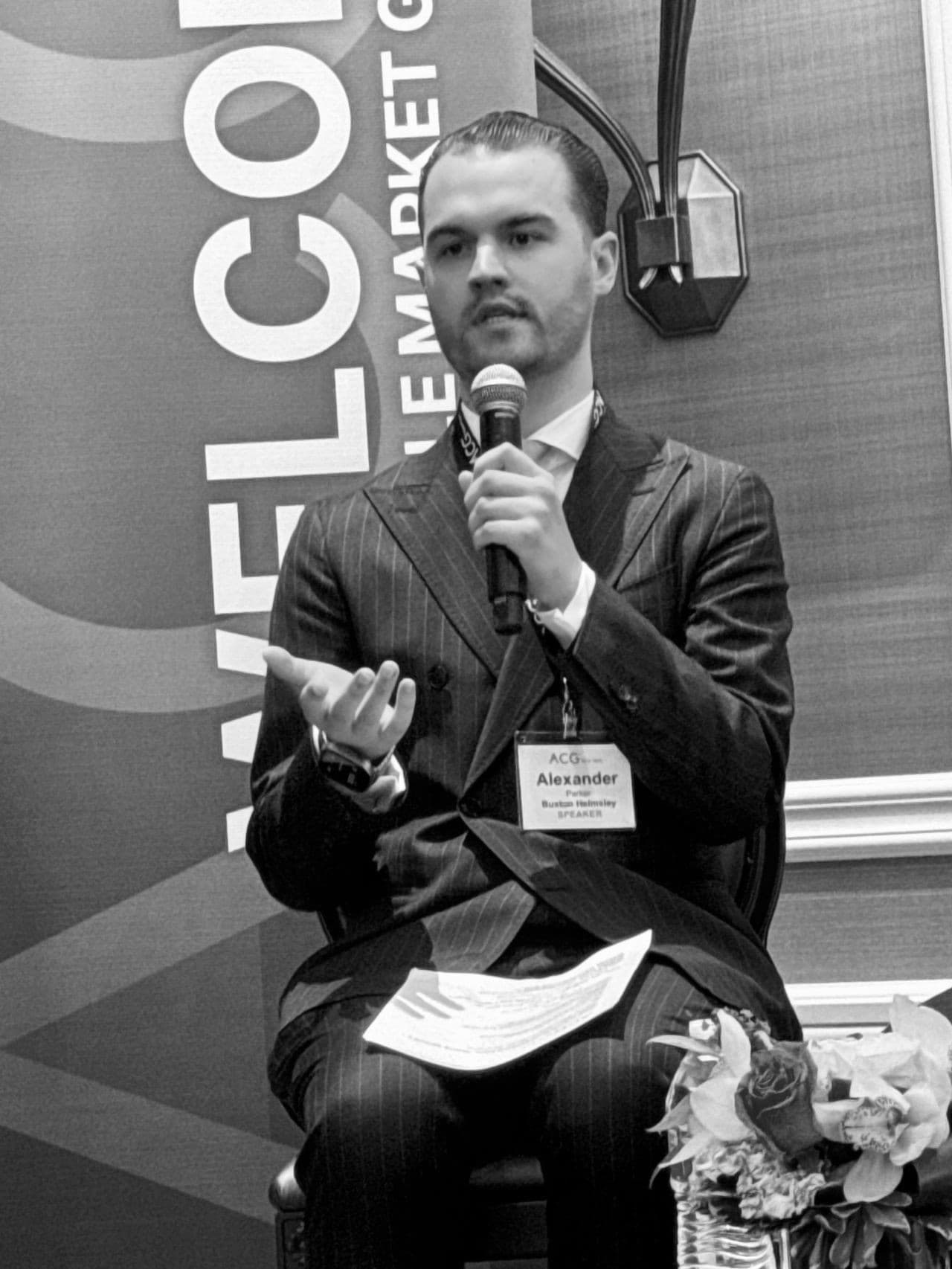
Alexander E. Parker is the Founder, Chairman, and Chief Executive Officer of Buxton Helmsley, Inc., a New York-based alternative asset manager. He founded The Buxton Helmsley Group, Inc. in December 2014 to manage separately managed accounts for individual investors. In February 2025, he established Buxton Helmsley, Inc. as a separate company to institutionalize the firm around dedicated hedge fund management, with its investment advisory business conducted through a subsidiary, Buxton Helmsley USA, Inc. The Buxton Helmsley Group’s private wealth management business is being wound down as part of that transition. Buxton Helmsley did not begin as a forensic practice. It became one in 2020, when a long position in Mallinckrodt plc was held into the company’s first bankruptcy on the strength of reported asset values that its own bankruptcy disclosure statement would later put billions of dollars lower. Since then, he has worked from a company’s entire disclosure record (its financial statements, current reports, Section 16 filings, proxy materials, etc.) and takes the required questions to managements and boards before relying on reported figures. The firm’s early engagements were short positions at companies already in serious distress. Its campaigns since 2024 have been long positions in companies with governance, disclosure, or operating problems it believed could be solved, and it treats a review confirming that a company is what it reports itself to be as a useful result in its own right.
Among the campaigns conducted under Mr. Parker’s leadership:
Fossil Group, Inc.
NASDAQ: FOSL
When the firm engaged, Fossil’s shares had declined approximately 97% from their historical peak and were trading at more than an 80% discount to book value, and not one director had bought a share in the open market in the preceding three years. Holding approximately 1.4% of the shares, the firm submitted a director nomination on February 16, 2024, and 37 days later, Fossil entered into a cooperation agreement appointing the firm’s nominee to its board. In the same period, the company’s longtime Chairman and Chief Executive Officer stepped down, and its Chief Financial Officer departed that July. Within two months of the board appointment, Fossil’s share price had risen more than 80%, and within approximately two years, more than 500%. As of October 2026, Fossil’s shares had notched a gain of over 700% since the board appointment.
Daily Journal Corporation
NASDAQ: DJCO
In July 2025, Mr. Parker engaged the board of Daily Journal Corporation, the publicly traded company formerly chaired by Charles T. Munger, over what he alleged were years of undisclosed GAAP and Regulation S-X violations. Chief among them was the company’s practice of expensing all of its software development costs, which he alleged violated GAAP ASC 985-20, a standard that requires costs incurred after technological feasibility to be capitalized; his reading reflected published AICPA guidance on external-use software built in an agile environment. He also identified Section 16(a) filing failures by every member of the Audit Committee and Sarbanes-Oxley certifications he alleged to be inaccurate. Following his private correspondence, a public campaign, and parallel regulatory submissions, the company made its first disclosure of software research and development expenditures and remedial Section 16 filings for each of its directors, and its Chief Financial Officer departed under a separation agreement. Within approximately seven months of the initial engagement, Daily Journal’s share price had appreciated approximately 65%. In February 2026, the firm gave the company additional time to reach full compliance before pursuing board representation, a right it has expressly reserved.
Mallinckrodt plc
formerly NYSE: MNK
Mallinckrodt entered its first Chapter 11 bankruptcy in October 2020 and emerged in June 2022, recording a $2.2 billion loss when it revalued its balance sheet to fair value under fresh-start accounting. Its bankruptcy disclosure statement had already valued the business billions of dollars below the figures its SEC filings continued to report. In public letters, Mr. Parker alleged that delaying recognition of those losses until fresh-start accounting violated GAAP ASC 350/360 and Regulation S-X, and that the company had also failed to account for a material loss contingency in violation of ASC 450-20. In March 2023, he contended publicly that Mallinckrodt was repeating the same practice with its intangible assets after its emergence. Over the following months, the company’s shares fell more than 85%, and on August 28, 2023, roughly fourteen months after leaving its first bankruptcy, Mallinckrodt filed for Chapter 11 a second time, then again admitting net asset insolvency while certifying positive net assets in filings with the U.S. Securities and Exchange Commission. On November 30, 2023, the U.S. Securities and Exchange Commission charged Mallinckrodt with failing to disclose the same loss contingency Mr. Parker had challenged, a potential liability for Medicaid rebates on its drug Acthar Gel that ultimately exceeded $500 million, finding violations of Sections 17(a)(2) and 17(a)(3) of the Securities Act of 1933 and Sections 13(a), 13(b)(2)(A), and 13(b)(2)(B) of the Securities Exchange Act of 1934.
Endo International plc
formerly NASDAQ: ENDP
Following a short position taken in February 2022, Mr. Parker conducted private and public correspondence with Endo’s directors and its independent auditor, PricewaterhouseCoopers LLP, alleging self-dealing, breaches of Irish law and fiduciary duty, and the concealment of billions of dollars of goodwill overstatement that was carrying the company toward insolvency. Five days after his open letter of May 13, 2022, to Endo’s shareholders and creditors, The Wall Street Journal reported that the company had begun restructuring negotiations with its lenders and senior bondholders, and Endo’s shares fell nearly 50% that day. Within months, the stock had fallen more than 90%, the company had recognized nearly $2 billion of belated goodwill write-downs, and on August 16, 2022, it filed for Chapter 11 protection.
EchoStar Corporation
NASDAQ: ECHO
Beginning January 22, 2024, Mr. Parker publicly alleged that EchoStar’s balance sheet overstated shareholder equity by more than $15 billion following its merger with DISH Network, through asset impairments that GAAP ASC 350/360 and Regulation S-X required the company to recognize. When EchoStar did not respond to successive detailed letters, he took his concerns to members of the United States Senate Committee on Finance. On November 6, 2025, EchoStar recorded a $16.48 billion non-cash impairment charge (ranking among the largest recorded losses in telecommunications history), which the company attributed to decommissioning 5G network assets following its spectrum sales.
Mr. Parker’s campaigns have been covered by The Wall Street Journal, Bloomberg, Reuters, The Irish Times, MarketWatch, and Axios. Bloomberg’s Activism League Tables rank Buxton Helmsley among the top 15% of global activist investors by engagement volume. He has spoken on activist investing and corporate governance, including at events hosted by the Association for Corporate Growth (ACG).
Buxton Helmsley is headquartered in New York City.
Activism Vulnerability Report
Harvard Law School Forum on Corporate Governance
2024
Fossil Group CEO Kosta Kartsotis Steps Down Amid Strategic Review
The Wall Street Journal
2024
Other Leadership

Charles Garcia
Lead Independent DirectorLead Independent Director
Mallory Hazzard
Director of Executive OperationsDirector of Executive Operations
Weiyee In [殷 維一]
Chief Information and Operating Officer, Deputy Portfolio Manager, and Head of Capital Markets ResearchChief Information and Operating Officer, Deputy Portfolio Manager, and Head of Capital Markets Research