How the Court of Chancery Valued the Activision Sellers’ Federal Securities Claims
- Published
- November 4, 2026
- Reading time
- 17 min
On October 23, 2026, the Delaware Court of Chancery approved a $250 million settlement of the stockholder class action over Microsoft Corporation’s acquisition of Activision Blizzard, Inc., and awarded the plaintiff’s counsel $60 million in fees and $447,680.66 in expenses.¹ The settlement class covers, with exclusions for the defendants and related persons, everyone who held Activision common stock at any time from the announcement of the merger agreement on January 18, 2022, through the closing on October 13, 2023, including those who bought or sold during that period, and it is a class without a right to opt out.¹ The release extends to claims by any class member “asserted in any forum that arise out of the facts alleged in this action.”¹ Among the claims it reaches are federal securities claims that The Arbitrage Fund, a merger-arbitrage fund, filed on behalf of a proposed class of stockholders who sold Activision shares while the merger was pending.¹ ²
The Fund and four other merger-arbitrage funds, all managed by Water Island Capital, objected to that part of the release and asked the court to carve the federal claims out of it.¹ Chancellor McCormick overruled the objection. “The Federal Claims have little or no value, in this court’s assessment,” the opinion states, and it points to two obstacles: the statute of limitations and what it calls “a weak theory of loss causation.”¹ It concludes that “releasing these claims for no consideration to the Seller Class is appropriate to realize the massive benefits of the Settlement for the Settlement Class.”¹ The opinion also says that only the federal court can rule on the merits of those claims, and that the federal court can determine whether to enforce the release.¹
Buxton Helmsley reads the opinion below against four questions that any valuation of a securities claim has to answer. Was the claim brought in time? Which way did the alleged misstatements move the stock price, and on what dates? Which members of the class traded at a price the alleged misstatements affected? And how would a loss be measured? The opinion answers the first question in detail and the third in part, from the record before it. On the second, it relies on the direction of the price move at the announcement, without figures; on the fourth, it reasons from the structure of the claims. In its discussion of the federal claims, it does not refer to an event study, a damages expert, or a dollar value for them.¹ The sections that follow take the four questions in turn, using the opinion, the public version of the federal complaint, and Activision’s 2022 proxy statement, and they leave the merits where the opinion leaves them, with the federal court. Buxton Helmsley takes no position on the merits of the federal claims.
The claims and the class
The Fund sued in the United States District Court for the District of Delaware. The defendants are Activision; Robert Kotick, who was its Chief Executive Officer when the merger was negotiated; and Brian Kelly, whom the opinion describes as an Activision director.¹ ² The opinion dates the filing to April 27, 2026, and the public version of the complaint was filed on May 5, 2026, as Document 7 in Case No. 1:26-cv-00489-JLH.¹ ² The proposed class is “all sellers of Activision common stock from January 18, 2022 through October 13, 2023,” excluding “those that tendered their Activision common stock in the Merger,” as well as the defendants and Activision’s officers and directors.² Count I alleges violations of Section 10(b) of the Securities Exchange Act of 1934 and Rule 10b-5 against all three defendants, and Count II alleges control-person liability under Section 20(a) against Mr. Kotick and Mr. Kelly.²
The complaint identifies three sets of statements that it alleges were misleading. The first concerns the fairness of the $95.00 per share merger consideration; the complaint alleges that management’s long-range plan “identified an implied per share price range of $113 to $128 for Activision common stock.”² The second concerns Microsoft’s reverse termination fee, which the complaint says the proxy statement described as ranging from $2 billion to $3 billion depending on when it became payable. The complaint alleges that a company disclosure letter, which it says was not disclosed, required Activision to negotiate a cloud agreement under which it would purchase cloud services from Microsoft “equal in value to no less than one-third” of that fee over seven years.² The third concerns a one-time dividend of $0.99 per share, paid on August 17, 2023. The complaint alleges that the dividend was also paid on 428.6 million treasury shares held by a wholly owned subsidiary, which “would receive a $424 million dividend” on them, and it treats that amount as value that went to Microsoft.²
The theory of harm runs in the opposite direction from the case the Supreme Court addressed in Dura Pharmaceuticals, Inc. v. Broudo, which concerned purchasers who said a misstatement had inflated the price they paid.⁴ This complaint is brought for sellers. It alleges that the statements “artificially depressed the market price of Activision common stock,” so that stockholders sold “at a discount from the fair value of the stock.”² It alleges two further harms: that the merger “set the ceiling for the market price of the common stock” below the range in the long-range plan, and that stockholders who sold before the closing gave up the appraisal rights they would otherwise have had under Section 262 of the Delaware General Corporation Law.² It pleads that the market for Activision stock was efficient, and also that a presumption of reliance applies because the claims rest “in primary part” on omissions.²
What the class received
The claims that produced the settlement arose under Delaware law. In a ruling of October 2, 2025, the court had sustained the plaintiff’s core claim that the directors breached their fiduciary duties in the sale, along with a claim that the board improperly delegated the negotiation of the merger agreement’s limit on dividends.¹ The mediator proposed an all-in cash settlement of $250 million on March 25, 2026, and the parties signed a term sheet on April 3, 2026.¹ The opinion calls the result “the largest ever cash settlement” in the Court of Chancery in a challenge to a merger with a third party, and it equates the amount to a per-share recovery of $0.30.¹ The fee award is approximately 24 percent of the fund after expenses, set against a lodestar of 10,727.20 hours valued at $10,852,110.50, which the opinion says implies an hourly rate of $5,593 and a multiple of about 5.5.¹
Those were the benefits the court weighed against the federal claims. It framed the question as “whether the release of the Federal Claims is appropriate in light of their value and the consideration achieved.”¹
When the facts were knowable
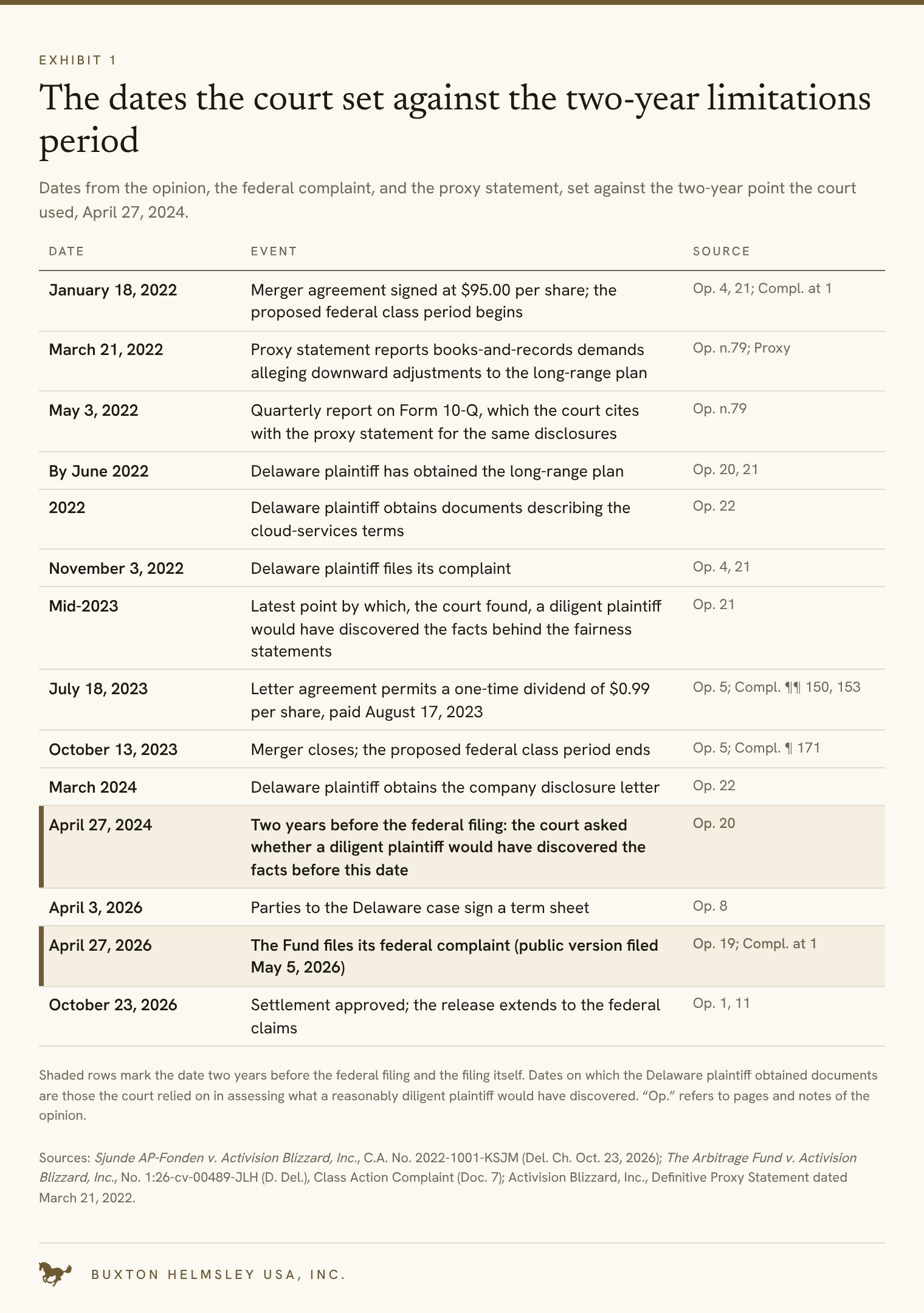
The opinion applies the two-year limitations period of 28 U.S.C. § 1658(b)(1), which it describes as running from the earlier of the date a reasonably diligent plaintiff would have discovered the facts constituting the violation and the date the plaintiff actually discovered them.¹ Measured back from the filing, the question was whether a reasonably diligent plaintiff would have discovered the facts before April 27, 2024.¹ The court concluded that one would have, for each of the three theories.
On the fairness of the price, the court found that a reasonably diligent plaintiff would have begun investigating by the end of 2022.¹ Activision’s SEC filings in the first half of 2022 disclosed lawsuits over the merger price, and its proxy statement of March 21, 2022, reported books-and-records demands alleging that “management may have attempted to validate the consideration through downward adjustments to the Long-Range Plan.”¹ ³ The Delaware plaintiff, Sjunde AP-Fonden, had obtained the long-range plan by June 2022 and filed its complaint on November 3, 2022.¹ The court concluded that a reasonably diligent plaintiff would have discovered the facts behind the fairness statements “no later than mid-2023.”¹
On the reverse termination fee, the court noted that the merger agreement “repeatedly references the company disclosure letter,” and that the Delaware plaintiff had obtained documents describing the cloud-services terms in 2022 and the disclosure letter itself in March 2024.¹ It concluded that the facts were discoverable more than two years before the federal filing.¹ On the dividend, it found that the facts were “publicly available by 2023 when that payment was announced,” and that a straightforward investigation “would have borne fruit before April 2024.”¹
The opinion also sets out the timing of the federal filing. The Fund sued about four years after the merger was announced, about two and a half years after it closed, and, in the opinion’s words, three weeks after the parties to the Delaware case signed a term sheet on April 3, 2026.¹ The court observed that the Fund “appeared to do little independent legwork” beyond the filings in the Delaware case.¹ In concluding when a reasonably diligent plaintiff would have discovered the facts, the court also relied on the Delaware plaintiff’s complaint of November 2022 and on when that plaintiff obtained the long-range plan (by June 2022), documents describing the cloud-services terms (2022), and the disclosure letter (March 2024).¹ Exhibit 1 sets those dates against the two-year period.
Exhibit 1. The dates the court set against the two-year limitations period
Which way the price moved, and when
Dura, decided unanimously in 2005, requires a plaintiff to prove that the misstatement caused the economic loss, and it explains why a purchase at an inflated price is not enough: “an inflated purchase price will not itself constitute or proximately cause the relevant economic loss.”⁴ One of the Court’s examples is a purchaser who “sells the shares quickly before the relevant truth begins to leak out,” in which case the misrepresentation will not have led to any loss.⁴ The Activision opinion cites Dura and applies the same reasoning to sellers.¹ The Fund bought Activision stock after the merger was announced and after the alleged misstatements were made, and sold while the merger was pending.¹ The court found that it “was not damaged from buying and then selling while the Merger was pending,” because “both the purchase and sale price already reflected any alleged deflation.”¹
A damages analysis of a deflation claim asks when, if ever, the information said to have been withheld reached the market, and what the price did when it arrived. The usual tool is an event study. In Halliburton Co. v. Erica P. John Fund, Inc., the Supreme Court described event studies as “regression analyses that seek to show that the market price of the defendant’s stock tends to respond” to pertinent events, and noted that plaintiffs “can and do introduce evidence of the existence of price impact” through them.⁵ In Buxton Helmsley’s reading, for a seller, the information would have had to move the price up when it arrived, and the seller’s loss would then be measured against the price that would have prevailed if the information had been known when the seller sold. The public version of the complaint does not identify any date on which the information it says was withheld reached the market, and it does not allege a rise in the price tied to any such date.² Its class period ends at the closing, which it does not describe as a disclosure.² On the dividend, it alleges that unaffiliated stockholders “were never informed” that Microsoft received the $424 million.²
The one price movement the opinion discusses is the reaction to the announcement. It says Activision’s stock price increased dramatically when the merger was announced, which in the court’s view contradicts the allegation that statements made at the same time depressed the price.¹ The proxy statement put the $95.00 price at a premium of approximately 45.3 percent to the closing price on January 14, 2022, the last trading day before the announcement.³ The opinion gives no figure for the move, and no trading prices for the “twenty-one-month pendency” in which every member of the proposed federal class sold.¹
The complaint’s own description of the market bears on the same question. It alleges that “the Merger set the ceiling for the market price of the common stock.”² In Buxton Helmsley’s reading, that allegation describes a pending merger at a fixed price per share, in which the trading price reflects the deal price, the time to closing, and the risk that the deal does not close. On that reading, information suggesting that the deal price was low would move the trading price during that period only to the extent it changed one of those inputs, for example by making a higher bid, an appraisal award above the deal price, or a failed deal more likely. An event study on the federal claims would, in the firm’s view, need to find such a change in the price record. The opinion states: “Nowhere does the Fund explain how the Seller Class could have sold their shares for more profit” without the alleged misstatements.¹
Who sold, and on what terms
The opinion discusses two kinds of seller. One held the stock before the announcement and sold during the pendency, at whatever the market paid on the day of the sale. The other bought after the announcement and sold before the closing, which is the pattern the court found in the Fund’s own trading.¹ In Buxton Helmsley’s reading, the court’s reasoning from Dura applies most directly to the second group. As to the first, the court said that even “a more traditionally situated stockholder that held shares before the Merger was announced and sold before it closed” would have “a difficult time proving that it was damaged by these alleged misrepresentations.”¹
Each lead party’s record combines elements of both. According to the opinion, the Fund acquired its Activision shares after the announcement, sold 26,600 shares, and held 819,477 to the closing, receiving $77,850,315 in merger consideration and at least $811,282.23 from the 2023 dividend.¹ Those amounts equal 819,477 shares at $95.00 and at $0.99, and the shares the Fund sold were about 3.1 percent of the 846,077 shares the two figures account for.⁶ The opinion says the Fund stands to receive approximately $250,000 from the settlement, based on the shares it held.¹ Sjunde AP-Fonden held more than 900,000 shares from before the announcement and exchanged them in the merger, and during the pendency it bought 115,332 shares and sold 130,641.¹ The court relied on those sales in rejecting the Fund’s argument that the Delaware plaintiff could not adequately represent sellers: “Plaintiff actually sold more shares than the Fund.”¹
A damages analysis would sort the proposed federal class along these lines: by when each seller bought, by when it sold, and by whether it also held shares through the closing, since a seller that also held shares at the closing is a member of the settlement class for those shares too. The complaint’s exclusion of “those that tendered” their shares leaves open whether a seller that also tendered shares at the closing falls within the proposed federal class.² The opinion approves a plan of allocation but does not describe it. It states that, although the settlement class includes the sellers, “the Seller Class members have no rights to bring or benefit from the claims asserted in this action based on the shares they sold.”¹
Appraisal and the threatened injunction
The Fund offered two other theories of loss causation.¹ Under the first, sellers would not have sold, and so would not have forfeited their appraisal rights, if the facts had been disclosed. Under the second, sellers who knew the facts “could have threatened to enjoin the Merger to negotiate higher consideration.”¹ The court found that both theories “rely on multiple layers of speculation that would present an uphill battle in litigation.”¹
The appraisal theory shows how the layers stack. The proxy statement told stockholders that a holder seeking appraisal had to submit a written demand before the vote on the merger and “must continue to hold the shares of Activision Blizzard common stock of record through the effective time.”³ As Buxton Helmsley reads it, a seller claiming that it would have sought appraisal would have to show that it would have held to the closing and made the demand, and its loss would then turn on what an appraisal proceeding would have awarded, compared with the price it received when it sold. The valuation the complaint relies on is the range of $113 to $128 per share that it attributes to management’s long-range plan.² On the same reading, the injunction theory adds further steps: that a seller would have sued, that a court would have granted the injunction or the threat of one would have been taken seriously, and that Microsoft would have responded by raising its price.
What the opinion leaves to the federal court
The Fund argued that the Court of Chancery should defer to the federal court to assess the merits of the federal claims.¹ The court relied on Matsushita Electric Industrial Co. v. Epstein, which addressed “the preclusive effect in federal court of a Court of Chancery judgment” releasing federal securities claims, and on the Delaware Supreme Court’s distinction in Nottingham Partners v. Dana between approving a general release and adjudicating a federal claim: “The former is within a state court’s power, the latter is not.”¹ It also cited the court’s 2015 approval of an earlier Activision settlement, arising from a different transaction, that released federal securities claims without allocating any consideration to them, and in which those claims were described as “entirely hypothetical.”¹ The court declined to wait for a federal ruling, noting that each day of delay “would cost the Settlement Class nearly $10,000 in interest,” and said that “the federal court can determine whether to enforce the Release and dismiss the Federal Claims.”¹
That question now sits in the District of Delaware. This piece reports nothing filed in the federal action, or in any appeal, after the opinion.
A routine for holders of claims arising during a merger’s pendency
For merger-arbitrage funds, and for the allocators who invest with them, the Activision record suggests a short routine for any position that might carry a claim of this kind.
The first step is to read the class definition in every stockholder suit challenging the deal against the fund’s own trading record. The Activision settlement class reached anyone who held the stock at any point between the announcement and the closing, buyers and sellers alike, and its members had no right to opt out of the release.¹
The second step is to date the limitations period from the public record, not from the fund’s own review. The court counted the proxy statement, a quarterly report, the Delaware complaint, and a dividend announcement among the events that would have started a diligent plaintiff’s investigation, and it measured the two years back from the day the federal complaint was filed.¹
The third step is to find the price event. In the firm’s reading of the opinion and Dura, a seller’s claim needs a date on which the withheld information reached the market and the price rose, and a fund that bought after the alleged misstatements and sold before the closing needs the price to have been more depressed when it sold than when it bought, or it meets the reasoning the court took from Dura.¹ ⁴
The fourth step is to price the alternative theories as the chains of estimates they are. An appraisal theory depends on a decision to hold, a timely demand, and an appraisal award, and an injunction theory depends on a lawsuit, a ruling or a credible threat of one, and a buyer’s response.¹ ³
Each of these steps can be taken from public filings and the fund’s own trade records while the merger is still pending.
Related reading
Referenced Sources:
[1] Court of Chancery of the State of Delaware, Sjunde AP-Fonden v. Activision Blizzard, Inc., C.A. No. 2022-1001-KSJM, Memorandum Opinion Approving Settlement and Awarding Attorneys’ Fees (Del. Ch. Oct. 23, 2026) (McCormick, C.) (primary; supports the approval of the $250 million settlement and the award of $60 million in fees and $447,680.66 in expenses, pages 1 to 2 and 35 to 41; the settlement class definition and its non-opt-out character, pages 25 to 26; the quoted definition of the release and its extension to the federal claims, pages 10 to 11; the objectors, page 9 and note 24; the quoted assessment of the federal claims, the conclusion that releasing them for no consideration to the Seller Class is appropriate, and the statements that only the federal court can rule on their merits and that it can determine whether to enforce the release, pages 18 to 19 and 24; the filing date of April 27, 2026, the defendants, and the description of Brian Kelly, page 19; the description of Robert Kotick, page 3; the quoted “twenty-one-month pendency,” page 10; the limitations analysis under 28 U.S.C. § 1658(b)(1), including the date of April 27, 2024, the disclosures in the first half of 2022, the long-range plan, the complaint of November 3, 2022, the cloud-services documents and the disclosure letter, the dividend, and the quoted findings, pages 20 to 23 and notes 76 to 89; the term sheet of April 3, 2026, page 8; the merger agreement date, the letter agreement, the closing date, and the Delaware plaintiff’s holdings and trading, pages 4 to 6; the Fund’s holdings, sales, merger consideration, and dividend receipts, page 9; the Fund’s expected share of the settlement and the approval of a plan of allocation that the opinion does not describe, pages 10 and 41; the ruling of October 2, 2025, the mediator’s proposal of March 25, 2026, the quoted description of the settlement, the per-share recovery of $0.30, the fee percentage, the lodestar, and the implied hourly rate and multiple, pages 7 to 8, 31, and 39 to 40; the quoted framing of the question, page 24; the timing of the federal filing relative to the term sheet, pages 10 and 19; the quoted observation on independent legwork, page 20; the quoted statement that Seller Class members have no rights to benefit based on the shares they sold, page 11; the loss causation analysis, its citation of Dura, the quoted findings on deflation and on the price reaction to the announcement, and the alternative theories, pages 23 to 24 and notes 90 and 91; the quoted statement that the Delaware plaintiff sold more shares than the Fund, page 16; the reliance on Matsushita, Nottingham, and the 2015 Activision settlement, and the quoted statements on delay and on the federal court’s role, pages 12 to 18 and notes 54 to 70; and the absence of any reference to an event study, a damages expert, or a dollar value for the federal claims in the discussion of them).
[2] The Arbitrage Fund v. Activision Blizzard, Inc., No. 1:26-cv-00489-JLH (D. Del.), Class Action Complaint for Violations of the Federal Securities Laws, unredacted public inspection version, Document 7, filed May 5, 2026, as posted with the court’s filing header at ksfcounsel.com (primary; supports the court, case number, and defendants; the quoted class definition, paragraph 171, and the class period stated on page 1; Counts I and II, paragraphs 177 to 194; the allegations concerning the long-range plan, paragraphs 6, 7, and 56; the allegation that the disclosure letter was not disclosed, paragraphs 90 and 94; the treasury shares and the subsidiary, paragraphs 9 and 119; the payment date of the dividend, paragraph 130; the reverse termination fee and the company disclosure letter, paragraphs 141 to 147; the dividend and the treasury shares, paragraphs 148 to 154; the statement that unaffiliated stockholders were never informed, paragraph 131; the quoted allegations of a depressed market price, a discount to fair value, and the merger as a ceiling, paragraphs 13 and 162 to 165; the appraisal allegations, paragraphs 13, 163, and 166; the allegations of an efficient market and of a presumption of reliance for omissions, paragraphs 159 to 161; and the absence of any alleged date on which the withheld information reached the market).
[3] Activision Blizzard, Inc., Definitive Proxy Statement on Schedule 14A, dated March 21, 2022 (primary; supports the premium of approximately 45.3 percent over the closing price on January 14, 2022, in the Letter to Stockholders; the quoted description of the books-and-records demands, under “Legal Proceedings Regarding the Merger”; and the quoted requirement that a holder seeking appraisal continue to hold its shares of record through the effective time, under “Appraisal Rights”).
[4] Dura Pharmaceuticals, Inc. v. Broudo, 544 U.S. 336 (2005) (primary; supports the requirement that a plaintiff prove loss causation, the quoted statement that an inflated purchase price will not itself constitute or proximately cause the relevant economic loss, and the quoted example of a purchaser who sells before the relevant truth begins to leak out, Part II-A).
[5] Halliburton Co. v. Erica P. John Fund, Inc., 573 U.S. 258 (2014) (primary; supports the quoted description of event studies and the statement that plaintiffs introduce evidence of price impact through them).
[6] Buxton Helmsley calculations, derived and not reported in the opinion. 819,477 shares multiplied by $95.00 is $77,850,315, and multiplied by $0.99 is $811,282.23, matching the figures in the opinion. 26,600 shares sold plus 819,477 shares held is 846,077 shares, and 26,600 is 3.1 percent of 846,077.
This publication is one of the Insights commentaries of Buxton Helmsley USA, Inc. (“Buxton Helmsley”). It reflects the opinions, analysis, and interpretations of Buxton Helmsley as of the date of publication, and it is based upon information that Buxton Helmsley believes to be accurate and that is derived from public sources or from other sources believed to be reliable. Buxton Helmsley does not represent or warrant that such information is accurate or complete, and it should not be relied upon as such. The views expressed are subject to change at any time, and Buxton Helmsley undertakes no obligation to update this publication or to correct any information contained within it.
Except for statements expressly attributed to an identified source or to a public filing, the statements in this publication constitute the opinions and good-faith analysis of Buxton Helmsley and are not statements of objective fact. Buxton Helmsley’s analysis may rest upon assumptions, estimates, and interpretations that could prove to be incorrect. Any reference to a potential violation, misstatement, impropriety, or deficiency reflects Buxton Helmsley’s analytical conclusions and opinions, and does not represent a finding by any court, regulator, or other authority. Readers should conduct their own investigation and analysis of any company, security, or matter discussed. Any company or person referenced that believes any statement in this publication to be inaccurate is invited to contact Buxton Helmsley at general@buxtonhelmsley.com, and Buxton Helmsley will give good-faith consideration to any correction supported by credible evidence.
This publication is provided for informational purposes only. It does not constitute, and should not be construed as, investment advice, a recommendation, or the provision of any individualized investment advisory service to any person, nor an offer or solicitation to buy, sell, or hold any security. Nothing in this publication takes into account the particular investment objectives, financial situation, or needs of any reader. No reader should construe this publication as creating any advisory, fiduciary, or other relationship between Buxton Helmsley and such reader. Readers should consult their own legal, tax, accounting, and financial advisers before making any investment decision.
As of the date of this publication, Buxton Helmsley, the funds and accounts that it manages or advises, and its principals hold no position in the securities of the companies mentioned in the article. Buxton Helmsley and the foregoing persons may, at any time and without further notice, purchase, sell, cover, or otherwise change any position in any security discussed in this publication, including in a manner inconsistent with the opinions expressed herein, for various reasons, including but not limited to new research discoveries. Buxton Helmsley may realize gains in the event that the price of any security discussed moves in a direction consistent with a position that it holds.
Buxton Helmsley has not received, and will not receive, any compensation from any third party, including any issuer discussed in this publication or any person holding an interest in any such issuer, in connection with the preparation or publication of this commentary, except as expressly disclosed in this publication. Buxton Helmsley was not engaged or compensated by any third party to publish this commentary, except as expressly disclosed in this publication.
This publication is not, and shall not be construed as, an offer to sell or a solicitation of an offer to buy any security or any interest in any fund or other investment vehicle managed or advised by Buxton Helmsley or any of its affiliates, nor is it an advertisement for any such fund, vehicle, or advisory service. Any such offer or solicitation will be made only by means of definitive offering documents, and only to eligible investors, in accordance with applicable law.
This publication is intended only for distribution to, and use by, persons in the United States. It is not directed to, intended for, or to be relied upon by, any person located in any jurisdiction outside the United States, and it does not constitute an offer, solicitation, or provision of any service in any such jurisdiction. Persons who access this publication from outside the United States do so on their own initiative and are responsible for compliance with the laws applicable to them.
This publication may contain forward-looking statements that reflect Buxton Helmsley’s current expectations and that are subject to risks and uncertainties that could cause actual results to differ materially from those expressed. Past performance is not indicative of, and does not guarantee, future results. No representation is made that any investment will achieve, or is likely to achieve, results comparable to those discussed.
To the fullest extent permitted by applicable law, neither Buxton Helmsley nor any of its affiliates, nor their respective principals, members, officers, employees, or agents, shall have any liability to any person for any direct, indirect, incidental, consequential, or other loss or damage arising from any use of, or reliance upon, this publication or any information contained within it.
If any provision of these disclosures is held to be invalid or unenforceable, the remaining provisions shall continue in full force and effect.
© 2026 Buxton Helmsley USA, Inc. All rights reserved. This publication may not be reproduced or redistributed, in whole or in part, without attribution to Buxton Helmsley.