One Invoice, Three Prices: What the First Brands Collapse Leaves for Boards, Owners, and Lenders
- Published
- November 19, 2026
- Reading time
- 8 min
- Industries & topics
- Transportation & Logistics
- Restructuring & Distressed Situations
- Accounting & Disclosure
- Corporate Governance
- Special Situations
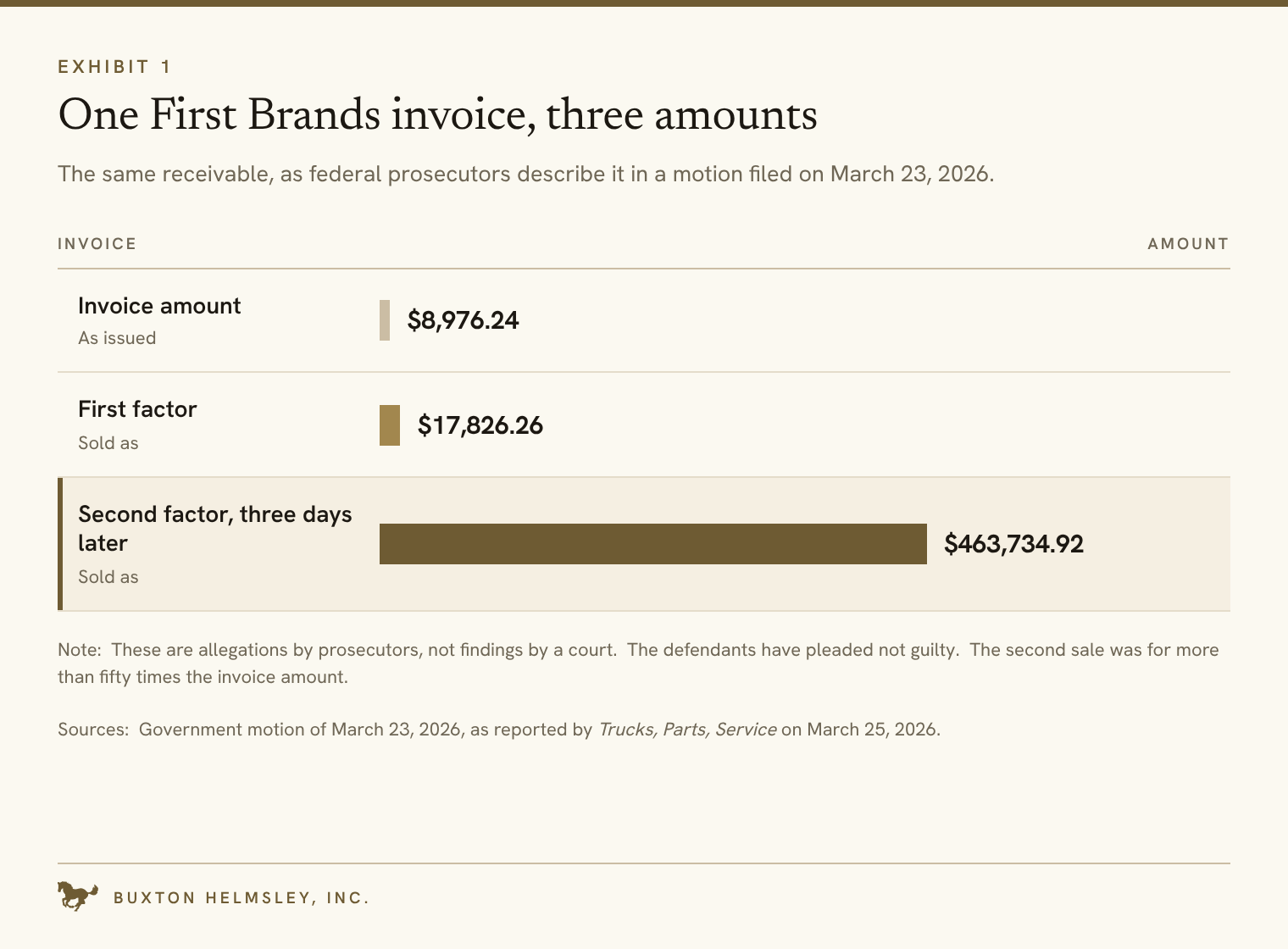
According to a motion federal prosecutors filed on March 23, 2026, one invoice First Brands Group issued for $8,976.24 was sold to a factor as $17,826.26 and, three days later, to a second factor as $463,734.92.² The same receivable, in other words, was sold twice, and the second time for more than fifty times its face amount.
First Brands made brakes, filters, wipers, and lights for the automotive aftermarket, and it reported approximately $5 billion in annual net sales.¹ When it filed for bankruptcy on September 28, 2025, it declared $12 million in cash in its corporate bank accounts and more than $9 billion in liabilities.¹ On January 29, 2026, prosecutors in the Southern District of New York unsealed an indictment charging its founder and former Chief Executive Officer, Patrick James, and his brother Edward James, a former senior vice president, with conspiracy to commit wire and bank fraud, conspiracy to commit money laundering, and wire and bank fraud.¹ Both have pleaded not guilty.⁷ Two former finance executives, including former Chief Financial Officer Stephen Graham, have pleaded guilty and are cooperating.³ ⁶ The brothers’ trial before Judge Analisa Torres is scheduled for February 2027.⁶ ⁷ On August 24, 2026, the bankruptcy court in Houston converted the case to a Chapter 7 liquidation.⁶
Everything below about what happened inside First Brands is what prosecutors, a court-appointed examiner, or litigants allege. None of it has been proven at trial, and the defendants dispute it. The question for this piece is narrower than guilt: what a board, an owner, or a lender would have needed to ask to see it sooner, since each of those questions is open to any company today.
What the Indictment Describes
The government’s account has four parts.
The first is the receivables. According to the Department of Justice, First Brands employees “routinely submitted fake invoices, fraudulently inflated invoices, and double-pledged invoices” to the factors that bought them, and in some instances invoices were generated “for transactions that had never occurred.”¹ The press release says the company sold its factoring partners billions of dollars of purported customer receivables that did not exist.¹
The second is what the company called “round trips.” Financiers believed they were paying First Brands’ suppliers, but, according to the indictment, the money came back to First Brands, where it went toward interest, rent, leases, and other operating costs.¹ ² Prosecutors say the brothers monitored these transactions as part of the company’s daily cash management.¹ One executive said in 2021, according to the March filing, that the practice was “getting out of control.”²
The third is the books. At Patrick James’s direction, the government alleges, employees made “unsupportable financial statement adjustments” to meet targets he set, and kept internal “bridge” files that set the accurate financials beside the manipulated ones.¹
The fourth is the debt that was not on the balance sheet. Entities wholly owned by Patrick James, which the indictment calls the James Entities, had “no independent business operations.”¹ They pledged inventory that was already subject to the liens of First Brands’ senior lenders and still carried on First Brands’ own books, and that borrowing never appeared on First Brands’ balance sheet.¹
By 2025 the brothers were trying to refinance the company or sell it. According to the government, those efforts failed when First Brands could not give the other side the financial diligence it asked for.¹
The People Who Saw a Piece of It
Several people outside the inner circle came close.
Around 2023, according to the March filing, one of the factors asked for copies of invoices. A lower-level employee sent the actual invoices, and the factor’s audit partner raised “huge” discrepancies with Edward James.² Afterward, prosecutors say, Patrick James directed that emails from that factor and other parties be restricted to a single executive.² On another occasion, a lender’s diligence request drew a written answer from a senior executive that the company had “no off-balance sheet financing” involving special purpose entities.²
Inside the company, the former Chief Strategy Officer, Michael Baker, said in a court filing of April 6, 2026, that he resigned in September 2025 once it became clear that “significant information was being withheld from him.” The filing, citing prosecutors, says Patrick James “and his inner circle” kept separate books and limited access to the company’s financial information.⁸
The outside auditor was BDO USA.⁵ In his interim report of April 27, 2026, the court-appointed examiner, E. Martin De Luca, recorded a former executive’s account that the company moved to BDO because it was viewed as “less rigorous,” and that its process let management “do what we want with these guys.”⁵ Witnesses told the examiner that BDO did not directly access the company’s underlying systems, such as Oracle, or consistently perform independent verification.⁵ BDO disputes all of this. It says the fraud was conducted to deceive it as auditor, that professional standards contemplate an auditor’s inability to detect collusive fraud, and that the examiner never interviewed its personnel or reviewed its files.⁵ A group of funds holding about $70 million of First Brands’ senior debt has sued BDO in an Ohio state court.⁵ The examiner said more work is needed to determine whether the audits met professional standards.⁵
The examiner also identified about $720 million in 36 transfers from First Brands to Patrick James or entities he controlled between 2021 and 2025, and he described the business as “a liquidity generating and value extracting enterprise.”⁴ Mr. James has called the report one-sided.⁴
What We Would Advise
First Brands was a private company that leaned heavily on factoring, supply chain finance, and inventory financing alongside more than $6 billion of funded debt,⁶ a mix found in a great many middle-market capital structures today. The questions below are the ones we would put to a board, a sponsor, or a lender with exposure to a company financed that way. None of them requires suspecting anyone.
Confirm receivables with the customer, not the company. A factor that buys an invoice is relying on a customer’s obligation to pay it. A confirmation sent to the customer named on the invoice in the March filing would have come back with one amount, not three. For a lender or owner with a material receivables or factoring exposure, we would advise direct confirmation of a sample of invoices with the account debtors, on a schedule the company does not choose, and a check of each receivable against the lien and factoring records of every other financier.
Ask for one map of all the financing, and test it against cash. Factoring, supply chain finance, inventory facilities, equipment leases, and any arrangement with an entity owned by an insider all belong on one schedule, with the counterparty, the collateral, and the balance. We would have the Chief Financial Officer certify that schedule in writing, ask the auditor separately whether it has seen anything not on it, and reconcile the payments on it to bank statements obtained directly from the banks. A company that reported $5 billion in sales and had $12 million in its corporate accounts at filing was, on the government’s account, financing itself in ways that did not appear on any one page.
Treat control of the lender relationship as a governance matter. An instruction that one financier’s emails go to one executive, if it happened as prosecutors allege, would have been visible to everyone whose access it took away. We would advise a board to know who at the company speaks to each lender and factor, to require that diligence answers on financing go out over the Chief Financial Officer’s name after review, and to give at least one independent director or audit committee member direct access to the principal lenders.
Decide who chooses the auditor, and write down why. The audit committee, not management, should select the auditor, and a change of firm should come with a written record of the reasons and of what the new firm will do differently. We would also ask the auditor plainly whether it pulled data directly from the company’s systems or relied on reports management prepared, and for which accounts.
Look at related-party payments as a separate item every quarter. Thirty-six transfers to a founder or his entities over five years is a pattern a board can see only if someone puts the transfers in front of it. We would advise a standing related-party report to the audit committee, covering every payment to an officer, director, or entity they own, with the business reason for each.
After the Collapse
A liquidation is not the end of the record. The criminal trial is set for February 2027, the brothers have each asked for a separate jury and blamed the other,⁷ and the estate’s claims against Patrick James pass to the Chapter 7 trustee.⁶ The lenders who are still owed money will spend the next several years establishing, in court, what each of them was told and when. A board or sponsor can establish the same things now, with a few written requests, before any of it is in dispute.
Boards, owners, and lenders working through questions like these can reach us at advisory@buxtonhelmsley.com.
Related reading
Sources
[1] U.S. Department of Justice, U.S. Attorney’s Office for the Southern District of New York, “First Brands Executives Charged in Multibillion-Dollar Fraud” (January 29, 2026) (primary; supports the business description, reported net sales, the receivables, round-trip, bridge-file, and James Entities allegations, the 2025 refinancing and sale efforts, and the cash and liabilities at filing).
[2] Beth Colvin, “Court filings detail alleged wrongdoing in First Brands’ collapse,” Trucks, Parts, Service (March 25, 2026) (secondary; reports the government’s motion of March 23, 2026, including the invoice amounts, the 2021 “getting out of control” statement, the factor’s audit partner, the restriction of emails, and the diligence answer on off-balance-sheet financing).
[3] Bloomberg Government, “First Brands Ex-CFO Pleads Guilty, Turns on James Brothers” (March 6, 2026) (secondary; supports Mr. Graham’s guilty plea and cooperation).
[4] Beth Colvin, “Court examiner alleges First Brands was used for executive gain,” Trucks, Parts, Service (April 28, 2026) (secondary; reports the examiner’s interim report of April 27, 2026, including the transfers to Mr. James and his response).
[5] Accounting Today, “First Brands creditor sues auditor BDO over missed red flags” (May 1, 2026) (secondary; supports the examiner’s account of the auditor’s selection and procedures, BDO’s response, and the creditor suit).
[6] The BRAKE Report, “First Brands Converted to Chapter 7 Liquidation” (August 26, 2026) (secondary; supports the conversion on August 24, 2026, the funded debt at filing, the survival of claims against Mr. James, the cooperating pleas, and the expected trial date).
[7] Jonathan Randles, Bloomberg News, via Transport Topics, “James brothers trade blame in First Brands case” (October 8, 2026) (secondary; supports the not-guilty pleas, the February trial schedule, and the brothers’ motions).
[8] Claims Journal, “Ex-First Brands Officer Says He Was Kept in the Dark About Fraud” (April 14, 2026) (secondary; reports Mr. Baker’s court filing of April 6, 2026).
This publication is one of the Insights commentaries of Buxton Helmsley, Inc. (“Buxton Helmsley”), published in connection with its advisory business rather than the investment management business of its subsidiary, Buxton Helmsley USA, Inc. It reflects the opinions, analysis, and interpretations of Buxton Helmsley as of the date of publication, and it is based upon information that Buxton Helmsley believes to be accurate and that is derived from public sources or from other sources believed to be reliable. Buxton Helmsley does not represent or warrant that such information is accurate or complete, and it should not be relied upon as such. The views expressed are subject to change at any time, and Buxton Helmsley undertakes no obligation to update this publication or to correct any information contained within it.
Except for statements expressly attributed to an identified source or to a public filing, the statements in this publication constitute the opinions and good-faith analysis of Buxton Helmsley and are not statements of objective fact. Buxton Helmsley’s analysis may rest upon assumptions, estimates, and interpretations that could prove to be incorrect. Any reference to a potential violation, misstatement, impropriety, or deficiency reflects Buxton Helmsley’s analytical conclusions and opinions, and does not represent a finding by any court, regulator, or other authority. Statements describing the conduct of any person discussed in this publication are allegations made by prosecutors, a court-appointed examiner, or litigants, as identified, and the persons concerned are presumed innocent unless and until proven guilty. Readers should conduct their own investigation and analysis of any company, security, or matter discussed. Any company or person referenced that believes any statement in this publication to be inaccurate is invited to contact Buxton Helmsley at general@buxtonhelmsley.com, and Buxton Helmsley will give good-faith consideration to any correction supported by credible evidence.
This publication is provided for informational purposes only. It does not constitute, and should not be construed as, investment advice, a recommendation, or the provision of any individualized investment advisory service to any person, nor an offer or solicitation to buy, sell, or hold any security. Nothing in this publication takes into account the particular investment objectives, financial situation, or needs of any reader. No reader should construe this publication as creating any advisory, fiduciary, or other relationship between Buxton Helmsley and such reader. Readers should consult their own legal, tax, accounting, and financial advisers before making any investment decision.
As of the date of this publication, Buxton Helmsley, its subsidiaries and affiliates (including Buxton Helmsley USA, Inc. and the funds and accounts that it manages or advises), and their principals hold no position in any security or loan of First Brands Group, LLC or its affiliates. Buxton Helmsley and the foregoing persons may, at any time and without further notice, purchase, sell, cover, or otherwise change any position in any security discussed in this publication, including in a manner inconsistent with the opinions expressed herein, for various reasons, including but not limited to new research discoveries. Buxton Helmsley may realize gains in the event that the price of any security discussed moves in a direction consistent with a position that it holds.
Buxton Helmsley has not been engaged by, and has had no advisory relationship with, First Brands Group, LLC, its bankruptcy estate, or any other person named in this publication.
Buxton Helmsley has not received, and will not receive, any compensation from any third party, including any issuer discussed in this publication or any person holding an interest in any such issuer, in connection with the preparation or publication of this commentary, except as expressly disclosed in this publication. Buxton Helmsley was not engaged or compensated by any third party to publish this commentary, except as expressly disclosed in this publication.
This publication is not, and shall not be construed as, an offer to sell or a solicitation of an offer to buy any security or any interest in any fund or other investment vehicle managed or advised by Buxton Helmsley or any of its affiliates, nor is it an advertisement for any such fund, vehicle, or advisory service. Any such offer or solicitation will be made only by means of definitive offering documents, and only to eligible investors, in accordance with applicable law.
This publication is intended only for distribution to, and use by, persons in the United States. It is not directed to, intended for, or to be relied upon by, any person located in any jurisdiction outside the United States, and it does not constitute an offer, solicitation, or provision of any service in any such jurisdiction. Persons who access this publication from outside the United States do so on their own initiative and are responsible for compliance with the laws applicable to them.
This publication may contain forward-looking statements that reflect Buxton Helmsley’s current expectations and that are subject to risks and uncertainties that could cause actual results to differ materially from those expressed. Past performance is not indicative of, and does not guarantee, future results. No representation is made that any investment will achieve, or is likely to achieve, results comparable to those discussed.
To the fullest extent permitted by applicable law, neither Buxton Helmsley nor any of its affiliates, nor their respective principals, members, officers, employees, or agents, shall have any liability to any person for any direct, indirect, incidental, consequential, or other loss or damage arising from any use of, or reliance upon, this publication or any information contained within it.
If any provision of these disclosures is held to be invalid or unenforceable, the remaining provisions shall continue in full force and effect.
© 2026 Buxton Helmsley, Inc. All rights reserved. This publication may not be reproduced or redistributed, in whole or in part, without attribution to Buxton Helmsley.