Nvidia’s Board Vouched for Jensen Huang’s Candor While Its Investigation Was Still Open
- Published
- November 23, 2026
- Reading time
- 10 min
- Industries & topics
- Technology
- Accounting & Disclosure
- Corporate Governance
- Special Situations
On the afternoon of November 17, 2026, Harvey C. Jones opened the third-quarter earnings call of NVIDIA Corporation (NASDAQ: NVDA) with a sentence about the company’s founder rather than its results: “The NVIDIA Board unanimously accepted his resignation and does not intend to reinstate Jensen as CEO.”¹ Hours earlier, Jensen Huang had posted on X that he would be honored to return.² At an all-hands meeting the next morning, according to Wired’s account of it, Mr. Jones told employees that the board had accepted the resignation because of Mr. Huang’s personal conduct and a “lack of candor.”³
On Sunday, November 22, the board voted unanimously to reinstate Mr. Huang as President, Chief Executive Officer, and a director, effective immediately.⁴ Its announcement the next morning said the vote followed “a series of discussions and meetings with Mr. Huang,” after which the board was “satisfied with respect to Mr. Huang’s candor and ability to lead NVIDIA.”⁵ The board said it had also “received input from senior levels of the United States government,” and that the investigation being run by a committee of independent directors, into reports that Mr. Huang had been the target of a foreign intelligence effort, “will proceed to conclusion.”⁵ The announcement does not say that the committee has reported to the board, and it gives no date for a report.
Eleven days separate the board’s acceptance of Mr. Huang’s resignation on November 11 from its vote to bring him back.⁴ ⁶ We wrote about Nvidia’s board on the morning of November 17, before the earnings call, and set out the decisions we thought were still open to it.⁷ This piece is about the one it has now made, and what other boards can take from the way it was made. As before, we take no view of the reporting about Mr. Huang. Whether he is the right person to run Nvidia is the board’s decision, and the shareholders’; how the board reached that decision, and what it has said along the way, is the subject here.
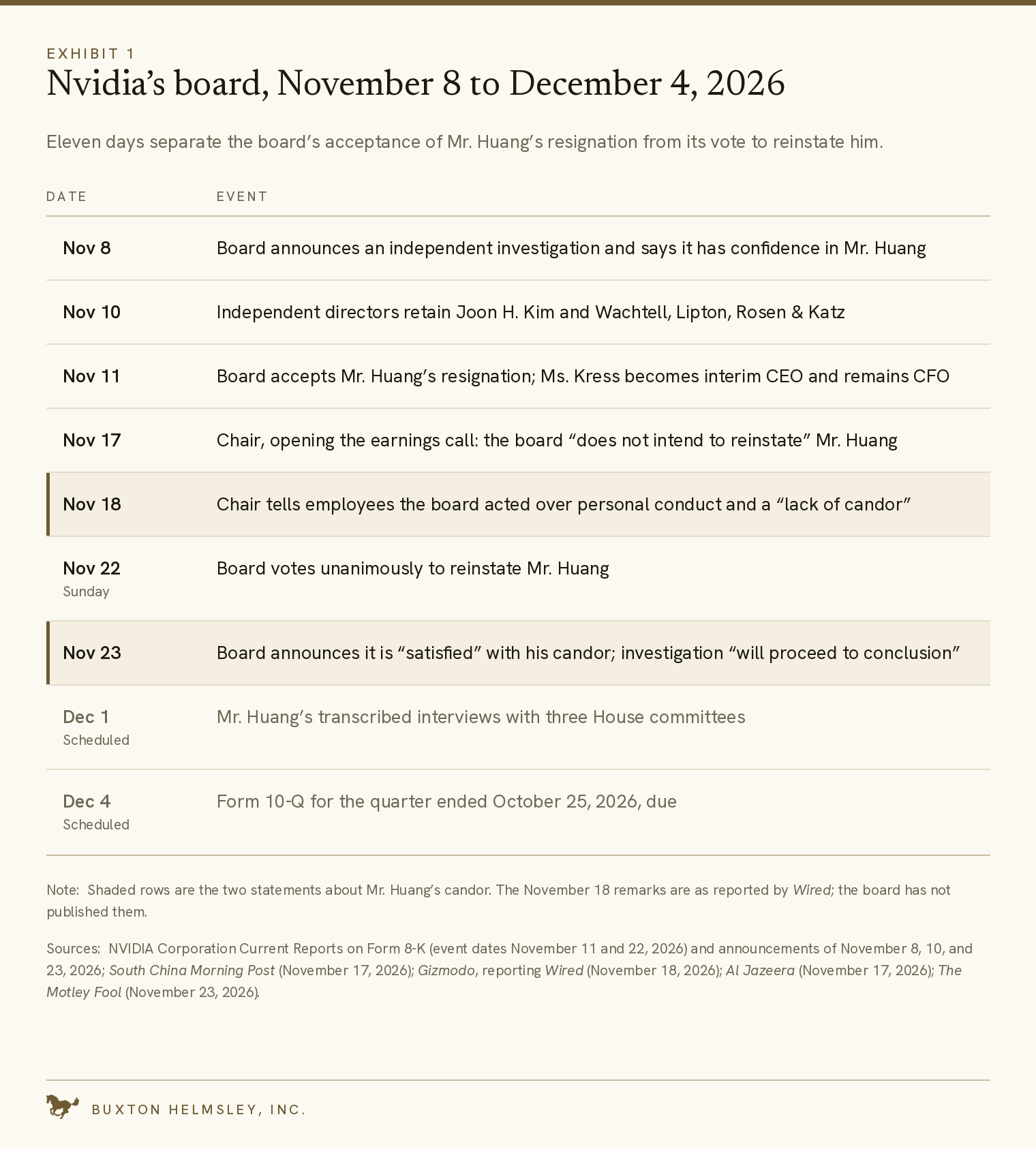
Two Findings About the Same Man’s Candor
In the space of five days, the board’s chair told employees that candor was part of the reason Mr. Huang left, and the board then told shareholders that it was satisfied with his candor.³ ⁵ Either the board learned something between November 18 and November 22 that changed its view, or one of the two statements went further than the information behind it. The November 23 announcement does not say which. The only sources of new information it describes are the board’s own discussions with Mr. Huang and the input from government officials.⁵
On November 17, our advice to the board was to confine what it said to things a reader could check.⁷ “Does not intend to reinstate” was a statement of intention, and the board was free to change its mind. The cost of changing it is that shareholders, employees, and customers have now heard two opposite judgments from the same directors within a week, each presented as unanimous, and none of those audiences can tell from the public record which one rested on more.¹ ⁵
When a board gives a reason for a decision about its chief executive, the reason becomes the standard its next decision will be measured against. A board that later decides the other way should expect to be asked what changed, and it should be ready to say: what it learned, from whom, and whether any of it came from someone other than the executive whose conduct was in question. An explanation that rests on conversations with that executive alone is the weakest one a board can give, because shareholders have no way to test it.
A Decision Made Ahead of the Investigation
The board announced the investigation on November 8, and on November 10 the independent directors retained Joon H. Kim, a former acting U.S. Attorney for the Southern District of New York, and his firm, Wachtell, Lipton, Rosen & Katz, to conduct it.⁸ ⁹ CNBC reported on November 16 that the inquiry covers Mr. Huang’s conduct and whether it compromised national security or company secrets.¹⁰ The board has now made the most consequential decision that work could have informed, with the work unfinished.
Boards sometimes have to act before an investigation is complete. Nvidia’s board was not obviously in that position. It had an interim Chief Executive Officer in office and had announced a search for a permanent one.¹¹ It chose to decide first.
A board that makes that choice can still limit what it costs by deciding now what the investigation’s findings will mean. The November 23 announcement does not say what happens if the committee’s findings are adverse to Mr. Huang, whether he has accepted any conditions on his return, or whether the board will publish what the committee concludes.⁵ Each of those questions can be answered today. We would advise any board that reinstates or retains an executive while an investigation into that executive’s conduct is open to put three things in writing and disclose them: the scope of the investigation as it now stands; the consequences the board has committed to if particular findings are made, with the executive’s written agreement to them; and the form in which the conclusions will be made public.
Government Input Is One Input
The announcement ties the board’s confidence that Mr. Huang’s reinstatement “poses no national security risk” to the input it received from senior levels of the government.⁵ It does not say who gave that input or what question it answered.
In the week before the vote, senior officials said different things in public about who should lead Nvidia. On November 15, Treasury Secretary Scott Bessent said the board needed to “go outside the company” for its next chief executive.¹² On November 16, President Trump told reporters that he “would not mind” seeing Mr. Huang reinstated.¹³ We take no view on either remark. They are cited because they show why public signals cannot carry a board’s decision: a day apart, they pointed in opposite directions.
On a national security question, information from the government may be the best information there is, and a board is right to ask for it. It is still information, and the decision, along with the fiduciary duty attached to it, stays with the directors. A board relying on it should record who provided it, what question it addressed, whether it was given in writing, and what work the board or its own counsel did to test it. If the committee’s findings later diverge from what the board was told, that record is what will show whether the board did its job.
The Certification Mr. Huang Will Now Sign
Nvidia reported its quarterly results on November 17 without filing its Quarterly Report on Form 10-Q for the quarter, although it has historically filed the report alongside its results. As of November 23, the report had not been filed, and it is due by December 4.¹⁴
On November 17, we wrote about the two certifications that Rule 13a-14 under the Securities Exchange Act of 1934 requires, one from the principal executive officer and one from the principal financial officer, and about the fact that Colette M. Kress, then holding both offices, would give both.⁷ ¹⁵ Mr. Huang’s return ends that concern. If the report is filed now, he will certify it as principal executive officer and Ms. Kress as principal financial officer.
One paragraph of that certification bears directly on what has happened this month. In it, each certifying officer states that he or she and the other certifying officer have disclosed to the company’s auditors and to the audit committee all significant deficiencies and material weaknesses in internal control over financial reporting, and any fraud, whether or not material, that involves management or other employees with a significant role in that control.¹⁶ Nothing on the public record suggests that there is any such matter at Nvidia. The paragraph matters here for a different reason. It is a representation of candor, made by the chief executive to the audit committee, and it will be made while an investigation that reaches his own conduct is still open.
Before the report is filed, we would advise the audit committee to ask the special committee’s counsel whether anything learned so far bears on the report’s disclosures or on either certification, and to record in its minutes that it asked and what it was told. The written sub-certifications we recommended on November 17, from Nvidia’s principal accounting officer and the heads of its principal finance and business functions, are still worth having.⁷ Before, the reason was that one person held both certifying offices. Now it is that the chief executive signing the report is the subject of an open inquiry.
Terms Nobody Has Seen
The Current Report on Form 8-K reporting the reinstatement states that the board reinstated Mr. Huang and that Ms. Kress will continue as Executive Vice President and Chief Financial Officer.⁴ It says nothing about the terms on which he returns: his compensation, the treatment of equity awards that were outstanding when he resigned, or any conditions attached to his reinstatement. The announcement is equally silent, and it does not say whether the search for a permanent Chief Executive Officer announced on November 12 has ended.⁵ ¹¹
A reinstatement is a fresh appointment, and a board should treat it as one, deciding the terms, documenting them, and disclosing them. If awards that lapsed or stopped vesting on Mr. Huang’s resignation are being restored, shareholders are entitled to know, because restoring them treats the eleven days as though they never happened. If no terms have been settled yet, the board should say when they will be.
What the Board Added
The November 23 announcement also described a National Security and Export Control Committee, made up solely of independent directors, to oversee trade compliance and national security risk, with its own national security counsel, and a search for a Chief Compliance Officer who will report to the Nominating and Corporate Governance Committee.⁵ Those are the right structures. A compliance officer who answers to a board committee, rather than to the executives whose conduct the role exists to check, is worth having.
Their value now depends on how independent they are from the chief executive the board has just restored. We would advise that the Chief Compliance Officer’s appointment, compensation, and removal rest with the Nominating and Corporate Governance Committee, not with management; that the committee meet the Chief Compliance Officer without management present on a fixed schedule; and that the new national security committee report its conclusions to the full board in writing.
The Next Two Weeks
The board’s next statements already have dates attached to them. Mr. Huang has agreed to sit for transcribed interviews with three House committees on December 1, and the Form 10-Q is due on December 4.² ¹⁴ Each is likely to produce statements that shareholders will set beside the November 17 call and the November 23 announcement.
A board that has reversed itself once in public should assume that everything it says next will be read against both of its earlier positions. The useful response is to say less and make all of it checkable: who sits on the investigating committee, what it is examining, when it expects to report, what the board will do with what it finds, and on what terms the chief executive has returned. The investigation will reach a conclusion whatever the board says now. The board can still decide, before that conclusion arrives, whether its own record will stand up when it does.
Related reading
One Invoice, Three Prices: What the First Brands Collapse Leaves for Boards, Owners, and Lenders
The Month After a Founder Leaves: Nvidia’s Board and the Decisions Still Open
Fossil Group’s Turnaround, Measured Against the 2023 Letters to Its Board
Sources
[1] “Nvidia board says it has no plans to reinstate Jensen Huang as CEO,” South China Morning Post (November 17, 2026) (secondary; supports Mr. Jones’s statement opening the earnings call and Mr. Huang’s post on X hours earlier).
[2] “Jensen Huang agrees to testify before US House, says can resume CEO role,” Al Jazeera (November 17, 2026) (secondary; supports Mr. Huang’s statement that he would be honored to return and his agreement to transcribed interviews with three House committees on December 1).
[3] “Nvidia Reportedly Just Briefed Employees on What Will Happen in the Near Future,” Gizmodo (November 2026), reporting Wired’s account of the all-hands meeting held on November 18, 2026 (secondary; supports Mr. Jones’s reported reference to a “lack of candor”).
[4] NVIDIA Corporation, Current Report on Form 8-K (event date November 22, 2026; signed November 23, 2026) (primary; supports the reinstatement on November 22, Ms. Kress’s continuation as Chief Financial Officer, and the absence of any disclosed terms).
[5] NVIDIA Corporation, “NVIDIA Board Reinstates Jensen Huang as President, CEO and Board Director” (November 23, 2026), Exhibit 99.1 to the Current Report cited at [4] (primary).
[6] NVIDIA Corporation, Current Report on Form 8-K (event date November 11, 2026; signed November 12, 2026) (primary; supports the acceptance of Mr. Huang’s resignation on November 11 and Ms. Kress’s appointment as interim Chief Executive Officer while continuing as Chief Financial Officer).
[7] Buxton Helmsley, Inc., “The Month After a Founder Leaves: Nvidia’s Board and the Decisions Still Open” (November 17, 2026).
[8] NVIDIA Corporation, “Statement from NVIDIA Board of Directors” (November 8, 2026) (primary).
[9] NVIDIA Corporation, “Statement From the Independent Members of the NVIDIA Board” (November 10, 2026) (primary).
[10] “Nvidia board is not considering bringing Jensen Huang back as CEO, source tells CNBC,” CNBC (November 16, 2026) (secondary; supports the reported scope of the investigation).
[11] NVIDIA Corporation, “NVIDIA Announces CEO Transition” (November 12, 2026) (primary; supports the search for a permanent Chief Executive Officer).
[12] “Bessent says Nvidia must go outside company to find new CEO,” South China Morning Post (November 15, 2026) (secondary).
[13] “President Trump says he ‘wouldn’t mind’ Jensen Huang being reinstated as Nvidia CEO,” Euronews (November 16, 2026) (secondary).
[14] “Nvidia’s 10-Q Is Delayed. Here’s What I’m Looking for When It Lands.” The Motley Fool (November 23, 2026) (secondary; supports the filing history, the status of the report as of November 23, and the December 4 deadline).
[15] U.S. Securities and Exchange Commission, Release No. 33-8124, Certification of Disclosure in Companies’ Quarterly and Annual Reports (August 29, 2002) (primary).
[16] NVIDIA Corporation, Exhibit 31.1 to Quarterly Report on Form 10-Q for the quarter ended April 26, 2026 (May 20, 2026) (primary; supports the content of the certification given by Nvidia’s principal executive officer).
This publication is one of the Insights commentaries of Buxton Helmsley, Inc. (“Buxton Helmsley”), published in connection with its advisory business rather than the investment management business of its subsidiary, Buxton Helmsley USA, Inc. It reflects the opinions, analysis, and interpretations of Buxton Helmsley as of the date of publication, and it is based upon information that Buxton Helmsley believes to be accurate and that is derived from public sources or from other sources believed to be reliable. Buxton Helmsley does not represent or warrant that such information is accurate or complete, and it should not be relied upon as such. The views expressed are subject to change at any time, and Buxton Helmsley undertakes no obligation to update this publication or to correct any information contained within it.
Except for statements expressly attributed to an identified source or to a public filing, the statements in this publication constitute the opinions and good-faith analysis of Buxton Helmsley and are not statements of objective fact. Buxton Helmsley’s analysis may rest upon assumptions, estimates, and interpretations that could prove to be incorrect. Any reference to a potential violation, misstatement, impropriety, or deficiency reflects Buxton Helmsley’s analytical conclusions and opinions, and does not represent a finding by any court, regulator, or other authority. Readers should conduct their own investigation and analysis of any company, security, or matter discussed. Any company or person referenced that believes any statement in this publication to be inaccurate is invited to contact Buxton Helmsley at general@buxtonhelmsley.com, and Buxton Helmsley will give good-faith consideration to any correction supported by credible evidence.
This publication is provided for informational purposes only. It does not constitute, and should not be construed as, investment advice, a recommendation, or the provision of any individualized investment advisory service to any person, nor an offer or solicitation to buy, sell, or hold any security. Nothing in this publication takes into account the particular investment objectives, financial situation, or needs of any reader. No reader should construe this publication as creating any advisory, fiduciary, or other relationship between Buxton Helmsley and such reader. Readers should consult their own legal, tax, accounting, and financial advisers before making any investment decision.
As of the date of this publication, Buxton Helmsley, its subsidiaries and affiliates (including Buxton Helmsley USA, Inc. and the funds and accounts that it manages or advises), and their principals hold no position in the securities of NVIDIA Corporation. Buxton Helmsley and the foregoing persons may, at any time and without further notice, purchase, sell, cover, or otherwise change any position in any security discussed in this publication, including in a manner inconsistent with the opinions expressed herein, for various reasons, including but not limited to new research discoveries. Buxton Helmsley may realize gains in the event that the price of any security discussed moves in a direction consistent with a position that it holds.
Buxton Helmsley has previously contacted NVIDIA Corporation, including about a potential advisory engagement. No engagement resulted, and Buxton Helmsley will not accept an advisory engagement from NVIDIA Corporation, its Board of Directors, or any committee of its Board.
Buxton Helmsley has not received, and will not receive, any compensation from any third party, including any issuer discussed in this publication or any person holding an interest in any such issuer, in connection with the preparation or publication of this commentary, except as expressly disclosed in this publication. Buxton Helmsley was not engaged or compensated by any third party to publish this commentary, except as expressly disclosed in this publication.
This publication is not, and shall not be construed as, an offer to sell or a solicitation of an offer to buy any security or any interest in any fund or other investment vehicle managed or advised by Buxton Helmsley or any of its affiliates, nor is it an advertisement for any such fund, vehicle, or advisory service. Any such offer or solicitation will be made only by means of definitive offering documents, and only to eligible investors, in accordance with applicable law.
This publication is intended only for distribution to, and use by, persons in the United States. It is not directed to, intended for, or to be relied upon by, any person located in any jurisdiction outside the United States, and it does not constitute an offer, solicitation, or provision of any service in any such jurisdiction. Persons who access this publication from outside the United States do so on their own initiative and are responsible for compliance with the laws applicable to them.
This publication may contain forward-looking statements that reflect Buxton Helmsley’s current expectations and that are subject to risks and uncertainties that could cause actual results to differ materially from those expressed. Past performance is not indicative of, and does not guarantee, future results. No representation is made that any investment will achieve, or is likely to achieve, results comparable to those discussed.
To the fullest extent permitted by applicable law, neither Buxton Helmsley nor any of its affiliates, nor their respective principals, members, officers, employees, or agents, shall have any liability to any person for any direct, indirect, incidental, consequential, or other loss or damage arising from any use of, or reliance upon, this publication or any information contained within it.
If any provision of these disclosures is held to be invalid or unenforceable, the remaining provisions shall continue in full force and effect.
© 2026 Buxton Helmsley, Inc. All rights reserved. This publication may not be reproduced or redistributed, in whole or in part, without attribution to Buxton Helmsley.