The Repurchase Safe Harbor and a Trading Day That Begins the Night Before
- Published
- October 1, 2026
- Reading time
- 22 min
On July 10, 2026, the Investors Exchange (IEX) filed a rule change allowing certain of its pegged order types, and its Discretionary Limit order, to trade in its pre-market and post-market sessions.¹ It left two order types out, and for one of them it gave a reason tied to issuer repurchases. The Corporate Discretionary Peg, which IEX introduced in 2019 to assist brokers “conducting buybacks on behalf of an issuer” with the price condition and the opening-purchase condition of the Rule 10b-18 safe harbor, will stay in the regular session, because “corporate buybacks are typically executed during Regular Market Hours in order to qualify for the safe harbor under Exchange Act Rule 10b-18.”¹ ² A footnote to that sentence describes the safe harbor as available “provided certain conditions are met, including that the purchases are effected during the primary trading session in the principal market for the security.”¹
The footnote is incomplete. Since 2003, the text of Rule 10b-18 has carried the safe harbor past the close. Paragraph (b)(2)(iv) provides that an issuer’s purchases “may be effected following the close of the primary trading session until the termination of the period in which last sale prices are reported in the consolidated system,” at prices that do not exceed the lower of the session’s closing price and any lower bids or sale prices reported in the consolidated system afterward.³ When the Commission adopted the provision, it described the change as extending the safe harbor to repurchases effected after hours “while the consolidated system is still open.”⁴ IEX’s own post-market session, which runs from 4:00 p.m. to 5:00 p.m., falls inside that window.¹ (The order type would have been a poor fit for that session all the same. It was designed not to “trade above the last transaction price reported in the consolidated system,” one of the two measures in the rule’s general price condition, and that limit would not by itself keep a post-market purchase within the lower after-hours cap.)²
The rule does not name an hour. It takes its after-hours limit from the consolidated tape, measures its price condition against the consolidated system, and counts its conditions by the day without defining one.³ On December 6, the tape is scheduled to change. Its processors, which now operate from 4:00 a.m. to 8:00 p.m. Eastern, will then operate from 9:00 p.m. on Sunday through 8:00 p.m. on Friday, pausing for one hour on Monday through Thursday evenings, and the orders approving the change give the processors a trade date that runs from 8:00 p.m. to 8:00 p.m. In the orders’ example, Wednesday’s trading day “would be between 8:00 p.m. ET on Tuesday and 8:00 p.m. ET on Wednesday.”⁵ ⁶ The plan participants added that setting the start of the trading day “is only applicable to the operation of the Processor,” and the plans’ operating committees said they do not have “the authority to set the start of the trading day for rules and regulations that might be dependent on when a trading day begins.”⁵ ⁶ Rule 10b-18 is one of those rules.
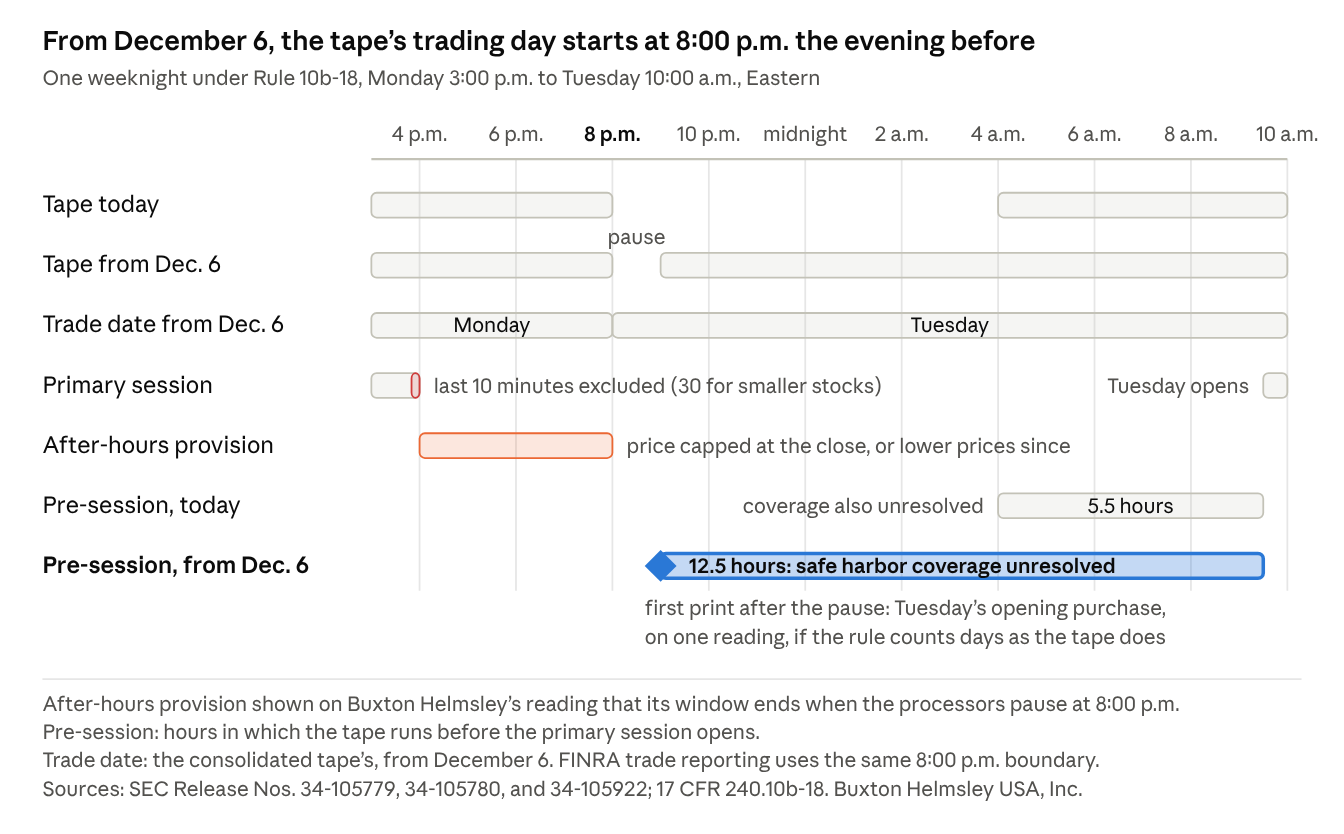
In Buxton Helmsley’s reading, the rule’s after-hours window will still close at 8:00 p.m., when the processors pause, and the change will come in the hours after it. From 9:00 p.m., the consolidated system will be disseminating bids and transaction prices through the night, so the rule’s price condition can be measured at hours when today it cannot, and the tape will treat those hours as the start of the next trading day. Whether an issuer may buy in them inside the safe harbor turns on two questions that, as far as Buxton Helmsley could find, neither the Commission nor its staff has answered: whether purchases made before a day’s primary session opens are covered at all, and to which day an overnight purchase belongs. The hours each trading day in which the tape is running before the primary session opens will go from five and a half to twelve and a half, and issuers’ periodic reports need not show how any of them has answered either question.
The safe harbor as written
Rule 10b-18 prohibits nothing. It provides that an issuer’s repurchases “shall not be deemed to have violated the anti-manipulation provisions of sections 9(a)(2) or 10(b) of the Act ... or § 240.10b-5 ... solely by reason of the time, price, or amount” of the purchases, or the number of brokers or dealers used, if the issuer meets each of four conditions, and an issuer that does not meet them is not presumed to have manipulated anything.³ The rule’s first preliminary note states what meeting them requires: “To come within the safe harbor, however, an issuer’s repurchases must satisfy (on a daily basis) each of the section’s four conditions. Failure to meet any one of the four conditions will remove all of the issuer’s repurchases from the safe harbor for that day.”³
The conditions cover the broker, the time, the price, and the volume. An issuer must use only one broker or dealer on any single day, with an exception for purchases not solicited by or on behalf of the issuer. Its purchase must not be “[t]he opening (regular way) purchase reported in the consolidated system,” and must not be effected in the ten minutes before the scheduled close of the primary trading session (thirty minutes for a stock whose average daily trading volume is under $1 million in value or whose public float is under $150 million). It may pay no more than the highest independent bid or the last independent transaction price reported in the consolidated system, whichever is higher. And its purchases on any single day may not exceed 25 percent of the stock’s average daily trading volume over the four calendar weeks before the week of the purchase, subject to a once-a-week exception for a block.³ A “Rule 10b-18 purchase,” for all of these purposes, includes “any bid or limit order that would effect such purchase.”³
The Commission explained in 2003 that the timing condition, as it then stood, excluded purchases at the opening and in the last half hour of trading “because market activity at such times is considered to be a significant indicator of the direction of trading, the strength of demand, and the current market value of the security.”⁴ The after-hours provision came in the same release. Until then, the Commission’s Division of Market Regulation had “interpreted Rule 10b-18 to be available to purchases effected during limited off-hours trading (OHT) sessions at the primary market’s closing price,” and had read the rule’s “one-half hour before the scheduled close of trading” language to refer to “an exchange’s primary (or regular) trading session (i.e., 9:30 a.m.–4 p.m. price discovery session), rather than OHT sessions.”⁴ In its proposal, the Commission had asked how the safe harbor’s conditions should apply “to each separate trading session in one day.”⁴ It answered by extending the safe harbor to repurchases “effected after-hours (while the consolidated system is still open)” at the capped price, and said the change “will allow issuers to provide a source of liquidity, while still providing investor protection.”⁴
The provision has three sentences. The first permits purchases after the close until the tape stops reporting last sales, at the capped price, if the rule’s other conditions are met. The second allows the issuer to use a different broker or dealer after the close from the one it used during the session. The third provides that “the issuer’s Rule 10b-18 purchase may not be the opening transaction of the session following the close of the primary trading session.”³ The Commission gave the same kind of reason for that restriction as for the regular opening, describing the opening transaction of the after-hours session as one that “may be considered to be a significant indicator of the direction of trading and the strength of demand in the after-hours trading session.”⁴ It added that “[t]he Rule’s volume calculation would carry over from the regular trading session,” so that the evening’s purchases count against the same day’s limit.⁴
The staff’s published answers call the provision “[a] limited safe harbor.”⁷ They read the opening condition by the day: The staff’s example, a delayed opening in the principal market, turns on which opening purchase is reported in the consolidated system “first that day.”⁷ In 2010, prompted by the same delayed-opening problem, the Commission proposed to add the principal market’s opening to the condition, on the ground that the principal market’s official opening transaction “may be a more significant indicator of the direction of trading, the strength of demand, and the current market value of a security than the smaller regional exchange’s opening purchase.”⁸ The proposal was not adopted, and the rule has not been amended since 2005.³ ⁸
The tape’s calendar
The Commission approved the processors’ new hours on June 26, 2026, in two orders that describe the change in the same terms.⁵ ⁶ The processors’ hours “will begin at 9:00 p.m. ET Sunday and continue through 8:00 p.m. ET Friday,” and each processor will pause operations at 8:00 p.m. on Monday through Thursday for one hour “to accommodate technical refreshes.”⁵ ⁶ The trade date runs “between 8:00 p.m. ET on the day before Regular Trading Hours begin and 8:00 p.m. ET on the same day as when Regular Trading Hours begin.”⁵ ⁶ The participants chose 8:00 p.m. over midnight because “the alternative would have required a new trading day to start in the middle of a trading session (i.e., at midnight),” and the Commission said the definition “will help to provide clarity as to a specified trade date in light of the Processor’s expanded hours of operation.”⁵ It also said that the change “defines a trade date for purposes of the Plans,” and the participants’ disclaimer, quoted above, confines the definition to the processors’ operation.⁵ FINRA has adopted the same boundary for its own trade reporting rules, under which trades executed after 8:00 p.m. on a calendar day take the next calendar day’s trade date, “regardless of whether the Calendar Day is a Business Day or a holiday or weekend.”⁹
On the 8:00 p.m. reading, the period in which last sale prices are reported ends at 8:00 p.m. each Monday through Thursday, when the processors pause, as it does today, and the after-hours window stays at 4:00 p.m. to 8:00 p.m. The other reading takes the words “continue through 8:00 p.m. ET Friday” to describe a single reporting period, which the pause interrupts without ending. On that reading, the evening window, with its price cap and its separate-broker allowance, would run through the night. The text would give it no stopping point short of Friday evening, so a reader would have to imply one at the next morning’s opening, and the reading sits poorly with a release that framed the question as how the conditions apply to “each separate trading session in one day.”⁴ The 8:00 p.m. reading has the pause on its side, but the participants said the processors “would endeavor to reduce the length of the pause where technically feasible,” with at least 90 days’ notice of any reduction.⁵ If the pause shrinks to nothing, the end of the processors’ trade date is what will be left to mark the end of the period, and the participants have said that date governs only the processors’ own operation.
Today, the processors are shut from 8:00 p.m. to 4:00 a.m., and trades executed over the counter while they are shut reach the tape only after the processors reopen, by 4:15 a.m.⁹ A purchase made overnight today therefore has no current consolidated bid or transaction price against which to measure the rule’s price condition. From December 6, it will have both.
Whether a purchase made before a day’s primary session opens can be inside the safe harbor is the first unanswered question. The text of paragraph (b)(2) excludes only the opening purchase and the minutes before the close, so, on a literal reading, a purchase at 7:00 a.m. passes the time condition. But paragraph (b)(2)(iv) opens with “However” and grants after-hours purchases as an exception, and the 2003 release, the Division’s earlier interpretation, and IEX’s footnote all treat the safe harbor as an instrument of the primary session, carried past the close first by interpretation and then by express provision. Buxton Helmsley found no discussion of purchases made before the primary session opens in the 2003 release or in the staff’s published answers, and no statement by the Commission or its staff on whether they are covered. Today, the question reaches the five and a half hours from 4:00 a.m. to 9:30 a.m. From December 6, it will reach the twelve and a half hours from 9:00 p.m. to 9:30 a.m.
If those hours are outside the safe harbor, a purchase in them fails the time condition, and the preliminary note removes every repurchase the issuer makes that day from the safe harbor. Which day that is depends on the second question. Counted on the processors’ trade date, a purchase at 10:00 p.m. on a Monday belongs to Tuesday and takes Tuesday’s regular-session purchases out with it. Counted by the calendar day, it belongs to Monday and takes out the purchases already made in Monday’s session. If the hours are inside the safe harbor, the 8:00 p.m. reading puts them on easier terms than the evening. A purchase at 7:00 p.m. may not exceed the lower of the closing price and any lower bid or sale price reported since, while a purchase at 1:00 a.m. would be held only to the general condition, which allows a price up to the highest independent bid or the last independent transaction price, whichever is higher.³ On the continuous reading, the cap would follow the purchase into the night, and a Commission that brought those hours inside the safe harbor might well attach it.
The rule’s daily conditions do not say whose day they use. The average daily trading volume is the volume “reported for the security,” and the opening condition looks to the purchase “reported in the consolidated system,” so those two have the best claim to inherit the tape’s day.³ The one-broker and 25 percent limits say only “any single day.” If the rule’s days are the processors’ trade dates, a purchase at 10:00 p.m. on Monday counts against Tuesday’s 25 percent, and it has to go through Tuesday’s broker, since, on the 8:00 p.m. reading, the allowance for a separate broker after the close covers only the window after Monday’s close, and that window closed at 8:00 p.m.³ If the rule’s days are calendar days, the overnight session is divided at midnight between two of them, the result the participants rejected for the tape.
If the opening condition follows the tape’s day, the first purchase reported for Tuesday will be the first print after 9:00 p.m. on Monday. Paragraph (b)(2)(i) will keep the issuer out of that print, and the principal market’s opening at 9:30 a.m. will not be an opening the text excludes. The same reasoning already reaches the first pre-market print at 4:00 a.m. On another reading, supported by the staff’s example, in which the opening purchases are exchanges’ opening transactions, the condition refers to the opening of regular trading, and an overnight print is not an opening at all.⁷ The Commission’s 2010 concern that the principal market’s official opening may be “a more significant indicator” than a smaller opening purchase reported first elsewhere applies with more force to a print made twelve and a half hours before the principal market opens.⁸
The 2003 release says the volume condition “is designed to prevent an issuer from dominating the market for its securities through substantial purchasing activity,” and the rule sets the limit as a share of a whole day’s average volume, not of the session in which the purchases are made.⁴ In August 2026, the overnight session (which the staff’s data measure from 8:00 p.m. to 4:00 a.m.) accounted for 0.9 percent of NMS share volume on an average trade date, and the ten NMS stocks most active in that session accounted for 43.4 percent of its share volume.¹⁰ The same mismatch exists in the evening today, where the after-hours price cap limits its effect. If the overnight hours are inside the safe harbor on the 8:00 p.m. reading, an issuer in most stocks could stay within the 25 percent limit while buying many times what its stock ordinarily trades overnight, at prices held only to the general condition.
These questions matter little for an issuer that keeps its repurchases inside the regular session, which, on IEX’s account, is the usual case. They arise for an issuer whose broker can route orders to an overnight venue, or whose resting limit orders carry a time-in-force that extends into the overnight session, since a bid or limit order that would effect a purchase is itself a Rule 10b-18 purchase.³ They also arise for an issuer that wants to buy after news it released in the evening, and for the dealers on the other side of accelerated repurchases, whose contracts measure their purchases against paragraph (b)(2).
What has been said
The orders extending the processors’ hours do not mention Rule 10b-18, and the plans’ operating committees disclaimed any authority to set the trading day for other rules.⁵ ⁶ The Commission’s order approving the overnight price bands, which apply from 9:00 p.m. to 4:00 a.m., does not mention the rule either.¹¹ A search of the Federal Register, run on October 1, 2026, for documents published since June 1, 2025, that mention Rule 10b-18 returns three: two IEX rule filings, one of them the July filing quoted above, and an executive order.¹² At the Commission’s roundtable on 24-hour trading on September 17, Chairman Paul S. Atkins invited feedback on how the change “may affect public companies’ execution of certain corporate actions, as well as their obligations to disseminate material information to the market and make SEC filings during EDGAR filing hours.”¹³ Commissioner Hester M. Peirce asked whether the Commission should “give guidance or relief to ease the burdens that extended hours trading may impose on issuers, especially smaller ones.”¹³ Neither mentioned repurchases, and neither did Commissioner Mark T. Uyeda in his remarks at the same roundtable.¹³
The executive order concerns a different subject. Executive Order 14372, signed on January 7, 2026, provides that the Chairman “shall consider whether to adopt amended regulations governing stock buy-backs under Rule 10b-18 that would prohibit use of the relevant safe harbor for defense contractors” of the type identified under the order.¹⁴ Buxton Helmsley found no proposal to amend the rule as of the date of this piece.
What a shareholder can see
An issuer reports its repurchases in its quarterly and annual reports in a table with one row per month, showing the number of shares purchased, the average price paid, the shares purchased under publicly announced programs, and the amount that may yet be purchased under them.¹⁵ The instruction to Item 703 of Regulation S-K requires the issuer to “[d]isclose all purchases covered by this Item, including purchases that do not satisfy the conditions of the safe harbor of § 240.10b-18,” and Rule 10b-18’s second preliminary note requires the report whether or not the purchases were made in accordance with the rule.¹⁵ ³ Neither requires the issuer to say which purchases were made within the safe harbor, on what day, or at what hour. The amendments the Commission adopted in 2023 would have required daily repurchase data, including the number of shares purchased each day that were intended to qualify for the safe harbor. The Fifth Circuit vacated them on December 19, 2023, and the Commission removed them from the Code of Federal Regulations in 2024.¹⁶ As the item stands, a month of purchases made at night and a month made in the regular session produce the same row.
The repurchase contracts say more. Accelerated share repurchases are not themselves within the safe harbor. The staff’s answers describe them as private transactions that “are not eligible for the Rule 10b-18 safe harbor, which applies only to open market purchases,” and add that the safe harbor “is not available for the broker’s covering transactions.”⁷ The contracts nonetheless use the rule as a yardstick.
On July 23, 2026, Visteon Corporation announced a $200 million accelerated share repurchase under its $800 million repurchase authorization and filed its confirmation with the dealer, Bank of America, N.A., as an exhibit to a Form 8-K the same day.¹⁷ The number of shares Visteon receives is set by reference to an average of a daily “10b-18 VWAP,” the volume-weighted average price “of the Rule 10b-18 eligible trades in the Shares” as reported on a Bloomberg page, “without regard to pre-open or after-hours trading outside of any regular trading session.”¹⁷ If the price shown on that page is clearly erroneous, the fallback takes into account “only those trades that are reported during the period of time during which Issuer could purchase its own shares under Rule 10b-18(b)(2).”¹⁷ The dealer’s purchases, other than those made for dynamic hedge adjustments, are measured against the rule as well: Bank of America agreed to “use good faith, commercially reasonable efforts to effect such purchases in a manner so that, if such purchases were made by Issuer, they would meet the requirements of Rule 10b-18(b)(2), (3) and (4),” taking into account any applicable no-action letters.¹⁷ The form of master confirmation for accelerated repurchases with Goldman Sachs & Co. LLC that Pinterest, Inc., filed in March 2026 is built the same way, with a price measured over “the regular trading session” of the exchange “(without regard to pre-open or after hours trading outside of such regular trading session ...)” and a dealer covenant measured against paragraphs (b)(1) through (b)(4) of the rule.¹⁸
In both, the price comes from the regular session, while the yardstick for the dealer’s purchases, and in Visteon’s case for the fallback price, includes paragraph (b)(2), which already reaches the evening from 4:00 p.m. to 8:00 p.m. Whether it reaches the hours from 9:00 p.m. to 9:30 a.m. depends on the questions above. Visteon has said it expects the repurchase to be completed no later than early in the fourth quarter of 2026, which would put it before December 6.¹⁷ A confirmation on the same pattern whose calculation period runs past December 6 will measure the price over one set of hours and the dealer’s purchases over a set whose limits depend on those questions, unless the parties write the hours in.
The day-counting question also reaches a company’s insider trading policy. Item 408(b) of Regulation S-K asks whether a company has adopted insider trading policies and procedures governing transactions in its securities “by directors, officers and employees, or the registrant itself.”¹⁹ Where a company’s policy governs its own repurchases and counts a waiting period after a release in trading days, it carries the ambiguity Buxton Helmsley described in its September 28 piece on overnight trading, with the company as the trader.²⁰
Before December 6
An institutional investor in a company with an active repurchase program can ask four things before December 6. The first is whether the company’s broker agreement or Rule 10b5-1 repurchase plan permits purchases, or resting orders, outside the primary session, and whether it reaches the overnight hours. If it does, the second is whether the company treats purchases before the primary session as inside the safe harbor, and to which day it assigns a purchase made at 10:00 p.m. The third, for a company that uses accelerated repurchases, is whether confirmations with calculation periods running past December 6 will confine the dealer’s purchases to the hours over which the price is measured. The fourth is how the company’s insider trading policy, if it governs the company’s own repurchases, will count a trading day.
A reader of the record will not find the answers in a quarterly report. An EDGAR full-text search run on October 1, 2026, found 841 documents, in quarterly reports on Form 10-Q filed this year, that mention Rule 10b-18.²¹ After December 6, a statement in a quarterly report that repurchases were made under the rule will say something definite about a purchase made at night only if the issuer also says how it reads the rule. The accelerated repurchase confirmations filed as exhibits are the better record, and the provisions to read together are the price definition and the dealer covenant.
The Commission could settle both questions in a sentence or two: one that says whether purchases made before the primary session opens are within the safe harbor, and on what price terms, and one that says by which day the rule’s daily conditions are counted. The plans’ operating committees have said they cannot supply the second answer, and nothing in the rule does. Buxton Helmsley will read the repurchase tables covering December 2026, and the confirmations filed with them, with both questions in view.
Related reading
Reading Travel + Leisure’s Loan Loss Ratio Against the SEC’s Complaint
Optimum’s Rate Reconciliation Treated a Franchise Impairment the Way It Treated Goodwill
The SEC Would Stop Asking Whether a Private Fund’s Auditor Is Subject to PCAOB Inspection
Referenced Sources:
[1] U.S. Securities and Exchange Commission, Self-Regulatory Organizations; Investors Exchange LLC; Notice of Filing and Immediate Effectiveness of Proposed Rule Change To Amend Rule 11.190 to Permit Trading of Pegged Orders During Pre-Market and Post-Market Sessions, Release No. 34-105959, File No. SR-IEX-2026-19, published at 91 FR 46805 (July 24, 2026) (primary; supports the filing date of July 10, 2026, the order types enabled and excluded, the hours of IEX’s Pre-Market and Post-Market Sessions, and the quoted statement on corporate buybacks and its footnote 30 (91 FR 46806)).
[2] U.S. Securities and Exchange Commission, Self-Regulatory Organizations: Investors Exchange LLC; Notice of Filing and Immediate Effectiveness of Proposed Rule Change To Add a Corporate Discretionary Peg Order Type and Make Two Minor Non-Substantive Clarifying Changes to the Definition of a Discretionary Peg Order, Release No. 34-87019, File No. SR-IEX-2019-10, published at 84 FR 50485 (September 25, 2019) (primary; supports the purpose of the order type, its limit at the last transaction price reported in the consolidated system, its opening-purchase feature, and its limitation to the Regular Market Session).
[3] 17 CFR 240.10b-18 (Rule 10b-18), Preliminary Notes 1 and 2 and paragraphs (a)(1), (a)(13), (b), (b)(1) through (b)(4), and (d), as currently published in the electronic Code of Federal Regulations, whose source note lists 68 FR 64970 (November 17, 2003), as amended at 70 FR 37618 (June 29, 2005) (primary; supports the quoted text and the absence of amendments since 2005).
[4] U.S. Securities and Exchange Commission, Purchases of Certain Equity Securities by the Issuer and Others, Release Nos. 33-8335, 34-48766, IC-26252, published at 68 FR 64952 (November 17, 2003) (primary; supports the explanation of the timing condition as it then stood and the purpose of the volume condition; and, in Section IV, the Division’s prior interpretation, the question posed in the proposal, the extension of the safe harbor to after-hours purchases, the reasons given for it and for the opening-transaction restriction, and the carry-over of the volume calculation (68 FR 64960–61)).
[5] U.S. Securities and Exchange Commission, Consolidated Tape Association; Order Approving the Fortieth Substantive Amendment to the Second Restatement of the CTA Plan and Thirty-First Substantive Amendment to the Restated CQ Plan, as Modified by Amendment No. 1 Thereto, Release No. 34-105779, File No. SR-CTA/CQ-2026-01 (June 26, 2026), published at 91 FR 40082 (July 1, 2026) (primary; supports the processor’s current and amended hours, the pause and its purpose, the statement on reducing the pause, the trade-date definition and example, the participants’ reasons for an 8:00 p.m. boundary, the statements in footnote 24 limiting the trade date to the processor’s operation, and the Commission’s statements on the trade date).
[6] U.S. Securities and Exchange Commission, Joint Industry Plan; Order Approving the Fifty-Fifth Amendment to the Joint Self-Regulatory Organization Plan Governing the Collection, Consolidation and Dissemination of Quotation and Transaction Information for Nasdaq-Listed Securities Traded on Exchanges on an Unlisted Trading Privileges Basis, as Modified by Amendment No. 1 Thereto, Release No. 34-105780, File No. S7-24-89 (June 26, 2026), published at 91 FR 40058 (July 1, 2026) (primary; supports the same hours, pause, and trade-date definition for the processor for Nasdaq-listed securities, and the same statements limiting the trade date to the processor’s operation).
[7] Division of Trading and Markets, U.S. Securities and Exchange Commission, Answers to Frequently Asked Questions Concerning Rule 10b-18 (“Safe Harbor” for Issuer Repurchases), Questions 13, 27, and 28 (primary; supports the quoted answers on accelerated share repurchases, the after-hours safe harbor, and the opening purchase condition).
[8] U.S. Securities and Exchange Commission, Purchases of Certain Equity Securities by the Issuer and Others, Release No. 34-61414, published at 75 FR 4713 (January 29, 2010) (primary; supports the proposed amendment to the opening purchase condition and the quoted reasoning (75 FR 4716)); see note 3 for the rule’s current text.
[9] U.S. Securities and Exchange Commission, Self-Regulatory Organizations; Financial Industry Regulatory Authority, Inc.; Notice of Filing and Immediate Effectiveness of a Proposed Rule Change To Amend the FINRA Rule 6300 Series (Trade Reporting Facilities) To Extend the Trade Reporting Facilities Operating Hours to 23 Hours Per Day, Five Days Per Week, Release No. 34-105922, File No. SR-FINRA-2026-015 (July 15, 2026), published at 91 FR 45299 (July 20, 2026) (primary; supports the assignment of trades executed after 8:00 p.m. to the next calendar day’s trade date (91 FR 45301) and the current reporting of overnight trades by 4:15 a.m.).
[10] Staff of the Office of Analytics and Research, Division of Trading and Markets, U.S. Securities and Exchange Commission, memorandum to File No. 4-913, Roundtable on Preparations for 24-Hour Trading Supporting Data (September 10, 2026) (primary; supports the definition of the overnight session used for the staff’s data, the overnight session’s share of NMS share volume in August 2026, and the share of overnight volume in the ten most active stocks in that session).
[11] U.S. Securities and Exchange Commission, Joint Industry Plan; Order Granting Approval of the Twenty-Seventh Amendment to the National Market System Plan To Address Extraordinary Market Volatility To Establish Temporary Price Band Protections in Overnight Trading, Release No. 34-106042, File No. 4-631 (August 5, 2026), published at 91 FR 51515 (August 10, 2026) (primary; supports the overnight protected hours and the absence of any reference to Rule 10b-18).
[12] Federal Register full-text search for documents containing “10b-18,” published on or after June 1, 2025, run by Buxton Helmsley on October 1, 2026 (primary; returned three documents, Federal Register document numbers 2026-14978, 2026-00554, and 2025-11887; results may change).
[13] Chairman Paul S. Atkins, U.S. Securities and Exchange Commission, “Remarks at the 24-Hour Trading Roundtable” (September 17, 2026); Commissioner Hester M. Peirce, “Stock Around the Clock: Remarks at the Roundtable on Preparations for 24-Hour Trading” (September 17, 2026); Commissioner Mark T. Uyeda, “Remarks at the SEC Roundtable on 24-Hour Trading” (September 17, 2026) (primary; support the quoted statements and the absence of any reference to repurchases).
[14] Executive Order 14372 of January 7, 2026, Prioritizing the Warfighter in Defense Contracting, 91 FR 1377 (January 13, 2026) (primary; supports the quoted text of Section 4(d) (91 FR 1378)).
[15] 17 CFR 229.703 (Item 703 of Regulation S-K), including the instruction to paragraph (b)(1) and the instruction to Item 703 (primary; supports the monthly table and the quoted instruction).
[16] U.S. Securities and Exchange Commission, Share Repurchase Disclosure Modernization, Release Nos. 34-97424, IC-34906, published at 88 FR 36002 (June 1, 2023) (primary; supports the daily repurchase data the amendments would have required, including shares intended to qualify for the Rule 10b-18 safe harbor); U.S. Securities and Exchange Commission, Share Repurchase Disclosure Modernization, Release Nos. 34-99778, IC-35157, published at 89 FR 24372 (April 8, 2024) (primary; supports the vacatur of the amendments by the U.S. Court of Appeals for the Fifth Circuit on December 19, 2023, in Chamber of Commerce of the USA v. SEC, 88 F.4th 1115 (5th Cir. 2023), and their removal from the Code of Federal Regulations).
[17] Visteon Corporation, Current Report on Form 8-K filed July 23, 2026, Item 1.01; Exhibit 10.1 (confirmation between Visteon Corporation and Bank of America, N.A., dated July 23, 2026, filed without its Schedule I and listed in the exhibit index as a form); and Exhibit 99.1 (press release) (primary; supports the size of the repurchase and of the authorization, the dealer, the 10b-18 VWAP definition and its fallback, the dealer’s covenant and its exclusion of dynamic hedge adjustments, and the expected completion date (Item 1.01)).
[18] Pinterest, Inc., Current Report on Form 8-K filed March 3, 2026, Exhibit 10.2 (form of master confirmation for accelerated share repurchases, Goldman Sachs & Co. LLC) (primary; supports the quoted VWAP Price definition and the dealer covenant).
[19] 17 CFR 229.408(b)(1) (Item 408(b) of Regulation S-K) (primary; supports the quoted text).
[20] Buxton Helmsley USA, Inc., “Overnight Exchange Trading Is Set to Begin December 6, and the Disclosure Rules Still Assume a Close” (September 28, 2026).
[21] EDGAR full-text search for documents containing “Rule 10b-18,” limited to Form 10-Q filings made from January 1 through September 30, 2026, run by Buxton Helmsley on October 1, 2026 (primary; supports the count of 841 documents, which includes exhibits filed with those reports and may change as filings are added).
This publication is one of the Insights commentaries of Buxton Helmsley USA, Inc. (“Buxton Helmsley”). It reflects the opinions, analysis, and interpretations of Buxton Helmsley as of the date of publication, and it is based upon information that Buxton Helmsley believes to be accurate and that is derived from public sources or from other sources believed to be reliable. Buxton Helmsley does not represent or warrant that such information is accurate or complete, and it should not be relied upon as such. The views expressed are subject to change at any time, and Buxton Helmsley undertakes no obligation to update this publication or to correct any information contained within it.
Except for statements expressly attributed to an identified source or to a public filing, the statements in this publication constitute the opinions and good-faith analysis of Buxton Helmsley and are not statements of objective fact. Buxton Helmsley’s analysis may rest upon assumptions, estimates, and interpretations that could prove to be incorrect. Any reference to a potential violation, misstatement, impropriety, or deficiency reflects Buxton Helmsley’s analytical conclusions and opinions, and does not represent a finding by any court, regulator, or other authority. Readers should conduct their own investigation and analysis of any company, security, or matter discussed. Any company or person referenced that believes any statement in this publication to be inaccurate is invited to contact Buxton Helmsley at general@buxtonhelmsley.com, and Buxton Helmsley will give good-faith consideration to any correction supported by credible evidence.
This publication is provided for informational purposes only. It does not constitute, and should not be construed as, investment advice, a recommendation, or the provision of any individualized investment advisory service to any person, nor an offer or solicitation to buy, sell, or hold any security. Nothing in this publication takes into account the particular investment objectives, financial situation, or needs of any reader. No reader should construe this publication as creating any advisory, fiduciary, or other relationship between Buxton Helmsley and such reader. Readers should consult their own legal, tax, accounting, and financial advisers before making any investment decision.
As of the date of this publication, Buxton Helmsley, the funds and accounts that it manages or advises, and its principals hold no position in the securities of the companies mentioned in the article. Buxton Helmsley and the foregoing persons may, at any time and without further notice, purchase, sell, cover, or otherwise change any position in any security discussed in this publication, including in a manner inconsistent with the opinions expressed herein, for various reasons, including but not limited to new research discoveries. Buxton Helmsley may realize gains in the event that the price of any security discussed moves in a direction consistent with a position that it holds.
Buxton Helmsley has not received, and will not receive, any compensation from any third party—including any issuer discussed in this publication or any person holding an interest in any such issuer—in connection with the preparation or publication of this commentary, except as expressly disclosed in this publication. Buxton Helmsley was not engaged or compensated by any third party to publish this commentary, except as expressly disclosed in this publication.
This publication is not, and shall not be construed as, an offer to sell or a solicitation of an offer to buy any security or any interest in any fund or other investment vehicle managed or advised by Buxton Helmsley or any of its affiliates, nor is it an advertisement for any such fund, vehicle, or advisory service. Any such offer or solicitation will be made only by means of definitive offering documents, and only to eligible investors, in accordance with applicable law.
This publication is intended only for distribution to, and use by, persons in the United States. It is not directed to, intended for, or to be relied upon by, any person located in any jurisdiction outside the United States, and it does not constitute an offer, solicitation, or provision of any service in any such jurisdiction. Persons who access this publication from outside the United States do so on their own initiative and are responsible for compliance with the laws applicable to them.
This publication may contain forward-looking statements that reflect Buxton Helmsley’s current expectations and that are subject to risks and uncertainties that could cause actual results to differ materially from those expressed. Past performance is not indicative of, and does not guarantee, future results. No representation is made that any investment will achieve, or is likely to achieve, results comparable to those discussed.
To the fullest extent permitted by applicable law, neither Buxton Helmsley nor any of its affiliates, nor their respective principals, members, officers, employees, or agents, shall have any liability to any person for any direct, indirect, incidental, consequential, or other loss or damage arising from any use of, or reliance upon, this publication or any information contained within it.
If any provision of these disclosures is held to be invalid or unenforceable, the remaining provisions shall continue in full force and effect.
© 2026 Buxton Helmsley USA, Inc. All rights reserved. This publication may not be reproduced or redistributed, in whole or in part, without attribution to Buxton Helmsley.