Overnight Exchange Trading Is Set to Begin December 6, and the Disclosure Rules Still Assume a Close
- Published
- September 28, 2026
- Reading time
- 19 min
Nasdaq’s proposal to trade twenty-three hours a day, which the Securities and Exchange Commission approved on April 10, 2026, came with an answer to a specific problem: A company releases material news in the middle of the night, and the listing exchange does not halt the stock.¹ The answer was disclosure to customers. Nasdaq’s rules, as amended, would require that “disclosures be provided to customers relating to the risks associated with the exaggerated effect of news announcements and the additional risks of trading during the Night Session,” and those requirements, Nasdaq said, “will help ensure that market participants, including investors, are informed about the potential risks associated with trading during the Night Session.”¹
Overnight trading on registered exchanges is scheduled to begin on December 6. Starting at 9:00 p.m. Eastern that Sunday, the securities information processors, which publish the consolidated tape for every listed stock, are expected to run each week from Sunday evening through 8:00 p.m. Friday, pausing for one hour on Monday through Thursday evenings.² ³ NYSE Arca plans to open an overnight session the same night, running from 9:00 p.m. to 4:00 a.m. (subject to SEC approvals, the availability of the processors, and DTCC’s modernization work).⁴ Nasdaq, whose Night Session the Commission approved for the same hours, has said it plans to launch Night Session trading “on or about December 6, 2026.”⁵ Under the approval, it must first file a further rule change, and if that filing is not made within eighteen months, Nasdaq must file to remove the Night Session rules.¹
Overnight trading itself is not new. Alternative trading systems already run overnight sessions, and in August 2026 the overnight session accounted for 144.6 million shares on an average trade date, 0.9 percent of all NMS share volume and 359 percent more than a year earlier.³ None of it reaches the consolidated tape while it happens. FINRA’s trade reporting facilities open at 4:00 a.m. on business days, and a trade executed while they are closed must be reported by 4:15 a.m.⁶ Trades executed between 8:00 p.m. and midnight on a Sunday are reported but never sent to the tape at all, because those hours are deemed a non-business day.³ What changes in December is that registered exchanges join the session, FINRA’s reporting facilities extend their hours to match the processors’ (so that trades on alternative trading systems, as well as exchange trades, can print on the consolidated tape as they happen), and every trading center that operates overnight must maintain policies designed to keep overnight prices inside bands written for the purpose.² ⁶ ⁷
The self-regulatory organizations that wrote those bands, as participants in the plan that governs price bands, took the corporate news calendar into account, and their filing says so. “Material information is frequently disseminated after the close of the Regular Trading Session,” it states, and the overnight protections end at 4:00 a.m. to accommodate “the well-established practice of issuers releasing earnings announcements, material corporate disclosures, and other price-sensitive information during pre-market hours.”⁷ The rules built around the news itself have not been rewritten with the same calendar in view. The exchanges’ notice requirements, EDGAR’s filing hours, and the insider trading policies companies now file with their annual reports all still assume that the market is closed at night. From December 6, it will be open five nights a week, Sunday through Thursday.
None of this makes overnight trading improper, and the listing exchanges keep the power to halt a stock at any hour.⁸ But an institutional investor that holds a stock through the night (or whose orders can execute overnight) should check whether the protections it takes for granted are written into any rule.
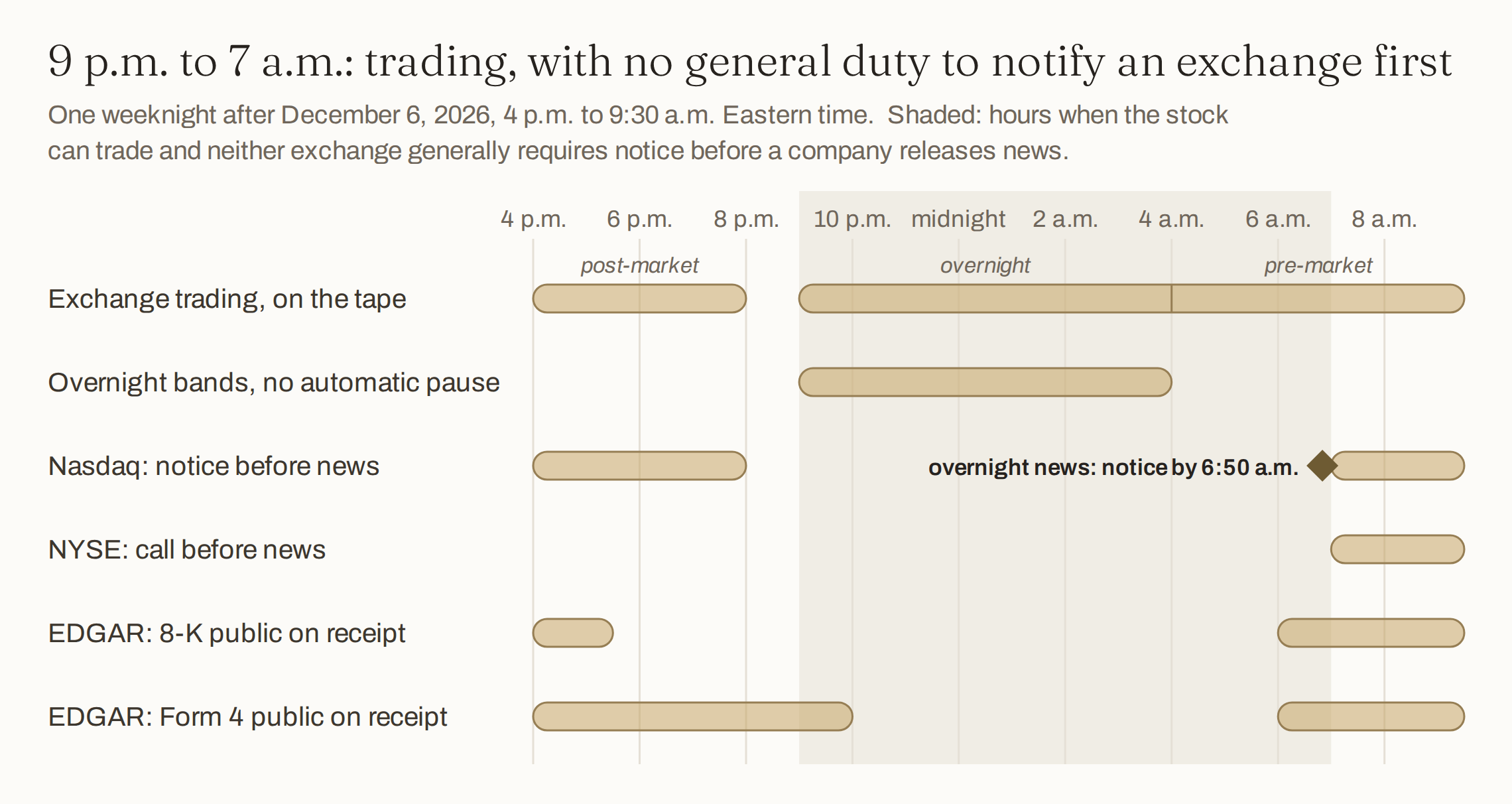
The exchange’s notice
Nasdaq’s rule on the disclosure of material information, IM-5250-1, requires a listed company to notify the exchange’s MarketWatch Department before releasing certain material news, “at least ten minutes prior to public announcement of the news,” when the release is made between 7:00 a.m. and 8:00 p.m.⁹ For a release outside that window, the requirement is lighter: The company “must notify MarketWatch of the material information prior to 6:50 a.m. ET.”⁹ Nasdaq revisited this passage in the Night Session filing. It replaced the words “market hours” with “7:00 a.m. to 8:00 p.m.” and described the edit as “a non-substantive, clarifying change.”¹
The 6:50 a.m. deadline fits a market in which Nasdaq does not trade between 8:00 p.m. and 4:00 a.m. (Nasdaq’s Day Session begins at 4:00 a.m., so, even without the Night Session, a stock can trade for nearly three hours before the notice for an overnight release falls due.)¹ From December 6, a Nasdaq-listed company that releases news at 10:00 p.m. on a Tuesday can meet the rule by notifying MarketWatch at 6:45 the next morning, after the stock has been open to trading, on whichever venues are operating overnight, for the better part of nine hours.
The New York Stock Exchange sets a narrower window. Its 2026 compliance guidance memo to listed companies, dated January 27, states that companies are required to call the exchange’s Market Watch Group “when intending to release material news between 7:00 a.m. ET and the end of the NYSE trading session (4:00 p.m. ET),” and that outside those hours “companies are generally not required to call the Exchange in advance.”¹⁰ (The memo still asks for a copy of material news once it is disclosed, and it states that at least ten minutes’ notice is required before any dividend or stock distribution announcement, “including when it is made outside of Exchange trading hours.”)¹⁰ A Nasdaq-listed company releasing news at 6:00 p.m. therefore still owes its exchange ten minutes’ notice, since 6:00 p.m. falls inside Nasdaq’s window, while an NYSE-listed company releasing the same news at the same hour generally has no call to make. The memo also sets out when the exchange halts a stock for pending news. From 9:25 a.m. to 4:00 p.m., its practice is to halt trading if it believes the news is material and the company has not yet disclosed it in compliance with the exchange’s policy, and, from 7:00 a.m. to 9:25 a.m., it will implement a news-pending halt “only at the request of the company.”¹⁰ The memo’s description of halt practice does not cover the hours from 4:00 p.m. to 7:00 a.m.
The halt power survives the night. Under the amendment as the approval order describes it, a stock’s primary listing exchange “may declare a Regulatory Halt when warranted to maintain a fair and orderly market,” including when “the price bands are otherwise limiting price discovery.”⁸ Nasdaq told the Commission that its staff “will be available during the proposed Night Session in order to maintain a fair and orderly market.”¹ A halt at night, however, is a different instrument from a halt at 11:00 in the morning. The plan participants wrote: “Without confidence in the standard method of reopening trading following a halt, and without sufficient information to create a different method, the Participants believe that it is in the best interests of the market not to reopen trading following a halt in the overnight session.”⁷ An overnight halt therefore ends trading in that stock for the rest of the overnight session, and it can come before any trading on the news only if the exchange knows the release is coming. On the notice rules as they stand, a Nasdaq-listed company need not tell it before 6:50 the next morning, and an NYSE-listed company generally need not call in advance at all.
In a rule change filed on June 29, 2026, and operative when 23/5 trading begins, NYSE Arca amended its halt rule for securities it lists that are the subject of a corporate action (a split, a symbol change, a spin-off, or a merger, among others).¹¹ Under the amended rule, such a security is halted before 9:00 p.m. on the evening before the action takes effect and resumes trading with an auction at 8:00 a.m.¹¹ NYSE Arca’s stated reason was that “[u]nder 23/5 Trading, however, the Exchange’s non-trading window will be reduced to a one-hour pause,” and the exchange “will no longer have a substantial non-trading window during which it can process such corporate actions without potentially impacting ongoing trading.”¹¹ It added that it understands the other primary listing exchanges plan to implement substantially identical versions of the rule.¹¹ That filing concerns the processing of corporate actions and does not mention material news. It does show a listing exchange treating the loss of the overnight window as a reason to write a rule.
For news, the written protection runs to the customer. FINRA Rule 2265 requires a broker to give a customer a risk disclosure statement before permitting extended-hours trading, and the required text on news announcements reads: “Normally, issuers make news announcements that may affect the price of their securities after regular trading hours. Similarly, important financial information is frequently announced outside of regular trading hours. In extended hours trading, these announcements may occur during trading, and if combined with lower liquidity and higher volatility, may cause an exaggerated and unsustainable effect on the price of a security.”¹² Nasdaq’s rules add a disclosure specific to the Night Session.¹ The effect is that the risk of trading into news the listing exchange had no advance notice of has been assigned to the person placing the order, in a statement furnished before that person’s first extended-hours trade.
The price bands
The overnight protections are set out in the twenty-seventh amendment to the National Market System Plan to Address Extraordinary Market Volatility (the limit up-limit down plan), which establishes temporary overnight price bands and which the Commission approved on August 5, 2026.⁸ Every trading center in NMS stocks that operates overnight must maintain written policies and procedures “reasonably designed to prevent both trades and the display of prices outside the Overnight Price Bands during Overnight Protected Hours,” which run from 9:00 p.m. to 4:00 a.m. on Sunday through Thursday nights.⁷ ⁸ The bands are static for the night.⁴ They are set from two reference prices, the listing market’s official closing price and the consolidated last round-lot sale as of 7:45 p.m., with the lower band 20 percent below the lower of the two and the upper band 20 percent above the higher.⁷ ⁸
Two features matter to anyone reading an overnight print after a release. The first is that neither reference price can reflect news released after 7:45 p.m. A release at 9:15 p.m. reaches a market whose limits were set by the close and by the last sale as of 7:45, so, if the news would justify a move of 35 percent, the overnight market cannot show it, and trades can print only at or inside a band drawn before anyone had read the release. After news, a print at the band’s edge shows where the limit sat.
The second is that nothing pauses. During regular hours, the plan backs its bands with automatic trading pauses. Overnight, under the amendment as the approval order describes it, “[t]here will not be automatic Trading Pauses during the Overnight Protected Hours if an Overnight Price Band is hit.”⁸ The participants explained the choice by reference to the “distinct characteristics of overnight trading, including significantly reduced liquidity, lower trading volumes, and fewer active market participants relative to Regular Trading Hours,” and noted that alternative trading systems do not pause either (they “simply reject orders that fall outside their bands”).⁷
The liquidity point shows up in the Commission staff’s own figures. In August 2026, the ten most active stocks in the overnight session accounted for 43.4 percent of its share volume on an average trade date, while the ten most active during regular trading hours accounted for 10.3 percent of regular-hours volume.³ Outside the most active names, an overnight print after news may rest on little volume.
At 4:00 a.m. the bands come off. The participants chose that hour to accommodate pre-market releases, intending “for market participants to be able to incorporate newly disclosed information into securities prices without the constraints of pricing bands based on the prior day’s activity.”⁷ The design suits a company that releases its results at 6:30 in the morning. When the release comes at 9:15 the night before, the stock will have spent nearly seven hours either trading inside limits drawn before the news or, if its listing exchange halted it, not trading at all, and it can trade free of those limits only after 4:00 a.m.
On the tape for Nasdaq-listed stocks, trades that print outside 9:30 a.m. to 4:00 p.m. will carry the “.T” designation.² Anyone using overnight prices to mark a position or to measure the market’s reaction to a disclosure should filter for that flag and check where the band sat when the trade printed.
EDGAR’s hours
Under Rule 13 of Regulation S-T, a filing transmitted to EDGAR after 5:30 p.m. Eastern is “deemed filed as of the next business day.”¹³ EDGAR’s guidance describes the practical effect: Most such submissions receive a filing date of 6:00 a.m. the next business day “and will not be disseminated by EDGAR until the next business day.”¹⁴
The main exception is for insiders, whose Forms 3, 4, and 5 and Form 144 (with their amendments), if transmitted after 5:30 p.m. and before 10:00 p.m., keep the date on which they were sent and are disseminated that evening.¹³ ¹⁴ Rule 13 gives Schedules 13D and 13G the same-day filing date until 10:00 p.m. as well, although EDGAR’s guidance does not list them among the forms disseminated that evening.¹³ ¹⁴ Once the overnight session opens, the insider exception produces an odd sequence. A director’s Form 4 transmitted at 9:00 p.m. reaches the public the same night. A Form 8-K the company transmits at 9:00 p.m. is not disseminated by EDGAR until the next business day, and the stock trades in between.
A company that pairs a filing with a press release on a newswire has put the information out when the wire runs, and Regulation FD permits that route, allowing a company to use, in place of a Form 8-K, a method “reasonably designed to provide broad, non-exclusionary distribution of the information to the public.”¹⁵ The first method the regulation names for public disclosure, however, is “furnishing to or filing with the Commission a Form 8-K … disclosing that information.”¹⁵ For a company that relies on the 8-K alone, the filing rules give a 9:00 p.m. submission the next business day’s date, and EDGAR does not disseminate it until then. Regulation FD counts hours in its definition of “promptly” (no later than “the later of 24 hours or the commencement of the next day’s trading on the New York Stock Exchange”), but it does not say at what hour a disclosure made by filing has occurred.¹⁵
Commissioner Hester M. Peirce raised the EDGAR question at the Commission’s roundtable on 24-hour trading on September 17, asking whether, “since filings submitted to EDGAR after 5:30 pm are typically not processed until the next business day,” the Commission needs “to modify the EDGAR system to ensure that corporate actions and material information are disseminated timely in the overnight session.”¹⁶ In the same remarks she observed that issuers “make filings and publicize material information either prior to or soon after ‘core’ trading hours to mitigate the real-time effect that information will have on the price of their stock,” and asked whether the change to extended-hours trading will “require issuers to change their behavior.”¹⁶ Buxton Helmsley found no answer to either question from the Commission as of the date of this piece.
For a reader reconstructing when the market learned something, EDGAR’s filing date can postdate the disclosure by a full night of trading. The newswire timestamp, where there is one, is the better record, and the Forms 4 filed the same evening may put insiders’ transactions in front of the market before the company’s own 8-K reaches it.
The insider trading policy
Item 408(b) of Regulation S-K requires a company that has adopted insider trading policies and procedures to file them as an exhibit, which puts the rules a company sets for its own insiders’ trading into the public record.¹⁷ Many of those policies make insiders wait a set number of full trading days after the company releases news before they trade. An EDGAR full-text search run on September 28, 2026, across annual reports on Form 10-K filed since January 1, returned 554 documents containing both “full trading day” and “insider trading policy.”¹⁸ Neither of the two quoted below defines the term.
Prologis, Inc.’s insider trading policy, dated December 3, 2025, states that “[e]ven after information has been made public, generally one (1) full trading day must elapse for the news to be absorbed by the market and investors before you may trade or disclose information to others.”¹⁹ Weatherford International plc’s policy, revised December 17, 2025, explains the term by example: “[I]f Weatherford’s earnings release is before the opening of the market on Monday, assuming the Insider does not otherwise possess inside information at such time, a securities transaction could be made on Tuesday. Alternatively, if Weatherford’s earnings release is after the closing of the market on Monday, assuming the Insider does not otherwise possess inside information at such time, a securities transaction could be made on Wednesday.”²⁰
Neither policy is wrong, and the Weatherford example is useful because it states the assumption plainly: A trading day has an opening and a closing, and news arrives either before the one or after the other. After December 6, the hours “after the closing of the market on Monday” will include an overnight session on registered exchanges.
The Commission’s staff and FINRA have already decided, for their own purposes, where those hours belong. The staff memorandum for the September roundtable, which calls its sessions “methodological constructs,” defines the overnight session as the executions between 8:00 p.m. “on the calendar day preceding Regular Trading Hours” and 4:00 a.m. on the day they begin.³ FINRA’s rule change for December states that “transactions executed after 8:00 p.m. on a Calendar Day will be considered to have a Trade Date of the next Calendar Day.”⁶ Both assign Monday night’s trading to Tuesday. Apply that allocation to a release at 9:15 p.m. on a Monday, and the Weatherford example can give a different answer from the one it gives today. If Tuesday’s trading day begins at 9:30 a.m., the release came before the opening, Tuesday is the full trading day, and an insider could trade on Wednesday. If Tuesday’s trading day began when the overnight session opened at 9:00 p.m. on Monday, the release came after the opening, Tuesday is not a full trading day, and the answer moves to Thursday. The policy does not say which reading applies, and it had no reason to when it was last revised.
Either reading can be defended from the text. A board that wants its policy to mean the later date has to say so, because an insider who sells on the Wednesday after a 9:15 p.m. Monday release will have followed one reasonable reading of a policy the company filed with the Commission.
The same assumption shapes when companies release news in the first place. Commissioner Peirce’s observation that issuers publicize material information before or soon after core hours “to mitigate the real-time effect” describes a practice that rests on the market being quiet after the release.¹⁶ After December 6, a company that releases material news after 9:00 p.m. on any night from Sunday through Thursday will be releasing into an overnight session with static bands and no automatic pauses, whether or not it has planned for one.
Before December 6
The first consequence is for trading desks. A manager whose orders can execute overnight, directly or through a broker’s algorithm, should know which venues are in the routing and whether its own procedures treat an overnight fill after news any differently from a fill at 10:00 in the morning. It should not mark a position to an overnight price (or read that price as the market’s verdict on a disclosure) without checking where the band sat.
The second is for stewardship. Before December 6, an institutional investor can reasonably ask each company in its portfolio whether it intends to release material news while the overnight session is open, and whether it will call its listing exchange first even where the exchange’s rules do not require advance notice. It can ask whether the company will pair every evening filing with a wire release, so that a submission EDGAR will not disseminate until the next business day is never the only disclosure. And it can ask how the company’s filed insider trading policy will count a trading day once the stock can trade overnight, and whether the board will amend the policy before the fourth-quarter reporting season in early 2027.
The third is for anyone who reads disclosure forensically. After December 6, any gap between the time a disclosure reached the market and the filing date EDGAR assigns to it may contain hours of trading. The records worth keeping are the newswire timestamp, the insider trading policy as filed, and the Forms 4 that, under EDGAR’s rules, reach the public on the evening they are transmitted, while an 8-K transmitted at the same hour waits for the next business day.¹⁴
Some of this may change before the first overnight session. Nasdaq has yet to make the filing that starts its Night Session (Buxton Helmsley found none as of the date of this piece), and that filing would be a natural place to revisit IM-5250-1.¹ The Commission has Commissioner Peirce’s questions in front of it, and the NYSE can revise its guidance to listed companies at any time.¹⁶ Buxton Helmsley would welcome each of those changes and will read the first overnight releases against the tape whether or not they are made.
Related reading
Optimum’s Rate Reconciliation Treated a Franchise Impairment the Way It Treated Goodwill
The SEC Would Stop Asking Whether a Private Fund’s Auditor Is Subject to PCAOB Inspection
The Repurchase Safe Harbor and a Trading Day That Begins the Night Before
Referenced Sources:
[1] U.S. Securities and Exchange Commission, Self-Regulatory Organizations; The Nasdaq Stock Market LLC; Notice of Filing of Amendment Nos. 2 and 3 and Order Granting Accelerated Approval of a Proposed Rule Change, as Amended by Amendment Nos. 2 and 3, To Extend the Exchange’s Trading Hours to 23 Hours a Day, Five Days a Week, Release No. 34-105199, File No. SR-NASDAQ-2025-109 (April 10, 2026), published at 91 FR 20222 (April 15, 2026) (primary; supports the Day Session’s 4:00 a.m. start and the Night Session’s hours, the further rule change required before the Night Session may begin, and the eighteen-month withdrawal requirement (91 FR 20224 and n.26); Nasdaq’s statements on customer disclosures and on staff availability during the Night Session (91 FR 20227 n.68); and the replacement of “market hours” in IM-5250-1, described as a non-substantive, clarifying change (91 FR 20230 n.92)).
[2] U.S. Securities and Exchange Commission, Joint Industry Plan; Order Approving the Fifty-Fifth Amendment to the Joint Self-Regulatory Organization Plan Governing the Collection, Consolidation and Dissemination of Quotation and Transaction Information for Nasdaq-Listed Securities Traded on Exchanges on an Unlisted Trading Privileges Basis, as Modified by Amendment No. 1 Thereto, Release No. 34-105780, File No. S7-24-89 (June 26, 2026) (primary; supports the processor’s hours from 9:00 p.m. Sunday to 8:00 p.m. Friday and the one-hour pause on Monday through Thursday (p. 2), the “.T” designation for trades reported outside 9:30 a.m. to 4:00 p.m. (p. 5), and expected implementation on December 6, 2026 (p. 7); page references are to the Commission’s copy).
[3] Staff of the Office of Analytics and Research, Division of Trading and Markets, U.S. Securities and Exchange Commission, memorandum to File No. 4-913, Roundtable on Preparations for 24-Hour Trading Supporting Data (September 10, 2026) (primary; supports the August 2026 overnight volume figures and the ten-stock concentration figures (p. 2), the description of its trading sessions as methodological constructs and the definition of the overnight session (p. 3), the treatment of Sunday-evening trades as trades on a non-business day that are withheld from public dissemination (p. 4 n.2), and the expected December 6, 2026 schedule for both processors (p. 14)).
[4] New York Stock Exchange, Extended-Hours FAQs, version 4.0 (August 2026) (primary; supports NYSE Arca’s planned launch of extended-hours trading on December 6, 2026, the conditions attached to it, and the hours of the overnight session (p. 1), and the static 20 percent overnight price bands (p. 4)).
[5] U.S. Securities and Exchange Commission, Self-Regulatory Organizations; The Nasdaq Stock Market LLC; Notice of Filing and Immediate Effectiveness of Proposed Rule Change To Amend Exchange Rule Equity 7 Regarding Pricing of Ports for the Night Session, Release No. 34-106319, File No. SR-NASDAQ-2026-073 (September 10, 2026), published at 91 FR 58517 (September 15, 2026) (primary; supports the planned launch of Night Session trading on or about December 6, 2026 (91 FR 58518)).
[6] FINRA, Regulatory Notice 26-07, “FINRA Adopts Amendments to the Equity Trade Reporting Rules to Provide a Limited Exception for Overnight Transactions Prior to 8:00 a.m. Eastern Time” (March 9, 2026) (primary; supports the 4:00 a.m. opening of the trade reporting facilities from March 30, 2026, and the 4:15 a.m. deadline for trades executed while they are closed). U.S. Securities and Exchange Commission, Self-Regulatory Organizations; Financial Industry Regulatory Authority, Inc.; Notice of Filing and Immediate Effectiveness of a Proposed Rule Change To Amend the FINRA Rule 6300 Series (Trade Reporting Facilities) To Extend the Trade Reporting Facilities Operating Hours to 23 Hours Per Day, Five Days Per Week, Release No. 34-105922, File No. SR-FINRA-2026-015 (July 15, 2026), published at 91 FR 45299 (July 20, 2026) (primary; supports the extended hours of the trade reporting facilities (91 FR 45299), the December 6, 2026 implementation date (91 FR 45300, 45303), the assignment of trades executed after 8:00 p.m. to the next calendar day’s trade date (91 FR 45301), and real-time reporting and public dissemination of over-the-counter trades in the newly covered hours (91 FR 45305–06)).
[7] U.S. Securities and Exchange Commission, Joint Industry Plan; Notice of Filing of the Twenty-Seventh Amendment to the National Market System Plan To Address Extraordinary Market Volatility To Establish Temporary Price Band Protections in Overnight Trading, Release No. 34-105596, File No. 4-631 (June 1, 2026), published at 91 FR 33774 (June 4, 2026) (primary; supports the reference prices and band widths, the requirement that trading centers maintain policies and procedures reasonably designed to prevent trades and the display of prices outside the bands, and the choice of 4:00 a.m. to accommodate pre-market releases (91 FR 33776); the statement that material information is frequently disseminated after the close (91 FR 33777); and the participants’ reasons for omitting automatic pauses, the practice of alternative trading systems, and the decision not to reopen trading after an overnight halt (91 FR 33777–78)).
[8] U.S. Securities and Exchange Commission, Joint Industry Plan; Order Granting Approval of the Twenty-Seventh Amendment to the National Market System Plan To Address Extraordinary Market Volatility To Establish Temporary Price Band Protections in Overnight Trading, Release No. 34-106042 (August 5, 2026), published at 91 FR 51515 (August 10, 2026) (primary; supports the overnight protected hours (91 FR 51515) and the reference prices and band widths (91 FR 51515–16); and, in the Commission’s description of the amendment, the absence of automatic trading pauses and the primary listing exchange’s authority to declare a regulatory halt, including where the bands are limiting price discovery (91 FR 51516)).
[9] The Nasdaq Stock Market LLC Rules, IM-5250-1, Disclosure of Material Information (current text, as amended by the rule change approved on April 10, 2026) (primary; supports the ten-minute advance notice requirement for certain material news released from 7:00 a.m. to 8:00 p.m. and the 6:50 a.m. deadline for news released outside those hours).
[10] NYSE Regulation, Annual Listed Company Compliance Guidance for NYSE Issuers, memorandum to NYSE listed companies (January 27, 2026) (primary; supports the call window under the Timely Alert/Material News Policy, the statement that companies are generally not required to call outside it, the request for a copy of material news, and the notice requirement for dividend and stock distribution announcements (p. 5); and the exchange’s halt practice (p. 6)).
[11] U.S. Securities and Exchange Commission, Self-Regulatory Organizations; NYSE Arca, Inc.; Notice of Filing and Immediate Effectiveness of Proposed Rule Change To Amend Rule 7.18-E Regarding Regulatory Halts for Corporate Actions and Issuer-Related Events, Release No. 34-105862, File No. SR-NYSEARCA-2026-71 (July 8, 2026), published at 91 FR 42999 (July 13, 2026) (primary; supports the filing date of June 29, 2026, and the other primary listing exchanges’ plans to implement substantially identical versions of the rule (91 FR 42999); the stated reason for the rule, the listed corporate actions, and the 8:00 a.m. auction (91 FR 43000); the halt before 9:00 p.m. (91 FR 43000–01); and the operative date (91 FR 43002)).
[12] FINRA Rule 2265, Extended Hours Trading Risk Disclosure (primary; supports the requirement to furnish a risk disclosure statement before permitting a customer to engage in extended hours trading and the required text on the risk of news announcements).
[13] 17 CFR 232.13(a)(2) and (a)(4) (Regulation S-T, Rule 13) (primary; supports the next-business-day filing date for filings transmitted after 5:30 p.m. and the same-day filing date, for submissions commencing on or before 10:00 p.m., for Forms 3, 4, and 5, Form 144, and Schedules 13D and 13G).
[14] U.S. Securities and Exchange Commission, “Determine the Status of My Filing,” EDGAR filer support resources (primary; supports the 6:00 a.m. filing date and next-business-day dissemination for most submissions transmitted after 5:30 p.m., and the list of submission types disseminated until 10:00 p.m. on the day transmitted, which does not include Schedules 13D and 13G).
[15] 17 CFR 243.100(a), 243.101(d), and 243.101(e) (Regulation FD) (primary; supports public disclosure by Form 8-K, the alternative of a method reasonably designed to provide broad, non-exclusionary distribution, and the definition of “promptly”).
[16] Commissioner Hester M. Peirce, U.S. Securities and Exchange Commission, “Stock Around the Clock: Remarks at the Roundtable on Preparations for 24-Hour Trading” (September 17, 2026) (primary; supports the quoted observation and questions).
[17] 17 CFR 229.408(b) (Item 408(b) of Regulation S-K) (primary; supports the requirement to file insider trading policies and procedures as an exhibit).
[18] EDGAR full-text search for documents containing both “full trading day” and “insider trading policy,” limited to Form 10-K filings made from January 1 through September 27, 2026, run by Buxton Helmsley on September 28, 2026 (primary; supports the count of 554 documents, which may change as filings are added).
[19] Prologis, Inc., Policy Governing Material, Non-Public Information and the Prevention of Insider Trading (dated December 3, 2025), filed as Exhibit 19.1 to the Annual Report on Form 10-K filed on February 13, 2026 (primary; supports the quoted provision and the absence of any definition of “trading day”).
[20] Weatherford International plc, Insider Trading Policy (revision date December 17, 2025), filed as Exhibit 19 to the Annual Report on Form 10-K filed on February 4, 2026 (primary; supports the quoted example and the absence of any definition of “trading day”).
This publication is one of the Insights commentaries of Buxton Helmsley USA, Inc. (“Buxton Helmsley”). It reflects the opinions, analysis, and interpretations of Buxton Helmsley as of the date of publication, and it is based upon information that Buxton Helmsley believes to be accurate and that is derived from public sources or from other sources believed to be reliable. Buxton Helmsley does not represent or warrant that such information is accurate or complete, and it should not be relied upon as such. The views expressed are subject to change at any time, and Buxton Helmsley undertakes no obligation to update this publication or to correct any information contained within it.
Except for statements expressly attributed to an identified source or to a public filing, the statements in this publication constitute the opinions and good-faith analysis of Buxton Helmsley and are not statements of objective fact. Buxton Helmsley’s analysis may rest upon assumptions, estimates, and interpretations that could prove to be incorrect. Any reference to a potential violation, misstatement, impropriety, or deficiency reflects Buxton Helmsley’s analytical conclusions and opinions, and does not represent a finding by any court, regulator, or other authority. Readers should conduct their own investigation and analysis of any company, security, or matter discussed. Any company or person referenced that believes any statement in this publication to be inaccurate is invited to contact Buxton Helmsley at general@buxtonhelmsley.com, and Buxton Helmsley will give good-faith consideration to any correction supported by credible evidence.
This publication is provided for informational purposes only. It does not constitute, and should not be construed as, investment advice, a recommendation, or the provision of any individualized investment advisory service to any person, nor an offer or solicitation to buy, sell, or hold any security. Nothing in this publication takes into account the particular investment objectives, financial situation, or needs of any reader. No reader should construe this publication as creating any advisory, fiduciary, or other relationship between Buxton Helmsley and such reader. Readers should consult their own legal, tax, accounting, and financial advisers before making any investment decision.
As of the date of this publication, Buxton Helmsley, the funds and accounts that it manages or advises, and its principals hold no position in the securities of the companies mentioned in the article. Buxton Helmsley and the foregoing persons may, at any time and without further notice, purchase, sell, cover, or otherwise change any position in any security discussed in this publication, including in a manner inconsistent with the opinions expressed herein, for various reasons, including but not limited to new research discoveries. Buxton Helmsley may realize gains in the event that the price of any security discussed moves in a direction consistent with a position that it holds.
Buxton Helmsley has not received, and will not receive, any compensation from any third party—including any issuer discussed in this publication or any person holding an interest in any such issuer—in connection with the preparation or publication of this commentary, except as expressly disclosed in this publication. Buxton Helmsley was not engaged or compensated by any third party to publish this commentary, except as expressly disclosed in this publication.
This publication is not, and shall not be construed as, an offer to sell or a solicitation of an offer to buy any security or any interest in any fund or other investment vehicle managed or advised by Buxton Helmsley or any of its affiliates, nor is it an advertisement for any such fund, vehicle, or advisory service. Any such offer or solicitation will be made only by means of definitive offering documents, and only to eligible investors, in accordance with applicable law.
This publication is intended only for distribution to, and use by, persons in the United States. It is not directed to, intended for, or to be relied upon by, any person located in any jurisdiction outside the United States, and it does not constitute an offer, solicitation, or provision of any service in any such jurisdiction. Persons who access this publication from outside the United States do so on their own initiative and are responsible for compliance with the laws applicable to them.
This publication may contain forward-looking statements that reflect Buxton Helmsley’s current expectations and that are subject to risks and uncertainties that could cause actual results to differ materially from those expressed. Past performance is not indicative of, and does not guarantee, future results. No representation is made that any investment will achieve, or is likely to achieve, results comparable to those discussed.
To the fullest extent permitted by applicable law, neither Buxton Helmsley nor any of its affiliates, nor their respective principals, members, officers, employees, or agents, shall have any liability to any person for any direct, indirect, incidental, consequential, or other loss or damage arising from any use of, or reliance upon, this publication or any information contained within it.
If any provision of these disclosures is held to be invalid or unenforceable, the remaining provisions shall continue in full force and effect.
© 2026 Buxton Helmsley USA, Inc. All rights reserved. This publication may not be reproduced or redistributed, in whole or in part, without attribution to Buxton Helmsley.