Under the SEC’s Cross-Trading Proposal, a Fund’s Own Valuation Could Set the Price
- Published
- October 23, 2026
- Reading time
- 10 min
On October 9, 2026, the Securities and Exchange Commission proposed amendments to Rule 17a-7 under the Investment Company Act of 1940.² ³ The Commission adopted the rule “to eliminate the need to file and process exemptive applications” for certain cross trades between a registered fund and its affiliates “(including affiliated registered funds and others who share a common investment adviser).”¹ The release says that fixed-income securities cross-traded under the rule before the adoption of Rule 2a-5 “generally have not been eligible for cross trading since September 8, 2022,” the compliance date of that valuation rule.¹ The proposal would make eligible any security whose fair value measurement is categorized as level 1 or level 2 in the U.S. GAAP fair value hierarchy. It would also replace the rule’s formulas for the price of a cross trade with two methods, one tied to the fund’s own valuation and one determined by its investment adviser.¹ ³
The release lists examples of possible cross-trading abuses. One is “dumping,” which it describes as a practice “where less desirable investments are cross traded to a less favored client,” and the footnote attached to it cites one case, the Commission’s settled order of September 19, 2024, against Macquarie Investment Management Business Trust (MIMBT).¹ ⁴ The label is the release’s, and the order does not use it. In the order, to which MIMBT consented without admitting or denying the findings, the Commission found that MIMBT priced small bond positions at a pricing vendor’s marks intended for larger ones, and that on July 30, 2018, internal cross trades moved such positions into registered funds at prices above independent current market prices.⁴ Read against the release, the order helps locate where the proposal would place the protection that the current rule puts in its price formulas.
The price the rule requires now
A cross trade qualifies under the current rule only if, among other conditions, the security “has readily available market quotations,” the price is “the independent current market price of the security as prescribed in the rule,” no brokerage commission or other remuneration is paid beyond customary transfer fees, and the trade is consistent with the policy of each participating fund.¹ For a security traded over the counter, the prescribed price is “the average of the highest current independent bid and lowest current independent offer determined on the basis of reasonable inquiry.”¹
Rule 2a-5, adopted in December 2020, narrowed the first condition. Under it, a market quotation is readily available only if it is “a quoted price (unadjusted) in active markets for identical investments that the fund can access at the measurement date,” and only if it is reliable.¹ The release says that definition is consistent with the definition of a level 1 input in the GAAP hierarchy, and that fixed-income securities are typically classified as level 2.¹ It cites a letter from the Investment Company Institute dated April 9, 2021, for an industry estimate that registered funds cross-traded more than $200 billion of fixed-income securities in 2020, with estimated savings to the funds and their shareholders of over $300 million.¹
The two prices the proposal would allow
Under the proposal, a fund could price a cross-trade in either of two ways, and it could use different methods for different trades.¹ Under the first, the trade “would be effected at the value the registered fund ascribes to the security in its next computation” of net asset value on the business day of the trade.¹
Under the second, a cross trade could be effected “at a price determined by the registered fund’s investment adviser to reasonably represent current market price for the security using one or more unaffiliated pricing sources,” provided that the adviser periodically reviews the reasonableness of those prices.¹ The release says funds “already use various unaffiliated pricing sources, such as pricing services that provide evaluated prices by using matrix or model-based pricing methodologies,” and that an adviser considering prices from a pricing service should conduct due diligence on the service and its methodologies.¹ It does not prescribe a method or a frequency for the adviser’s review of its prices, which it says “would be established by the investment adviser and should be specific to the circumstances of the registered fund’s cross trading.”¹
The Macquarie order
MIMBT, a registered investment adviser based in Philadelphia and an indirect wholly owned subsidiary of Macquarie Group Limited, was adviser or sub-adviser to twenty accounts with exposure to some or all of the investments of a mortgage-backed securities strategy. Eleven of the accounts were registered investment companies (which the order calls RICs), and nine were unregistered vehicles.⁴ ⁵ The positions at issue were interest-only and inverse interest-only bonds (which the order calls IOs) and last-cash-flow bonds from collateralized mortgage obligations, many held in odd lots, and the order says odd lots of those bonds “typically traded at a significant discount to round lot positions.”⁴ MIMBT priced them at a pricing vendor’s bid-side evaluations, which represented the vendor’s expectation of what a holder would receive for “an institutional round lot position under current market conditions.”⁴ According to the order, the vendor “specifically disclosed that it did not provide separate evaluations for odd lot positions.”⁴ The order found that MIMBT “improperly priced odd lot Relevant CMOs at Pricing Vendor Marks that were intended only for round lot positions,” and that at certain times this overstated the net asset value of the RICs by at least $0.01 per share.⁴
During 2017 and 2018, MIMBT met part of the redemption requests of unregistered vehicles by cross-trading odd lots with other accounts, primarily the RICs.⁴ On July 30, 2018, MIMBT sold 134 IO positions out of one redeeming vehicle through approximately 450 internal cross trades with the RICs, and nearly 80 percent of those trades involved positions valued at less than $100,000.⁴ The order states: “All cross trades were executed above independent current market prices.”⁴ It found that the RICs absorbed losses the redeeming vehicles would otherwise have borne in a market sale, and that none of the cross trades it described involving the RICs, whether internal or routed through broker-dealers, complied with Rule 17a-7.⁴
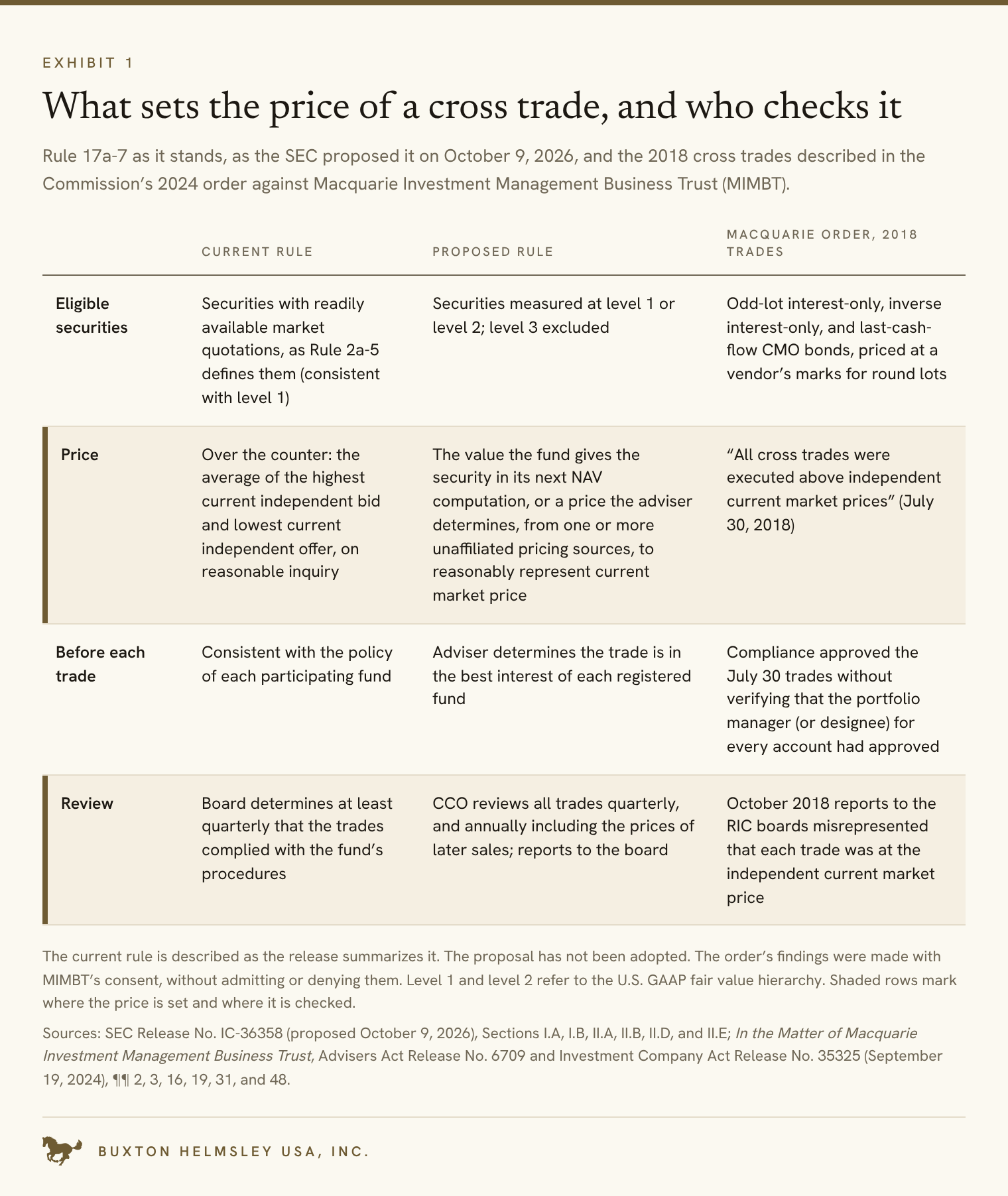
The quarterly compliance reports MIMBT gave the RIC boards in October 2018 represented that each cross-trade in the quarter had been effected at the independent current market price of the security.⁴ The order found that the reports misrepresented this, and that they did not disclose that hundreds of the internal cross trades had been made with the redeeming vehicles in odd lots “that could not be sold in the open market at Pricing Vendor Marks.”⁴ The order, among other things, censured MIMBT, ordered it to cease and desist, and imposed a civil penalty of $70 million and disgorgement and prejudgment interest of about $9.8 million.⁴ ⁵ ⁶ Exhibit 1 sets the current rule, the proposal, and the order side by side.
Exhibit 1. What sets the price of a cross trade, and who checks it
Where the protection would sit
Under the current rule, the price of an over-the-counter cross trade is fixed by a formula built from independent bids and offers, and the board must determine at least quarterly that the trades complied with the fund’s procedures.¹ The order describes the RIC cross trades as subject to that price requirement, and it found that they were not executed at independent current market prices.⁴ Under the proposal, the price would come from the fund’s valuation or from the adviser’s judgment applied to unaffiliated sources. The release says the first method draws on a fund’s own valuation processes, which are already subject to board oversight, and that those processes and controls “would decrease the likelihood of inappropriate values for cross trading purposes.”¹ The valuations the Macquarie order found overstated were vendor marks for round lots applied to odd lots.⁴ The documents do not say how the proposal would have applied to the 2018 trades, including whether those positions would have been measured at level 2, and this article does not say either.
The proposal does not rely on the price alone, and the release says the proposed rule would provide “layers of protection for investors against conflicts of interest implicated by cross trading.”¹ Before each trade, the adviser would have to determine that the trade is in the best interest of each registered fund involved, and the release says an adviser could not reach that conclusion “simply because the other conditions of the rule, including the pricing conditions, are met.”¹ It states that if an adviser “can obtain a more favorable outcome for a fund by trading in the open market (including if more favorable pricing is available in the open market), buying or selling a different security, or not transacting at all, the cross trade is not in the fund’s best interest.”¹ Among the factors the release describes is “[t]he size of the trade and the expected effect on the price of the security if that volume of securities were purchased or sold on the open market,” and it says a trade large enough to move the market price “may require a heightened level of review of price” before the adviser concludes that it is in the fund’s best interest.¹
After the trades, the fund’s chief compliance officer, instead of its board, would review all cross trades at least quarterly for compliance with the rule, and at least annually “to determine if they may have disadvantaged the registered fund relative to the eligible affiliate,” reporting the results to the board.¹ The annual review would include “the timing and price of subsequent sales of securities purchased in cross trades,” and the compliance officer could use any testing method, including sampling a selection of cross trades “to analyze and compare their disposition price to the cross-trade price.”¹ The release describes the annual review as a look at trades over a longer period, for example, to identify indicators “of parking, dumping, or cherry-picking,” and says such patterns may be more difficult to detect when trades are reviewed one at a time, at or near the time of each trade.¹ The proposal also includes conditions on fees and recordkeeping and would add aggregate reporting of cross trades on Forms N-PORT and N-MFP, which this article does not discuss.³
What to ask a manager that cross trades
For an allocator or a fund board, the proposal would turn on facts the rule text does not show. A manager that advises registered funds alongside other accounts can be asked which method it expects to use for fixed-income cross trades and, for the adviser-determined method, which unaffiliated sources it would use. Where a pricing service supplies the price, the manager can be asked whether the service evaluates positions of the size being traded; the vendor in the Macquarie order had disclosed that it did not provide separate evaluations for odd lots.⁴ And a board can ask to see the results of the compliance officer’s review of later sales, broken out by the kind of account on the other side of each trade, since in the order the selling accounts were unregistered vehicles meeting redemptions and the buyers were primarily registered funds.⁴
Comments on the proposal will be due 60 days after the release is published in the Federal Register.²
Related reading
Reading Travel + Leisure’s Loan Loss Ratio Against the SEC’s Complaint
Optimum’s Rate Reconciliation Treated a Franchise Impairment the Way It Treated Goodwill
The SEC Would Stop Asking Whether a Private Fund’s Auditor Is Subject to PCAOB Inspection
Referenced Sources:
[1] U.S. Securities and Exchange Commission, Investment Company Cross Trading, Release No. IC-36358, File No. S7-2026-36 (proposed October 9, 2026) (primary; Section I.A and footnote 5 support the quoted purpose of the rule, the description of eligible affiliates, the quoted parenthetical, and the quoted conditions of the current rule; Section I.B supports the adoption of Rule 2a-5 in December 2020, the quoted definition of readily available market quotations, its consistency with the definition of a level 1 input, the typical classification of fixed-income securities as level 2 in footnote 22, the quoted statement on eligibility since September 8, 2022, and the ICI estimate and its source in footnote 18; Section I.C and footnote 39 support the quoted description of dumping and the citation of the Macquarie order; Section II.A supports the proposed eligibility of level 1 and level 2 securities; Section II.B supports the quoted pricing standard of the current rule for securities traded over the counter, the two proposed pricing methods and the quoted language of each, the rationale for the net asset value method and the quoted statement on processes and controls, the quoted statement on pricing services and the due diligence statement, and the absence of a prescribed review method or frequency, with the quoted statement that follows it; Section II.D supports the best interest determination, the quoted statement that it cannot rest on the other conditions, the quoted statement on a more favorable outcome, the quoted factor on trade size, and the quoted statement on heightened review of price; Section II.E supports the transfer of the quarterly review from the board to the chief compliance officer, the quoted descriptions of the quarterly, annual, and later-sales reviews, the reports to the board, the quoted statement that the proposed rule would provide layers of protection, and the description of the annual review as a way to identify indicators of parking, dumping, or cherry-picking).
[2] U.S. Securities and Exchange Commission, Press Release No. 2026-104, “SEC Proposes Expanding Securities Eligible for Cross Trading by Registered Funds” (October 9, 2026) (primary; supports the date of the proposal and the comment period of 60 days after publication in the Federal Register).
[3] U.S. Securities and Exchange Commission, Fact Sheet, Investment Company Cross Trading (primary; supports the date of the proposal, October 9, 2026, the summary of its pricing, eligibility, and review provisions, and its provisions on payments, recordkeeping, and aggregate reporting on Forms N-PORT and N-MFP).
[4] In the Matter of Macquarie Investment Management Business Trust, Advisers Act Release No. 6709 and Investment Company Act Release No. 35325, Administrative Proceeding File No. 3-22144 (September 19, 2024) (primary; ¶ 1 supports the twenty accounts with exposure to the strategy, eleven RICs and nine unregistered vehicles; ¶ 2 supports the quoted definition of the Pricing Vendor Marks and the vendor’s quoted disclosure on odd lots; ¶ 3 supports the description of the positions and the quoted statement on odd-lot discounts; ¶ 9 supports MIMBT’s registration, place of business, and parent; ¶¶ 16 and 19 support the quoted finding on pricing and the overstatement of net asset value by at least $0.01 per share; ¶ 21 supports the use of cross trades, primarily with the RICs, to meet redemptions during 2017 and 2018; ¶ 23 supports the price requirement of Rule 17a-7 as the order describes it; ¶ 31 supports the July 30, 2018, trades, their number and size, the quoted statement on prices, and the losses absorbed by the RICs; ¶ 35 supports the findings that the cross trades were not executed at independent current market prices and that none of the cross trades described involving the RICs complied with Rule 17a-7; ¶¶ 48 and 49 support the October 2018 quarterly reports to the RIC boards, their representations, and the quoted statement on odd lots; Section II supports the consent without admitting or denying the findings; Section IV supports the censure, the cease-and-desist order, the civil penalty of $70,000,000, disgorgement of $7,633,671, and prejudgment interest of $2,197,535).
[5] U.S. Securities and Exchange Commission, Press Release No. 2024-140, “SEC Charges Advisory Firm Macquarie Investment Management Business Trust with Fraud” (September 19, 2024) (primary; supports the twenty advisory accounts, including eleven retail mutual funds, and the total of $79.8 million, including disgorgement and prejudgment interest of $9.8 million).
[6] Buxton Helmsley calculations, derived and not reported in the order. Disgorgement of $7,633,671 plus prejudgment interest of $2,197,535 is $9,831,206, or about $9.8 million; with the civil penalty of $70,000,000, the total is $79,831,206, consistent with the $79.8 million in the Commission’s press release.
This publication is one of the Insights commentaries of Buxton Helmsley USA, Inc. (“Buxton Helmsley”). It reflects the opinions, analysis, and interpretations of Buxton Helmsley as of the date of publication, and it is based upon information that Buxton Helmsley believes to be accurate and that is derived from public sources or from other sources believed to be reliable. Buxton Helmsley does not represent or warrant that such information is accurate or complete, and it should not be relied upon as such. The views expressed are subject to change at any time, and Buxton Helmsley undertakes no obligation to update this publication or to correct any information contained within it.
Except for statements expressly attributed to an identified source or to a public filing, the statements in this publication constitute the opinions and good-faith analysis of Buxton Helmsley and are not statements of objective fact. Buxton Helmsley’s analysis may rest upon assumptions, estimates, and interpretations that could prove to be incorrect. Any reference to a potential violation, misstatement, impropriety, or deficiency reflects Buxton Helmsley’s analytical conclusions and opinions, and does not represent a finding by any court, regulator, or other authority. Readers should conduct their own investigation and analysis of any company, security, or matter discussed. Any company or person referenced that believes any statement in this publication to be inaccurate is invited to contact Buxton Helmsley at general@buxtonhelmsley.com, and Buxton Helmsley will give good-faith consideration to any correction supported by credible evidence.
This publication is provided for informational purposes only. It does not constitute, and should not be construed as, investment advice, a recommendation, or the provision of any individualized investment advisory service to any person, nor an offer or solicitation to buy, sell, or hold any security. Nothing in this publication takes into account the particular investment objectives, financial situation, or needs of any reader. No reader should construe this publication as creating any advisory, fiduciary, or other relationship between Buxton Helmsley and such reader. Readers should consult their own legal, tax, accounting, and financial advisers before making any investment decision.
As of the date of this publication, Buxton Helmsley, the funds and accounts that it manages or advises, and its principals hold no position in the securities of the companies mentioned in the article. Buxton Helmsley and the foregoing persons may, at any time and without further notice, purchase, sell, cover, or otherwise change any position in any security discussed in this publication, including in a manner inconsistent with the opinions expressed herein, for various reasons, including but not limited to new research discoveries. Buxton Helmsley may realize gains in the event that the price of any security discussed moves in a direction consistent with a position that it holds.
Buxton Helmsley has not received, and will not receive, any compensation from any third party—including any issuer discussed in this publication or any person holding an interest in any such issuer—in connection with the preparation or publication of this commentary, except as expressly disclosed in this publication. Buxton Helmsley was not engaged or compensated by any third party to publish this commentary, except as expressly disclosed in this publication.
This publication is not, and shall not be construed as, an offer to sell or a solicitation of an offer to buy any security or any interest in any fund or other investment vehicle managed or advised by Buxton Helmsley or any of its affiliates, nor is it an advertisement for any such fund, vehicle, or advisory service. Any such offer or solicitation will be made only by means of definitive offering documents, and only to eligible investors, in accordance with applicable law.
This publication is intended only for distribution to, and use by, persons in the United States. It is not directed to, intended for, or to be relied upon by, any person located in any jurisdiction outside the United States, and it does not constitute an offer, solicitation, or provision of any service in any such jurisdiction. Persons who access this publication from outside the United States do so on their own initiative and are responsible for compliance with the laws applicable to them.
This publication may contain forward-looking statements that reflect Buxton Helmsley’s current expectations and that are subject to risks and uncertainties that could cause actual results to differ materially from those expressed. Past performance is not indicative of, and does not guarantee, future results. No representation is made that any investment will achieve, or is likely to achieve, results comparable to those discussed.
To the fullest extent permitted by applicable law, neither Buxton Helmsley nor any of its affiliates, nor their respective principals, members, officers, employees, or agents, shall have any liability to any person for any direct, indirect, incidental, consequential, or other loss or damage arising from any use of, or reliance upon, this publication or any information contained within it.
If any provision of these disclosures is held to be invalid or unenforceable, the remaining provisions shall continue in full force and effect.
© 2026 Buxton Helmsley USA, Inc. All rights reserved. This publication may not be reproduced or redistributed, in whole or in part, without attribution to Buxton Helmsley.