Optimum’s Rate Reconciliation Treated a Franchise Impairment the Way It Treated Goodwill
- Published
- October 15, 2026
- Reading time
- 20 min
On September 21, 2026, Optimum Communications, Inc., formerly Altice USA, Inc., filed a current report on Form 8-K under Item 4.02 stating that its audited financial statements for 2025, and its quarterly financial statements for the periods ended September 30, 2025, March 31, 2026, and June 30, 2026, should no longer be relied upon.¹ ² The Company said it had identified that it “inadvertently failed to recognize non-cash deferred tax benefits associated with two previous non-cash impairment charges of its indefinite-lived cable franchise rights.”¹ It expects the restatements to reduce previously reported net losses by approximately $430 million for the third quarter, the first nine months, and the full year of 2025, and by approximately $720 million for the first quarter and the first half of 2026.¹ Management expects to report a material weakness in internal control over financial reporting related to accounting for income taxes, and the Audit Committee concluded that management’s report on internal control as of December 31, 2025, and the opinion of KPMG LLP on its effectiveness, should no longer be relied upon.¹
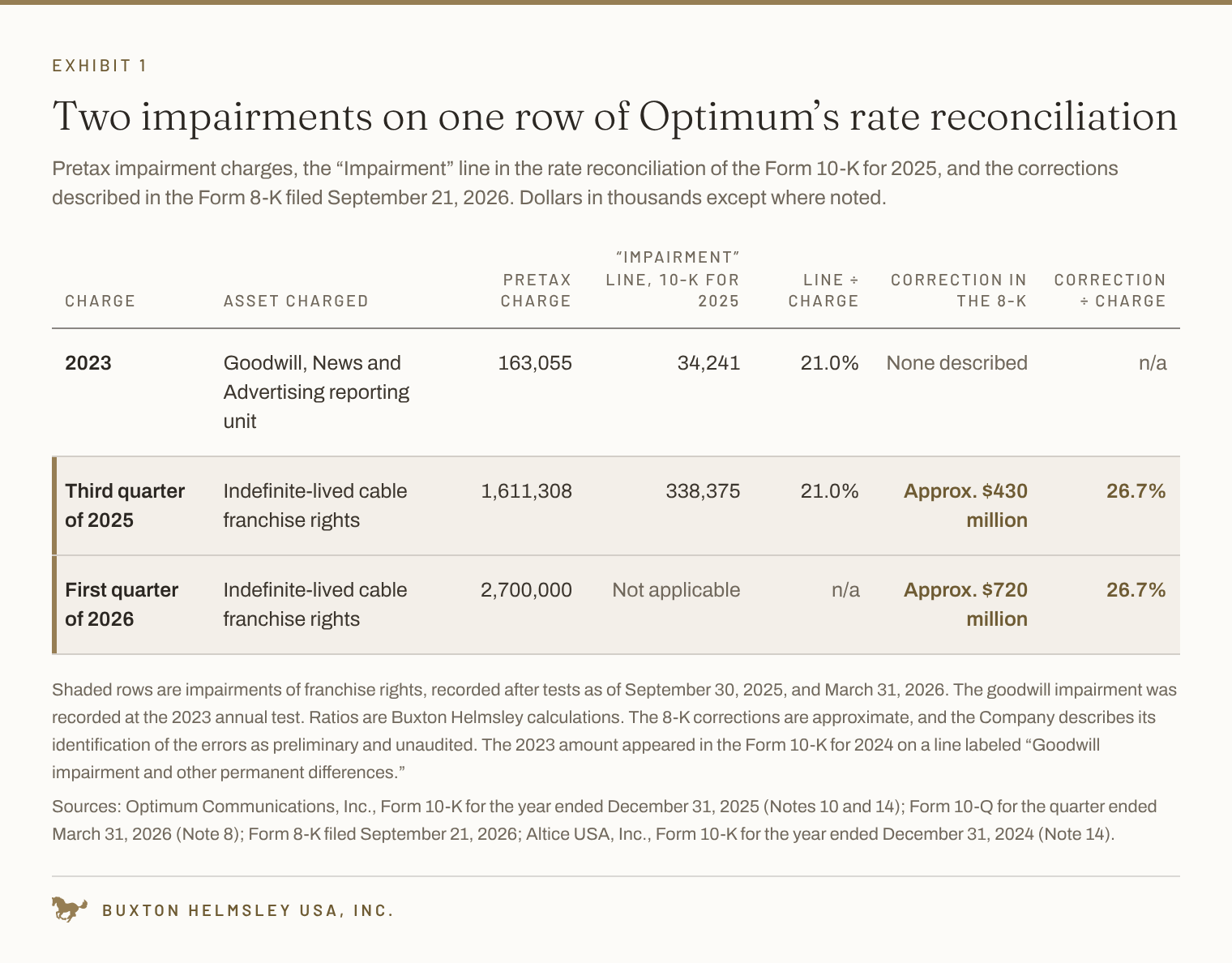
The Company says the restatements will not change its cash balances, revenue, capital expenditures, cash flows, EBITDA, or loss before income taxes.¹ They correct the provision for income taxes and a deferred tax liability, and in Buxton Helmsley’s reading, the federal part of the treatment they correct can be traced to one line of the annual report. The Annual Report on Form 10-K that Optimum filed on February 13, 2026, was its first under Accounting Standards Update No. 2023-09, which requires a public company to sort its income tax rate reconciliation into prescribed categories and to present each one in dollars as well as in percentages.³ ⁴ Under the category the standard calls nontaxable or nondeductible items, the 10-K showed a line labeled “Impairment” of $338.4 million for 2025.³ That is 21 percent of the $1,611.3 million impairment the Company recorded against its cable franchise rights in the third quarter of 2025, to within a thousand dollars.⁵ ⁶
Twenty-one percent is the federal statutory rate. Placed in the nontaxable or nondeductible category, a reconciling line equal to the statutory rate times a pretax charge records that charge as a permanent difference for federal purposes, meaning an expense with no federal tax effect in the current period or in any later one. The same row of the table carried the Company’s 2023 impairment of goodwill, computed at the same rate.³ ⁶ For goodwill that is not deductible for tax purposes, that treatment follows from the accounting standards, which prohibit a deferred tax liability on it.⁷ The standards do not extend the exception to other acquired intangible assets: deferred taxes are recognized on a difference between the carrying amount and the tax basis of any acquired identifiable intangible, whether its life is finite or indefinite.⁷ The Company’s accounting policy addresses franchise rights “acquired in business combinations,” and its 8-K refers to “a related deferred tax liability.”¹ ⁵
The “Impairment” line recorded the treatment seven months before the 8-K, in a form a reader could identify with one multiplication. A reader outside the Company could not have been certain from the line that the treatment was wrong; that depended on facts the 10-K did not disclose, such as the tax basis of the franchise rights and how the related deferred taxes had been recorded. In Buxton Helmsley’s view, the disclosure did what ASU 2023-09 asks of it, putting the nature and the size of the item in front of readers. The Company identified the errors after it issued its report for the second quarter of 2026.¹
One row, two impairments
Note 14 of the 10-K reconciles an income tax benefit of $96.9 million to the benefit of $405.3 million that the 21 percent federal rate would produce on a pretax loss of $1,930.0 million.³ The largest item between the two figures is the impairment line, at 17.53 percentage points of rate. It sits under the heading for one of the standard’s prescribed categories, “Nontaxable or Nondeductible Items,” next to the line for excess tax deficiencies on share-based compensation.³ The reported effective rate for 2025 was 5.02 percent.³
ASU 2023-09 changed the reconciliation in three ways that bear on this case. It fixed eight categories that every public business entity must use, one of which is nontaxable or nondeductible items, defined by reference to federal tax in the country of domicile.⁴ It requires items within that category to be shown separately when they meet a threshold of 5 percent of the tax computed at the statutory rate, which for a U.S. company is 1.05 percent of pretax income.⁴ And it requires a company to explain its reconciling items, “if not otherwise evident,” such as their nature, effect, and underlying causes and the judgment used in categorizing them.⁴ The stated purpose of the disclosure is to let readers understand what drives the difference between the effective rate and the statutory rate, and how much each factor contributes.⁴
Optimum’s explanation follows the table. It refers to the 2025 non-cash impairment of the franchise rights and says: “The impairment charge was not recognized for tax purposes.”³ The discussion of income taxes in Management’s Discussion and Analysis says the 2025 effective rate “includes the nondeductibility of the impairment of our indefinite-lived cable franchises.”⁸
The 2023 column of the same row shows $34.2 million.³ The Company’s goodwill rollforward shows a 2023 impairment of $163.1 million, the full carrying amount of the goodwill of its News and Advertising reporting unit.⁵ The line is 21 percent of that charge, to within a thousand dollars.⁶ The note explains that 2023 income tax expense was affected by “the non-deductibility of the impairment of goodwill related to our News and Advertising business.”³ In the 10-K for 2024, filed before the new standard applied, the same $34.2 million appeared on a line labeled “Goodwill impairment and other permanent differences.”⁹ When the Company recast its comparative years into the new categories, the 2023 goodwill amount moved to the row it named “Impairment,” and the 2025 franchise amount joined it there.³ ⁹
Why goodwill is the exception
When one company acquires another, it generally records the identifiable assets it obtains and the liabilities it assumes at fair value, and records the excess of the price over that net amount as goodwill. Where the acquisition does not give the buyer a new tax basis in those assets, as can happen in a purchase of stock, the amounts recorded for financial reporting can exceed the amounts the tax law recognizes.⁷ Each such excess is a temporary difference, and the acquirer records a deferred tax liability on it, because the difference will produce taxable amounts as the asset is recovered.
Goodwill that is not deductible for tax is the exception. ASC 805-740-25-3 and ASC 805-740-25-9 prohibit a deferred tax liability for an excess of financial reporting goodwill over tax-deductible goodwill.⁷ The exception rests on the nature of goodwill as a residual, and the Financial Accounting Standards Board did not carry it over to indefinite-lived intangible assets.⁷ In Deloitte’s summary of the guidance, deferred income taxes are recognized for differences on all acquired identifiable intangible assets, “regardless of whether they are indefinite-lived or finite-lived.”⁷
Optimum describes its cable franchise rights as the value of its agreements with state and local governments to construct and operate a cable business within specified geographic areas, and treats them as having an indefinite useful life.⁵ It states that goodwill and the value of indefinite-lived cable franchise rights “acquired in business combinations are not amortized.”⁵ Note 1 describes how the Company was put together: a subsidiary of Altice Europe acquired Cequel Corporation in December 2015, Cequel was contributed to the Company in June 2016, and the Company acquired Cablevision Systems Corporation later that month.³ The 10-K does not disclose the tax basis of the franchise rights or the portion of its deferred tax liabilities that relates to them. The 8-K, however, describes the errors as “understatements of deferred tax benefits and overstatements of a related deferred tax liability.”¹ That description presupposes a deferred tax liability related to the franchise rights.
Take a franchise right carried at $100 for financial reporting with no tax basis, at a combined tax rate of 25 percent (an illustration, not the Company’s figures). The company carries a deferred tax liability of $25. Write the right down to $80, and the temporary difference falls to $80, the liability falls to $20, and the $5 reduction is a deferred tax benefit in the period of the write-down. The charge is not deductible on the tax return, as Optimum said. It still has a tax effect in the financial statements, through the deferred tax liability, and that effect is what the 8-K says was not recorded.¹ Read this way, the Company’s sentence, “The impairment charge was not recognized for tax purposes,” is accurate about the return.³ The reconciliation line that accompanied it treated the charge as though it had no federal tax consequence at all.
The deferred tax table in the same note shows the line on which such a liability would sit. Deferred tax liabilities for “Fixed assets and intangibles” were $5,208.6 million at the end of 2024 and $5,231.9 million at the end of 2025, an increase of $23.3 million in the year of a $1,611.3 million impairment of intangibles.³ ⁶ The line combines fixed assets with intangibles, and the 10-K attributes the size of these liabilities primarily to 100 percent bonus depreciation on qualifying assets under tax legislation enacted in 2017 and 2025, so its movement cannot be assigned to the franchise rights from outside the Company.³ If the approximately $430 million correction falls on this line, as its label suggests it would, the restated balance at the end of 2025 would be roughly $4,800 million, about $400 million below the balance a year earlier.¹ ⁶
The quarters
The 10-K was not the first filing to record the treatment. The impairment was booked in the third quarter of 2025, after the Company completed its annual long-term plan, concluded that the decline in estimated future cash flows it reflected was a triggering event, and tested the franchise rights and goodwill as of September 30, 2025.⁵ For that quarter, the Company set aside its usual method of applying an estimated annual effective rate to year-to-date income, because small changes in estimated full-year income would have caused large changes in that rate, and computed the provision on the actual year-to-date rate instead.¹⁰ It recorded a tax benefit of $1.4 million on a pretax loss of $1,623.4 million, an effective rate of less than one-tenth of 1 percent.⁶ ¹⁰ The explanation read: “The lower rate is primarily due to the nonrecognition for tax purposes of the intangible impairment charge during the three and nine months ended September 30, 2025.”¹⁰ The report was filed on November 6, 2025, under the name Altice USA.² ¹⁰
In the first quarter of 2026, the Company updated its long-term plan again, tested the franchise rights as of March 31, 2026, and recorded a further impairment of $2,700.0 million, which reduced the franchise rights to $8,900.0 million.¹¹ It recorded a tax benefit of $45.1 million on a pretax loss of $2,922.1 million, an effective rate of about 1.5 percent, and explained that the lower rate “is primarily due to the nonrecognition for tax purposes of the intangible impairment charge.”⁶ ¹¹ The report for the second quarter gave the same reason for the three- and six-month periods, together with the expense of a private exchange transaction recognized in that quarter.¹²
The 8-K does not divide either figure between federal and state taxes. Divided by the charges they relate to, the two figures give nearly the same ratio, about 26.7 percent, within the rounding of the 8-K’s amounts: approximately $430 million is 26.69 percent of the $1,611.3 million charge, and approximately $720 million is 26.67 percent of the $2,700.0 million charge.¹ ⁶ A ratio above the 21 percent federal rate is consistent with a correction that includes state income taxes, though the 8-K does not say so. On the 8-K’s approximate amounts, the restated tax benefit for the third quarter of 2025 would be about $431 million on the same pretax loss, an effective rate of about 26.6 percent, and for the first quarter of 2026 about $765 million, or about 26.2 percent.⁶ Exhibit 1 sets the charges, the reconciliation line, and the corrections side by side.
Exhibit 1. Two impairments on one row of Optimum’s rate reconciliation, and the corrections described on September 21, 2026
The size of the correction
The corrections are large relative to the balances they affect. The Company reported a consolidated net loss of $1,833.0 million for 2025, and a correction of approximately $430 million would reduce it by about 23 percent, to about $1,403 million.³ ⁶ For the first quarter of 2026, a reported consolidated net loss of $2,877.0 million would fall by about 25 percent, to about $2,157 million.⁶ ¹¹ The deferred tax liability on the balance sheet was $4,232.9 million at the end of 2025 and $4,040.6 million at June 30, 2026, and the corrections would reduce it by about 10 percent and about 28 percent.³ ⁶ ¹² Total stockholders’ deficiency, reported at $2,292.2 million and $5,510.5 million at the same dates, would be about $1,862 million and about $4,360 million.³ ⁶ ¹²
What the audit report covered
KPMG LLP, the Company’s auditor since 2016, signed its reports on the 2025 financial statements and on internal control over financial reporting on February 13, 2026, and its opinion on internal control was unqualified.¹³ Its report on the financial statements communicated one critical audit matter: “Evaluation of goodwill and indefinite-lived cable franchise rights for impairment.”¹³ Among the primary procedures it lists are tests of certain controls related to the Company’s evaluation of goodwill and franchise rights for impairment, including controls over the development of revenue growth rates, long-term growth rates, and discount rates. KPMG also performed sensitivity analyses, compared past revenue forecasts with actual results, and used its valuation professionals to develop independent ranges for long-term growth rates, discount rates, and fair value.¹³ The critical audit matter concerns the fair values used in the impairment assessments, and it does not refer to income taxes.¹³
The report defines a critical audit matter as one that relates to material accounts or disclosures and involved especially challenging, subjective, or complex auditor judgment. Beyond a general description of how the audit was conducted, it describes specific procedures only for that matter, and it states that communicating the matter leaves its opinion on the financial statements unchanged.¹³ The work done on the income tax provision is not described, and Buxton Helmsley cannot say from the filings what it was or whether it was adequate. The 2025 franchise impairment rested on the fair value evaluated in the critical audit matter, and it is one of the two charges whose tax effects the Company now intends to restate.¹ ¹³ The 8-K says the errors affected the audited 2025 financial statements and the associated audit report.¹ The Audit Committee and management discussed the matters with KPMG, and the Audit Committee has said that KPMG’s opinion on internal control as of December 31, 2025, should no longer be relied upon.¹
What does not change
The Company says the restatements will not affect cash flows, so the $159.2 million of income taxes it paid in 2025 stands, as do the pretax loss and EBITDA.¹ ³ A deferred tax liability on an asset with an indefinite useful life may not reverse for a long time, and a creditor concerned with cash flow and debt service could reasonably set it aside. The error also worked against the Company: it overstated reported net losses, and the correction reduces them, along with total liabilities, the accumulated deficit, and the stockholders’ deficiency.¹
Net loss, the effective tax rate, and the deferred tax liability are nonetheless numbers that readers use. On the 8-K’s approximate amounts, the net loss and the deferred tax liability in each of four successive reports will be corrected by hundreds of millions of dollars.¹ The material weakness the Company expects to report is described as one “related to accounting for income taxes.”¹ The 10-K also said that any reduction in the fair value of the franchise rights would result in an additional impairment charge.⁵ A charge of $2,700.0 million followed in the first quarter of 2026, and the 8-K covers both impairments.¹ ¹¹
What the amended filings should show
The Company intends to amend the 10-K for 2025 and the applicable 10-Qs, and to restate the financial statements of its subsidiary CSC Holdings, LLC for the same periods.¹ CSC Holdings is not an SEC registrant, and its statements are included in the combined filings as supplemental information.³ No amended filing had been made as of October 15, 2026.²
If the restated reconciliation treats the franchise impairment as reducing a temporary difference, all or nearly all of the $338.4 million line should leave the 2025 column, because a federal deferred benefit on the charge would match the benefit that the computation at the statutory rate already assumes. Whatever remains, and the category in which it is placed, will show what the Company now concludes about the charge. The state line deserves a look as well, since a correction of about 26.7 percent of the charge is more than the federal rate alone would produce. If the federal part of the 2025 correction equals the reconciliation line, about $338 million of the approximately $430 million is federal, and the remaining $92 million or so comes from a component the 8-K does not identify.⁶
In the deferred tax table, the amended note should show which line absorbs the correction and whether the Company now presents the franchise rights apart from fixed assets. The 10-K’s realizability analysis also rests on these liabilities: it concluded that it was more likely than not that the Company would realize its gross deferred tax assets, other than those under a valuation allowance for certain state net operating losses, because the future taxable income from “the reversal of existing taxable temporary differences” is sufficient.³ The largest of those assets, $1,004.8 million, is labeled nondeductible interest; the 10-K for 2024 showed the same asset, $781.8 million at the end of 2024, as “Interest deferred for tax purposes.”³ ⁹ The restatement reduces deferred tax liabilities by about $430 million at the end of 2025 and, adding the two amounts in the 8-K, by about $1,150 million at June 30, 2026.¹ ⁶ Even after the correction, deferred tax liabilities at the end of 2025 would be nearly four times the gross deferred tax assets, but the totals do not settle the question, because the analysis turns on when and how the liabilities reverse.³ ⁶ A liability on an indefinite-lived intangible has no scheduled reversal. In practice it is used chiefly to support deferred tax assets that do not expire either, such as business interest carried forward under the federal limit on interest deductions, and then only to the extent that limit allows.⁷ Liabilities that reverse on a schedule can support such assets as well.⁷ On the 10-K’s account, the liability for fixed assets and intangibles arises primarily from bonus depreciation, and liabilities of that kind reverse as the assets are depreciated.³ The amended filing should show how the analysis applies to the corrected balances.
The description of the material weakness should say whether the controls that failed sat in the tax provision process, in the handoff from the impairment process to the tax process, or somewhere else. The 8-K also says the identification of errors is preliminary and may change, “including the potential identification of additional errors.”¹
Reading the reconciliation the new standard requires
For calendar-year public companies that did not adopt early, the annual reports for 2025 were the first prepared under the eight categories of ASU 2023-09.⁴ The Optimum case suggests a short routine for reading them.
The first step is to divide each dollar line in the nontaxable or nondeductible category by the statutory rate. The result is the pretax amount the company has treated as having no federal tax effect. Not every line in the category corresponds to a pretax charge, but where one does, the result can be compared with charges disclosed elsewhere in the filing. A line that equals 21 percent of a disclosed charge says the company treated the whole charge as permanent for federal purposes.
The second step is to identify what was charged. An impairment of nondeductible goodwill belongs in that category. Goodwill that is deductible for tax, as it can be after a purchase of assets, is treated differently. The standards split it into two components and recognize deferred taxes on differences that arise later in the first of them, so an impairment of deductible goodwill can carry a deferred tax effect too.⁷ An impairment of an acquired identifiable intangible, amortized or indefinite-lived, ordinarily has a deferred tax effect, because it changes the difference between the asset’s carrying amount and its tax basis.⁷ It should not appear in that category at the full statutory rate without an explanation. Where a company concludes that such a charge has no deferred tax effect, the explanation should say why. A deferred benefit offset by a valuation allowance is a different case, and because the standard requires reconciling items to be shown gross, the allowance belongs in its own category.⁴
The third step is to read the explanation the standard requires. A statement that a charge is not deductible describes the tax return. Optimum’s franchise charge was not deductible on the return and, according to the 8-K, still had a deferred tax effect.¹ ³
The fourth step is to find the deferred tax line the charge should have moved and to see whether it moved. Where liabilities are aggregated, as Optimum’s were, the movement may not settle the question, but a liability that rose in the year of a large write-down of the assets it relates to is worth asking about.
The fifth step is to go back to the quarter in which the charge was booked. An effective rate near zero on a pretax loss dominated by an impairment of an asset carrying a deferred tax liability raises the same question earlier. In Optimum’s case, the quarterly report filed in November 2025 showed an effective rate of less than one-tenth of 1 percent on a pretax loss that consisted mostly of the impairment, and attributed the low rate to the nonrecognition of the charge for tax purposes.¹⁰
Each step can be started from the filings, with the tax note and the intangibles note read together, though the filings alone may not answer every question the steps raise.
When the Company files its amended 10-K, Buxton Helmsley intends to compare the restated Note 14 with the original, line by line.
Related reading
The SEC Would Stop Asking Whether a Private Fund’s Auditor Is Subject to PCAOB Inspection
The Repurchase Safe Harbor and a Trading Day That Begins the Night Before
Overnight Exchange Trading Is Set to Begin December 6, and the Disclosure Rules Still Assume a Close
Referenced Sources:
[1] Optimum Communications, Inc., Current Report on Form 8-K, filed September 21, 2026 (date of earliest event reported, September 16, 2026), Items 2.02 and 4.02(a) (primary; supports the Audit Committee’s conclusion of September 16, 2026, that the financial statements identified should no longer be relied upon, and the periods affected; the quoted description of the errors; the approximate amounts of $430 million and $720 million and the periods to which each relates; the statement that the restatements will not affect cash balances, revenues, capital expenditures, cash flows, EBITDA, or loss before income taxes, and their effect on net loss, total liabilities, accumulated deficit, and total stockholders’ deficiency; the statement that the audited financial statements for 2025 and the associated audit report of KPMG LLP were impacted by the errors; the Company’s intention to amend its Form 10-K and the applicable Forms 10-Q and to restate the financial statements of CSC Holdings, LLC; the expected material weakness “related to accounting for income taxes”; the conclusion that management’s report on internal control over financial reporting and KPMG LLP’s opinion on its effectiveness, each as of December 31, 2025, should no longer be relied upon; the statement that the errors were identified after the issuance of the financial statements for the three and six months ended June 30, 2026, and that the identification is preliminary, unaudited, and subject to change, “including the potential identification of additional errors”; and the Audit Committee’s and management’s discussion of the matters with KPMG LLP).
[2] U.S. Securities and Exchange Commission, EDGAR filing record for Optimum Communications, Inc., CIK 1702780 (submissions data) (accessed October 15, 2026) (primary; supports the Company’s former name, Altice USA, Inc., the filing dates of the reports cited, and the absence of any amended Form 10-K or Form 10-Q as of October 15, 2026).
[3] Optimum Communications, Inc., Annual Report on Form 10-K for the fiscal year ended December 31, 2025, filed February 13, 2026, Note 14, Income Taxes, pages F-44 to F-48 (primary; supports the pretax loss of $1,930.0 million; the income tax benefit of $96.9 million; federal tax at the statutory rate of $(405.3) million; the categories and lines of the rate reconciliation, including the heading “Nontaxable or Nondeductible Items” and the “Impairment” line of $338.4 million, or (17.53) percent, for 2025 and $34.2 million for 2023; the effective rate of 5.02 percent; the quoted explanations of the 2025 franchise rights impairment and the 2023 goodwill impairment; deferred tax liabilities for fixed assets and intangibles of $5,231.9 million and $5,208.6 million at December 31, 2025 and 2024; gross deferred tax assets of $1,303.6 million, including $1,004.8 million for nondeductible interest, and noncurrent deferred tax liabilities of $5,491.6 million at December 31, 2025; a valuation allowance of $44.6 million at December 31, 2025; the quoted realizability analysis, its conclusion that it is more likely than not that the Company will realize its gross deferred tax assets except those against which a valuation allowance has been recorded, which relate to certain state net operating losses, and its attribution of the deferred tax liabilities for fixed assets and intangibles primarily to 100 percent bonus depreciation; and income taxes paid of $159.2 million in 2025); the Consolidated Balance Sheets and Consolidated Statements of Operations, pages F-7 to F-8 (support the deferred tax liability of $4,232.9 million and total stockholders’ deficiency of $2,292.2 million at December 31, 2025, and the consolidated net loss of $1,833.0 million for 2025). See also id., Note 3, Accounting Standards, pages F-26 to F-27 (supports adoption of Accounting Standards Update No. 2023-09 for the year ended December 31, 2025), and Note 1, page F-19 (supports the acquisition of Cequel Corporation by a subsidiary of Altice Europe on December 21, 2015, its contribution to the Company on June 9, 2016, and the Company’s acquisition of Cablevision Systems Corporation on June 21, 2016; and that CSC Holdings is not an SEC registrant and that its financial statements are included as supplemental information).
[4] FASB Accounting Standards Codification 740-10-50-11A (objective of the income tax disclosures), and 740-10-50-12, 740-10-50-12A, and 740-10-50-12C as amended or added by Accounting Standards Update No. 2023-09, Income Taxes (Topic 740): Improvements to Income Tax Disclosures (December 2023), paraphrased except for the phrase quoted (supports the eight required categories, the definition of the nontaxable or nondeductible items category by reference to federal taxes in the jurisdiction of domicile, the 5 percent threshold and its 1.05 percent equivalent for a U.S. company, the requirement to explain reconciling items “if not otherwise evident,” the presentation of reconciling items on a gross basis, with changes in valuation allowances as a separate category, the objective of the disclosures, and the effective date for public business entities). Buxton Helmsley does not hold a Codification license; these provisions were verified against Deloitte’s Roadmap: Income Taxes, Appendix B, Section B.2 and Deloitte’s Heads Up, “Income Tax Disclosure Considerations Related to the Adoption of ASU 2023-09” (May 20, 2025), each of which reproduces or describes them (secondary interpretive guidance from a major accounting firm).
[5] Optimum Communications, Inc., Form 10-K for the fiscal year ended December 31, 2025, Note 2, Summary of Significant Accounting Policies, pages F-24 to F-25, and Note 10, Goodwill and Intangible Assets, pages F-33 to F-34 (primary; supports the description of the cable franchise rights and their indefinite useful life; the quoted statement that goodwill and indefinite-lived cable franchise rights acquired in business combinations are not amortized; the completion of the annual long-term plan, the triggering event, and the quantitative test of the franchise rights and goodwill as of September 30, 2025; the impairment of $1,611.3 million in the third quarter of 2025 and the franchise rights balance of $11,600.0 million at December 31, 2025; the 2023 goodwill impairment of $163.1 million, representing the full carrying amount of the goodwill of the News and Advertising reporting unit at the annual test date; and the statement that any reduction in the fair value of the franchise rights would result in an additional impairment charge).
[6] Buxton Helmsley calculations, derived and not reported by the Company. Computed on the 10-K’s figures, which run to the thousand dollars: twenty-one percent of $1,611.308 million is $338.37468 million, which rounds to the $338.375 million reported, and twenty-one percent of $163.055 million is $34.24155 million, against the $34.241 million reported. Approximately $430 million divided by $1,611.3 million is 26.69 percent, and approximately $720 million divided by $2,700.0 million is 26.67 percent. The third-quarter 2025 effective rate is $1.4 million divided by $1,623.4 million, or 0.09 percent; adding approximately $430 million to the reported benefit gives approximately $431 million, or 26.6 percent of the pretax loss. The first-quarter 2026 effective rate is $45.1 million divided by $2,922.1 million, or 1.5 percent; adding approximately $720 million gives approximately $765 million, or 26.2 percent. The increase in deferred tax liabilities for fixed assets and intangibles is $5,231.9 million less $5,208.6 million, or $23.3 million; reducing the year-end 2025 balance by approximately $430 million gives approximately $4,800 million. The cumulative correction through June 30, 2026, is approximately $430 million plus $720 million, or approximately $1,150 million. Noncurrent deferred tax liabilities at December 31, 2025, of $5,491.6 million, reduced by approximately $430 million, are approximately $5,062 million, or about 3.9 times gross deferred tax assets of $1,303.6 million. If the federal part of the 2025 correction equals the $338.4 million reconciliation line, the remainder of approximately $430 million is approximately $92 million. Consolidated net loss for 2025 of $1,833.0 million less approximately $430 million is approximately $1,403 million, a reduction of about 23 percent; consolidated net loss for the first quarter of 2026 of $2,877.0 million less approximately $720 million is approximately $2,157 million, a reduction of about 25 percent. Approximately $430 million is about 10 percent of the balance-sheet deferred tax liability of $4,232.9 million at December 31, 2025, and approximately $1,150 million is about 28 percent of the $4,040.6 million at June 30, 2026. Total stockholders’ deficiency of $2,292.2 million and $5,510.5 million, reduced by approximately $430 million and $1,150 million, is approximately $1,862 million and $4,360 million. These figures assume, as the 8-K indicates, that the corrections change only the income tax provision and the related deferred tax liability, and they rest on approximate amounts and on an identification of errors that the Company describes as preliminary and unaudited.
[7] FASB Accounting Standards Codification 805-740-25-3, 805-740-25-8, and 805-740-25-9, paraphrased (supports the prohibition of a deferred tax liability for an excess of financial reporting goodwill over tax-deductible goodwill, and the separation of tax-deductible goodwill into components, with deferred taxes recognized on later differences in the first component). Buxton Helmsley does not hold a Codification license; these paragraphs were verified against Deloitte’s Roadmap: Income Taxes, Chapter 11, Business Combinations, which cites each of them (secondary interpretive guidance from a major accounting firm; Section 11.3.2 supports the separation of deductible goodwill into components and the recognition of a deferred tax asset or liability for later differences in the first component; Section 11.3.4.1 also supports the quoted statement that deferred income taxes are recognized for differences on all acquired identifiable intangible assets regardless of whether they are indefinite-lived or finite-lived, and the FASB’s reasoning that goodwill is a residual asset, for which the exception is not carried over to indefinite-lived intangible assets). See also Murray J. Solomon, “Naked credits and the interest expense limitation”, The Tax Adviser (October 1, 2021) (secondary; the publisher notes that the article is from its archives and may be out of date; supports that an indefinite-lived intangible acquired in a stock acquisition can carry a tax basis below its basis for financial reporting, creating a deferred tax liability; that in assessing a valuation allowance, indefinite-lived deferred tax liabilities are measured against indefinite-lived deferred tax assets and generally are not used to support definite-lived deferred tax assets; that interest disallowed under the federal limit on business interest deductions may be carried forward indefinitely; that the limit restricts the amount of an indefinite-lived deferred tax liability that can support a deferred tax asset for that interest; and, in its note 6, that definite-lived deferred tax liabilities can also offset indefinite-lived deferred tax assets when they reverse). The general description of acquisition accounting and the numerical illustration in the text are Buxton Helmsley’s.
[8] Optimum Communications, Inc., Form 10-K for the fiscal year ended December 31, 2025, Item 7, Management’s Discussion and Analysis of Financial Condition and Results of Operations, Income Tax Benefit, page 61 (primary; supports the quoted statement on the 2025 effective tax rate).
[9] Altice USA, Inc., Annual Report on Form 10-K for the fiscal year ended December 31, 2024, filed February 13, 2025, Note 14, Income Taxes (primary; supports the line labeled “Goodwill impairment and other permanent differences” of $34.2 million for 2023, and the deferred tax asset labeled “Interest deferred for tax purposes” of $781.8 million at December 31, 2024).
[10] Altice USA, Inc., Quarterly Report on Form 10-Q for the quarterly period ended September 30, 2025, filed November 6, 2025, Note 12, Income Taxes, and Item 2, Management’s Discussion and Analysis (primary; supports the use of the discrete method for the third quarter of 2025 and the reason given for it, the tax benefit of $1.4 million on a pretax loss of $1,623.4 million, and the quoted explanation).
[11] Optimum Communications, Inc., Quarterly Report on Form 10-Q for the quarterly period ended March 31, 2026, filed May 7, 2026, Consolidated Statements of Operations and Notes 7, 8, and 11 (primary; supports the update of the long-term plan, the quantitative test as of March 31, 2026, the impairment of $2,700.0 million, the franchise rights balance of $8,900.0 million at March 31, 2026, the tax benefit of $45.1 million on a pretax loss of $2,922.1 million, the consolidated net loss of $2,877.0 million, and the quoted explanation).
[12] Optimum Communications, Inc., Quarterly Report on Form 10-Q for the quarterly period ended June 30, 2026, filed August 6, 2026, Consolidated Balance Sheets and Note 11, Income Taxes (primary; supports the deferred tax liability of $4,040.6 million and total stockholders’ deficiency of $5,510.5 million at June 30, 2026, and the explanation for the three and six months ended June 30, 2026, citing the impairment recognized in the first quarter of 2026 and the expense related to the private exchange transaction recognized in the second quarter).
[13] KPMG LLP, Reports of Independent Registered Public Accounting Firm, included in Optimum Communications, Inc., Form 10-K for the fiscal year ended December 31, 2025, pages F-2 to F-4 (primary; supports the report date of February 13, 2026; the unqualified opinion on internal control over financial reporting; the critical audit matter’s quoted title, its description, and the primary procedures described; the absence of any reference to income taxes in the critical audit matter; the report’s definition of a critical audit matter and its statement that communicating one does not alter the opinion or provide a separate opinion on it; the general description of the audit in the section headed “Basis for Opinion”; and the statement that KPMG LLP has served as the Company’s auditor since 2016).
This publication is one of the Insights commentaries of Buxton Helmsley USA, Inc. (“Buxton Helmsley”). It reflects the opinions, analysis, and interpretations of Buxton Helmsley as of the date of publication, and it is based upon information that Buxton Helmsley believes to be accurate and that is derived from public sources or from other sources believed to be reliable. Buxton Helmsley does not represent or warrant that such information is accurate or complete, and it should not be relied upon as such. The views expressed are subject to change at any time, and Buxton Helmsley undertakes no obligation to update this publication or to correct any information contained within it.
Except for statements expressly attributed to an identified source or to a public filing, the statements in this publication constitute the opinions and good-faith analysis of Buxton Helmsley and are not statements of objective fact. Buxton Helmsley’s analysis may rest upon assumptions, estimates, and interpretations that could prove to be incorrect. Any reference to a potential violation, misstatement, impropriety, or deficiency reflects Buxton Helmsley’s analytical conclusions and opinions, and does not represent a finding by any court, regulator, or other authority. Readers should conduct their own investigation and analysis of any company, security, or matter discussed. Any company or person referenced that believes any statement in this publication to be inaccurate is invited to contact Buxton Helmsley at general@buxtonhelmsley.com, and Buxton Helmsley will give good-faith consideration to any correction supported by credible evidence.
This publication is provided for informational purposes only. It does not constitute, and should not be construed as, investment advice, a recommendation, or the provision of any individualized investment advisory service to any person, nor an offer or solicitation to buy, sell, or hold any security. Nothing in this publication takes into account the particular investment objectives, financial situation, or needs of any reader. No reader should construe this publication as creating any advisory, fiduciary, or other relationship between Buxton Helmsley and such reader. Readers should consult their own legal, tax, accounting, and financial advisers before making any investment decision.
As of the date of this publication, Buxton Helmsley, the funds and accounts that it manages or advises, and its principals hold no position in the securities of the companies mentioned in the article. Buxton Helmsley and the foregoing persons may, at any time and without further notice, purchase, sell, cover, or otherwise change any position in any security discussed in this publication, including in a manner inconsistent with the opinions expressed herein, for various reasons, including but not limited to new research discoveries. Buxton Helmsley may realize gains in the event that the price of any security discussed moves in a direction consistent with a position that it holds.
Buxton Helmsley has not received, and will not receive, any compensation from any third party—including any issuer discussed in this publication or any person holding an interest in any such issuer—in connection with the preparation or publication of this commentary, except as expressly disclosed in this publication. Buxton Helmsley was not engaged or compensated by any third party to publish this commentary, except as expressly disclosed in this publication.
This publication is not, and shall not be construed as, an offer to sell or a solicitation of an offer to buy any security or any interest in any fund or other investment vehicle managed or advised by Buxton Helmsley or any of its affiliates, nor is it an advertisement for any such fund, vehicle, or advisory service. Any such offer or solicitation will be made only by means of definitive offering documents, and only to eligible investors, in accordance with applicable law.
This publication is intended only for distribution to, and use by, persons in the United States. It is not directed to, intended for, or to be relied upon by, any person located in any jurisdiction outside the United States, and it does not constitute an offer, solicitation, or provision of any service in any such jurisdiction. Persons who access this publication from outside the United States do so on their own initiative and are responsible for compliance with the laws applicable to them.
This publication may contain forward-looking statements that reflect Buxton Helmsley’s current expectations and that are subject to risks and uncertainties that could cause actual results to differ materially from those expressed. Past performance is not indicative of, and does not guarantee, future results. No representation is made that any investment will achieve, or is likely to achieve, results comparable to those discussed.
To the fullest extent permitted by applicable law, neither Buxton Helmsley nor any of its affiliates, nor their respective principals, members, officers, employees, or agents, shall have any liability to any person for any direct, indirect, incidental, consequential, or other loss or damage arising from any use of, or reliance upon, this publication or any information contained within it.
If any provision of these disclosures is held to be invalid or unenforceable, the remaining provisions shall continue in full force and effect.
© 2026 Buxton Helmsley USA, Inc. All rights reserved. This publication may not be reproduced or redistributed, in whole or in part, without attribution to Buxton Helmsley.