The Record Daily Journal Filed Against Itself
- Published
- October 27, 2026
- Reading time
- 30 min
On December 26, 2025, Daily Journal Corporation (NASDAQ: DJCO) issued a press release under the subheading “The Company Stands Firmly Behind its Financial Statements and Accounting Judgments.”⁴ Three days later, it filed an annual report that disclosed what it spends on software research and development, a figure its previous annual report did not contain, and that rewrote the accounting policy the press release had just defended.⁵
The same release announced that the company had referred Buxton Helmsley and its Chief Executive Officer “to federal and state authorities to evaluate the evidence and consider criminal prosecution,” and to the SEC’s Division of Enforcement “for consideration of civil charges.”⁴ Ten months later, no federal or state authority has contacted Buxton Helmsley about any referral by Daily Journal. The Form 8-K that carried that announcement attached, as exhibits, our letter of December 13 withdrawing the compensation proposal the release went on to describe.⁴ ¹⁶ We have no way of knowing what was sent, or to whom.
The release is still on the company’s investor relations site and on the financial news aggregators that carried it. Below, each of the company’s public statements sits beside its own SEC filings, with numbered references to the documents listed at the end. The quotations from Daily Journal are its own words, taken from its filings, its press releases, its CEO’s correspondence with us, and its annual meeting.
The standard its CEO agreed was correct
Our first letter to the board, in July 2025, said that Journal Technologies, the subsidiary that produces most of the company’s revenue, was expensing software development costs that ASC 985-20 requires a company to capitalize once a product reaches technological feasibility.¹ On July 18, 2025, Chief Executive Officer Steven Myhill-Jones wrote back to us: “you cite the correct guidance in regards to ASC 985-20 (Internally Developed Software for Sale).”¹⁶
Four weeks later, on August 14, 2025, the company filed a Form 8-K telling shareholders, “Simply stated, Mr. Parker got it wrong.”² The same filing stated that “the Company has been correctly accounting for its software development costs in accordance with ASC 950-20.”² Topic 950 of the FASB Codification is titled “Financial Services—Title Plant,” and it concerns the property records that title insurers keep.¹⁵ We assume the number is a typographical error; the filing has not been amended.
By December 26, the company’s position had moved again. The press release said that capitalization is not “mandatory,” that “the Company has no such costs,” and that its annual report would “reflect the Company’s continued application of ASC 985-20, consistent with past practice.”⁴ The standard the CEO accepted in July, and that the company’s August filing replaced with another number, had become by December the standard the company said it had applied all along. On whether capitalization is optional, the company’s own policy note answers it: after technological feasibility is established, “until the product is released for sale, software development costs are capitalized.”⁵
The annual report filed on December 29, 2025, then gave two different accounts, in one document, of why nothing was capitalized in the periods it presents. Note 2 to the financial statements dropped the sentence the company had used for years and replaced it with a new definition of technological feasibility: a working model “completed and approved through internal quality assurance, which typically occurs late in the development cycle and near the time the software is ready for customer testing and release.”⁵ With feasibility placed that late, the note concludes that the period before release “is generally insignificant.”⁵ The Critical Accounting Policies section of the same annual report kept the old sentence word for word: “The Company believes its process for developing software is essentially completed concurrent with the establishment of technological feasibility.”⁵
Exhibit 1. One accounting standard, five statements in under six months
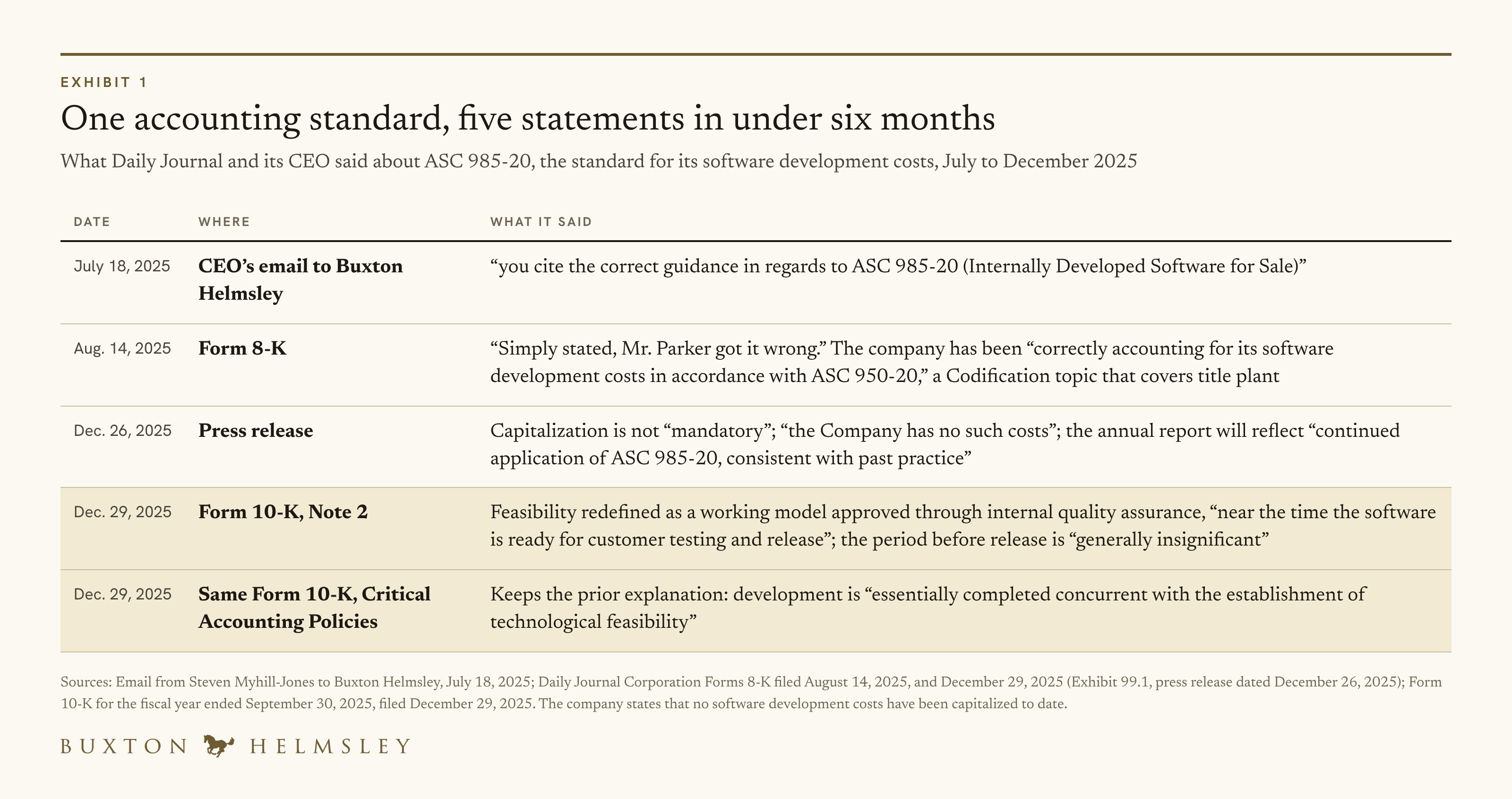
Under the new definition, feasibility arrives when the work is essentially finished, so there will rarely be anything left to capitalize. The question we raised in July was whether that fits a company whose own risk factors describe its development spending as the cost “to update and upgrade” products already in service,⁵ and the new wording does not take it up.
The profession has written about this exact situation. In March 2018, two auditors at Crowe published an article in the AICPA’s Journal of Accountancy on accounting for software developed with agile methods, in which individual features are developed separately rather than all at once.²³ We first sent the article to the company and its auditor in 2025.¹⁶ Daily Journal’s December 26 release did not dispute it: “There’s nothing wrong with the article that Mr. Parker cites about ‘agile’ development.” Its answer was that we were not applying the article correctly to the company’s facts: each new upgrade or enhancement “must undergo its own feasibility assessment,” and “the Company has no such costs” in the window between feasibility and release.⁴
The article takes up each of those positions, seven years before the company took them. It explains that a working model ready for customer testing is the familiar milestone for software built the traditional way, in a single sequence, and it warns that a company developing in stages “might conclude inappropriately that technological feasibility has not been met” until the software is nearly ready for customers. That is the position Daily Journal wrote into its annual report three days after the release. On upgrades, the article says that product enhancements “that are not considered maintenance activities sometimes can meet the technological feasibility threshold more easily because the developers are adding functions to an already successful product,” which is the kind of work the company’s risk factors describe. On whether any costs fall in the window, it says that “large portions of the costs incurred to develop and test such features often should be capitalized,” including “the actual coding, testing, and associated labor costs.” And it names the result of getting this wrong: “errors in the application of GAAP as well as errors in the amount of net income or loss entities report.”²³
In plain terms, the question is when money spent becomes an asset. A delivery company that buys a truck it expects to drive for five years does not record the full price as an expense in the month it buys it; it records the truck as an asset and spreads the cost over the years the truck is in use. ASC 985-20 treats software built for sale the same way. Money spent working out whether a product can be built is an expense. Once it can be built, what the company spends building it until release is an investment in something it will sell for years, and the standard requires it to be recorded as one; the company’s own policy note says that in that period “software development costs are capitalized.”⁵ If, as we believe, Daily Journal has costs in that window, expensing every dollar is the equivalent of writing off the truck the day it is delivered. Profit is lower in the year of the spending, the balance sheet shows no software asset at all, and when development spending falls, as Daily Journal’s reported figure has this year, the cut flows straight into reported profit, with nothing on the balance sheet to show that less is being invested in the product.⁷
Some will call expensing everything conservative, and assume that conservative accounting is acceptable accounting. That is not how the standards are built. The FASB’s conceptual framework requires financial information to be neutral, “without bias in the selection or presentation of financial information,” and it leaves out prudence and conservatism on purpose, “because including either would be inconsistent with neutrality.”²⁵ The Board gave its reason: “Understating assets or overstating liabilities in one period frequently leads to overstating financial performance in later periods.”²⁵ Accounting is not meant to lean cautious or to lean optimistic; it is meant to be accurate. The standards do contain some cautious rules of their own, but where a standard prescribes the treatment, as ASC 985-20 does once feasibility is established, a company that chooses a more conservative answer is not being careful. It is not following the standard.
A number shareholders had not been given
The same annual report disclosed, in the policy note, that “Research and development expenses related to software development were $2.5 million and $1.4 million for the years ended September 30, 2025 and 2024,” and that those expenses are “included under Salaries and employee benefits.”⁵ The prior annual report, and the three quarterly reports of fiscal 2025, contained no such figure.⁶ ¹⁹
The income statement in that annual report gives eleven categories of operating expense a line of their own. Eight of them are smaller than software research and development, among them “Postage and delivery expenses” of $774,000, “Newsprint and printing expenses” of $639,000, and stock-based compensation of $140,000.⁵ Software research and development, at $2.5 million, is not one of the eleven. It appears in a sentence in the accounting policy note, folded into “Salaries and employee benefits.”⁵
Exhibit 2. Postage gets its own line. Software research and development does not.
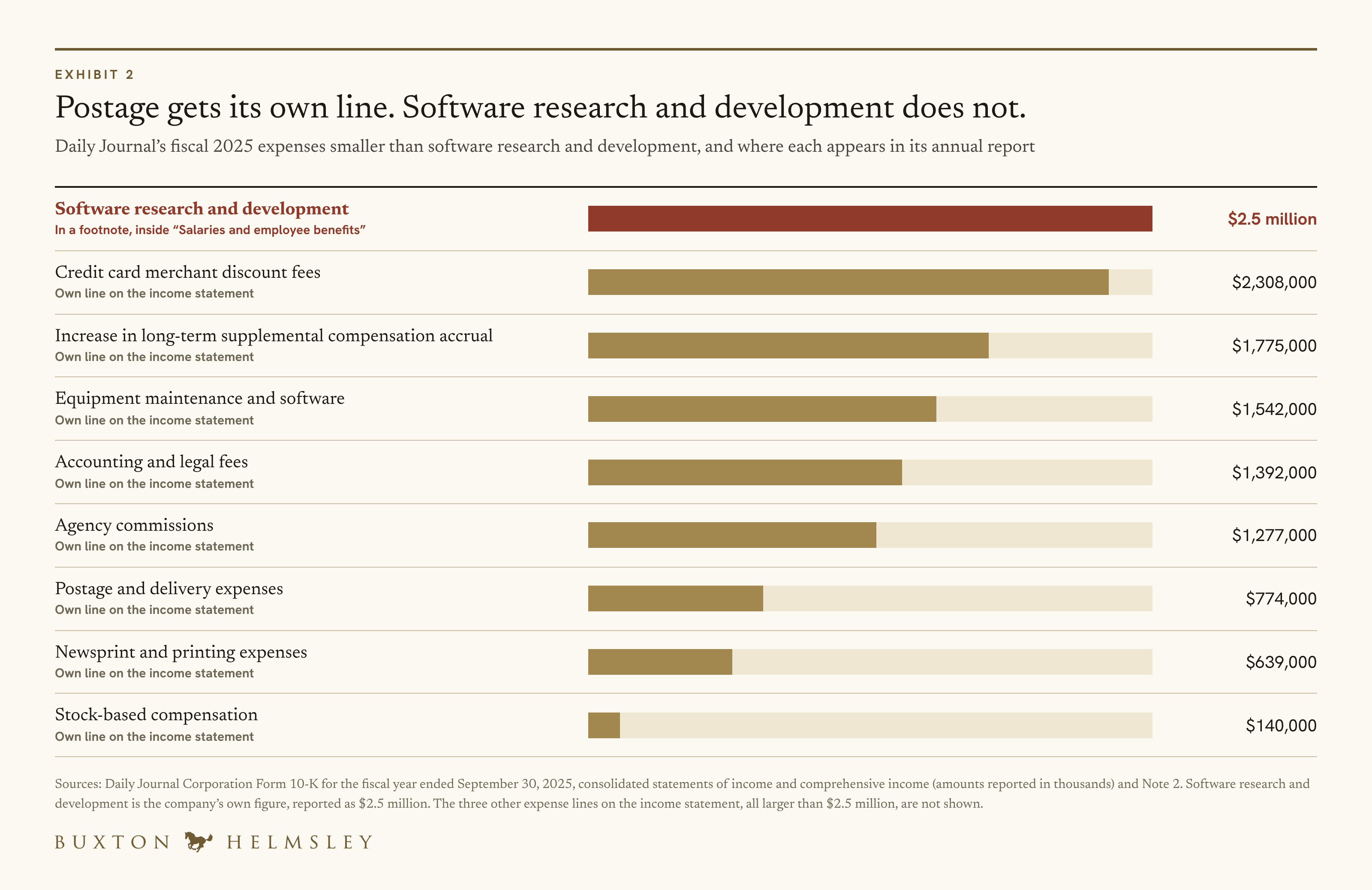
Regulation S-X Rule 5-03, which sets out what belongs on the face of an income statement, calls for “any material amounts” of other operating costs and expenses to be stated separately.²² Daily Journal’s own income statement shows how small an expense can be and still get a line of its own: $140,000. By that measure, a $2.5 million category is material many times over, and our position since February has been that it belongs on the face of the statement. Every quarterly report since the annual report has kept the figure in the note.⁷ Shareholders can find what the company spends on postage on the face of its income statement; to find what it spends developing the software behind most of its revenue, they have to read the accounting policy note.
The quarterly report for the three months ended December 31, 2025, put research and development expense at $0.9 million.⁷ The next quarterly report revised that figure to approximately $0.2 million, stating that “This revision had no impact on the results of operations, net income (loss), total expenses, or cash flows.”⁷ For the nine months ended June 30, 2026, the company reports approximately $0.8 million, against approximately $1.8 million for the same nine months a year earlier.⁷ So in the first year it has published the number, the company has cut its first quarterly figure by roughly three-quarters on revision, and its reported spending through nine months is less than half of the year before.
There is a second problem with the figure itself. The company says its research and development expense is “included under Salaries and employee benefits.”⁵ Under the FASB’s rule for research and development costs, first issued in 1974 and carried into ASC 730, salaries are only one element. The rule also counts materials and equipment used in the work, intangibles bought for it, the costs of “services performed by others in connection with the research and development activities,” and “a reasonable allocation of indirect costs.”³⁰ In explaining a $6.7 million rise in Journal Technologies’ operating expenses, the same annual report cites “additional contractor services and the hiring of additional staff members to strengthen operational efficiencies, conduct product development and address technical debt,” and it reports contractor services under outside services, not salaries.⁵ It also tells shareholders, “We have already introduced AI features in some of our products,” and that the company “must further invest in these cutting-edge technologies.”⁵ Building software, and AI features above all, carries costs beyond payroll: contractors, development tools, cloud computing, and the usage fees that AI model providers charge. If the reported figure is limited to what sits in the salaries line, then either Daily Journal has none of those costs, or they have been left out of it.
The lesson for investors is about records. A company can report only what it tracks. A research and development figure assembled after the fact from a share of payroll will miss everything that is not on the payroll, and a company that does not track development costs by project, from contractor invoices to cloud and AI usage bills, cannot show where technological feasibility was reached or what was spent after it. The Journal of Accountancy article makes the same point: a company that does not coordinate with its accountants before a development project begins may find that this “could make it difficult to correctly separate costs.”²³ When a company publishes its research and development spending for the first time only after a shareholder presses for it, investors should ask how the number was put together, and from what records.
“This one is true”
The December 26 release listed seven of what it called our claims and answered each one. Its answer on Section 16 of the Exchange Act began, “This one is true.”⁴
The release then set out the rule itself: directors and officers who owned no stock when they joined “were indeed supposed to file Forms 3 listing their ‘zero’ shares,” and Forms 4 are due “when equity grants are made or vest, rather than when the shares are delivered.”⁴ Exhibit 3 shows how that rule had been applied by the people responsible for overseeing the company’s financial reporting.
Exhibit 3. Every Audit Committee member filed late. The CEO has never filed a Form 4.
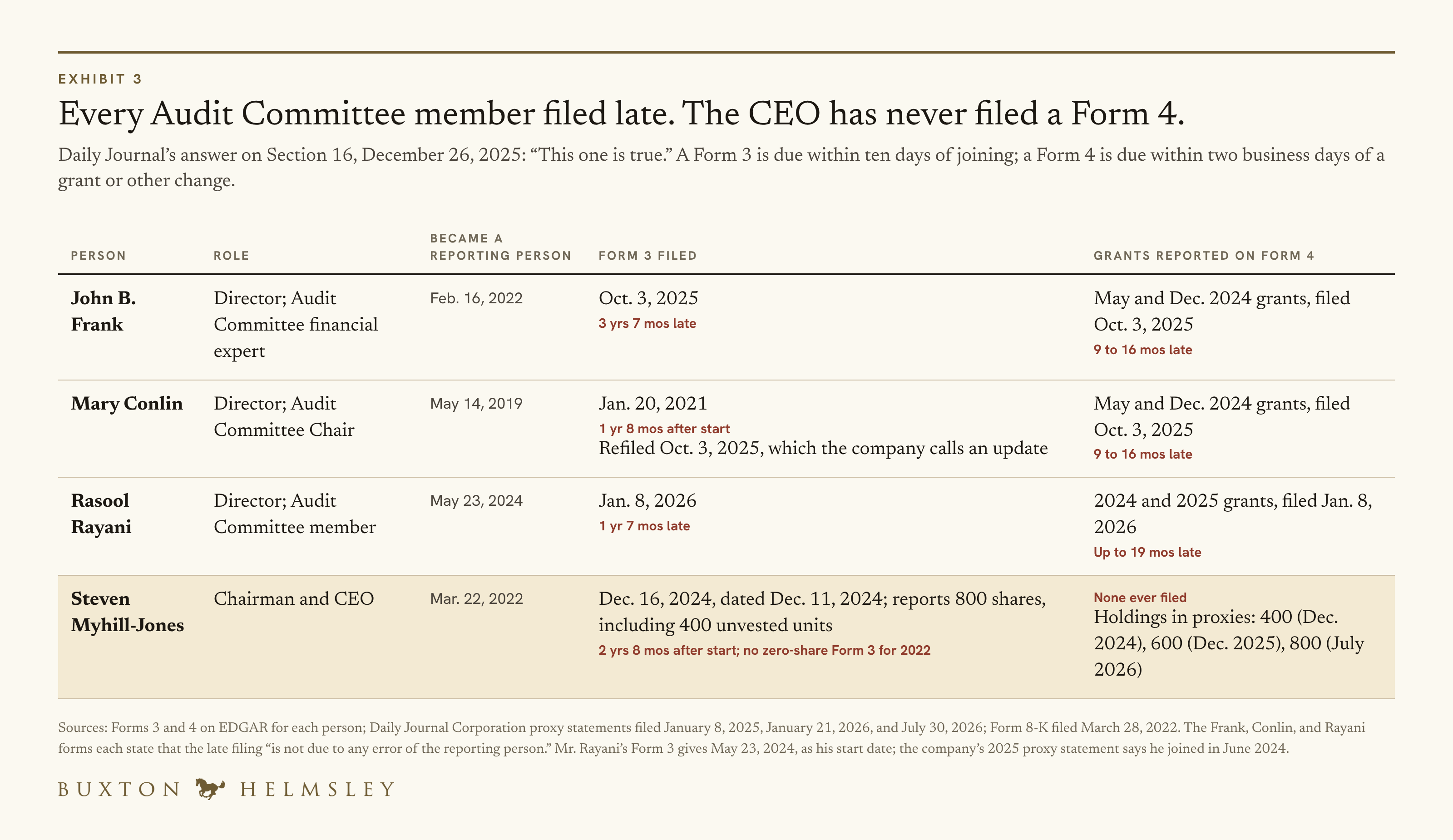
John B. Frank, whom the board designates as its Audit Committee financial expert, became a director on February 16, 2022.¹² His Form 3 was filed on October 3, 2025, three years and seven months late, together with a Form 4 for restricted stock unit grants made in May and December 2024.¹² Mary Conlin, who chairs the Audit Committee, filed a late Form 4 for the same 2024 grants on the same day.⁹ ¹² ²⁰ Rasool Rayani, the Committee’s third member, reports on his own Form 3 that he became a director on May 23, 2024; that Form 3 and his Form 4 were filed on January 8, 2026.¹² Each of these forms carries the remark that the late filing “is not due to any error of the reporting person.”¹² In writing to us, Mr. Rayani called Section 16 “the flimsiest of technicalities.”¹⁶
The company’s proxy statement of January 8, 2025, written while Mr. Frank’s Form 3 had been outstanding for almost three years and the May 2024 grants had gone unreported, told shareholders that “during fiscal 2024 all filing requirements were timely satisfied.”⁸
The Chief Executive Officer’s filings are the ones the company has not addressed at all. Mr. Myhill-Jones became a director and interim CEO on March 22, 2022.¹³ His first and only Section 16 filing is a Form 3 filed on December 16, 2024, dated December 11, 2024, reporting 800 shares of common stock owned directly.¹² Its own remarks say that 400 of those are restricted stock units that had not vested, and the company’s 2025 proxy statement describes the other 400 as shares “granted to him in fiscal 2024.”⁸ At the company’s annual meeting in February 2023, eleven months after he took the job, Mr. Myhill-Jones told shareholders, “while I don’t have equity yet, I’m certainly keen to participate in future growth of the business.”¹⁴ By the rule in the company’s own press release, he owed a Form 3 in 2022 listing zero shares, a Form 4 for the 2024 grant, and a Form 4 each time his units vested. The proxy statements show his beneficial holdings rising from 400 shares to 600 to 800 as the units vested in July 2025 and July 2026.⁸ ⁹ ¹¹ He has never filed a Form 4.¹²
Daily Journal’s Code of Ethics calls on its directors and officers to “comply with applicable governmental laws, rules and regulations.”¹⁶ Item 5.05 of Form 8-K, for the company’s senior officers, and Nasdaq Rule 5610, for its directors, require prompt disclosure of a waiver of the code, and the SEC defines a waiver to include a company’s failure to act within a reasonable time on a material departure that has been made known to an executive officer.¹⁷ ¹⁸ In our view, years of unremedied Section 16 delinquencies are such a departure. The company has made no such disclosure for any of them.
The date on the cover
The company’s first public filing about us came only after we had asked for it three times. On July 21, 2025, a week after our first letter, the board held an emergency meeting, and on July 22 the company told us it would engage an independent accounting consultant to review the issue.¹ On July 23, we wrote to the board that the company had filed no Form 8-K disclosing either.¹ On July 25, we said so again, in an open letter to shareholders.¹ On July 28, we wrote to the board a third time, under the heading “Continued Failure to Disclose Investigation.”¹⁶ The company filed its Form 8-K the next day, July 29.¹
The cover page of that filing gives the “Date of report (Date of earliest event reported)” as July 28, 2025.¹ Nothing the filing reports took place on July 28. Its first sentence of substance reads, “Two weeks ago, we received a letter from Alexander E. Parker”; it attaches our letters of July 14, 18, 23, and 25 as exhibits; and it says the company informed us of its decision to engage a consultant on July 22.¹ Item 8.01, under which the company filed, carries no deadline of its own. But the cover date is the first thing a reader sees, and a date of July 14 or July 22 on a filing made July 29 would have shown, at a glance, how long shareholders had been kept waiting. In our view, that is why the cover gives a date on which nothing it reports happened. We pointed out the discrepancy the day the filing was made. The cover page still gives July 28, and no amendment has been filed.
The same Form 8-K offered shareholders the view that “Mr. Parker will learn with age and experience that few people want to work with someone who presents himself this way.”¹
The Chief Financial Officer
Our letter to the board of July 25, 2025, called for the resignation of the company’s Chief Executive Officer and its Chief Financial Officer; the company attached that letter to its Form 8-K four days later.¹ On October 27, 2025, three months after that letter, the company announced that Chief Financial Officer Tu To would retire effective January 15, 2026, after forty-two years with the company.²⁴ Her separation agreement, filed with the annual report, provides a lump-sum payment of $175,000 described as a “retroactive pay adjustment,” a $40,000 bonus for fiscal 2025, up to $75,000 in milestone bonuses, and a general release of claims.⁵ ²⁴ The December 26 release answered our point about her departure with the word “Wrong” and the statement that she is “retiring after 42 years of dedicated service to the Company.”⁴ We do not claim to know why Ms. To left. The sequence is in the company’s own filings.
The $24 million
The press release of December 26 told shareholders that Mr. Parker had demanded “a consulting contract that would give him a cash payment of 15 cents for every dollar of appreciation,” and that “He estimated that this would pay him $24 million.”⁴
The company had described the same proposal differently five months earlier. Its Form 8-K of July 29, 2025, said he had asked for an engagement that would pay “$24 million worth of Company equity if the stock price increased by that amount for any reason.”¹ The two descriptions disagree on whether the payment was cash or equity, and the July version is closer to what we proposed: in place of standard director pay, no compensation at all unless the share price rose to set levels and held them there, paid in equity. The board was free to decline it, in which case it would have been put to shareholders.
The proposal was also withdrawn before the press release was issued. Our letter to the board of December 13, 2025, states: “the contingent compensation proposal referenced in our earlier correspondence has been withdrawn and is no longer under consideration.”¹⁶ That letter is attached to the same Form 8-K as the press release, which does not mention the withdrawal.⁴ The company’s letter to shareholders of January 21, 2026, was headlined with the claim that Buxton Helmsley “Previously Tried to Extract Consulting Payments.”⁹
The referrals, and ours
The company announced its referrals in a press release distributed on a newswire. Since December 2025, Buxton Helmsley has made submissions to the SEC’s Office of the Whistleblower and provided notices to the PCAOB concerning the company’s auditor, Baker Tilly, and we have described them in letters published on our website.¹⁶ We will not speculate publicly about the status of any regulatory matter.
We also filed a complaint with the State Bar of California concerning Mr. Frank, who is a member of the California bar, on December 23, 2025. It concerns his own filings under federal law. The State Bar closed it on April 3, 2026, on the grounds that it concerned duties Mr. Frank owes to a client and that the facts needed to evaluate it were subject to the confidentiality of the lawyer-client relationship. Those facts are in Daily Journal’s public filings and in our published letters, and no privileged information is needed to read them. We asked the State Bar’s Complaint Review Unit to review the closure the same day. That request is pending.²¹
The disclosure gaps continue
Most of what we raised in 2025 concerned filings that were late, incomplete, or wrong. The company has gone on making them, including after it told shareholders our letters were “error-filled.”⁴
On December 16, 2025, the company reported the appointment of Erik Nakamura as Chief Financial Officer. The Form 8-K said his compensation arrangements had not been finalized, and “Once completed, the Company will disclose such information in a filing with the Securities and Exchange Commission.”³ Instruction 2 to Item 5.02 of Form 8-K allows a company to do that, on one condition: it must file an amendment within four business days after the terms are determined.¹⁷ As of October 25, 2026, we have found no amendment, and no proxy statement, quarterly report, or other filing that discloses his pay.⁵ ⁷ ⁹ Unless the Chief Financial Officer’s compensation is still not settled ten months into the job, that amendment is overdue. Mr. Nakamura has signed the company’s Forms 8-K throughout, and his own Form 3, due ten days after his appointment on December 12, 2025, was filed on January 12, 2026.¹²
The CFO’s pay sits alongside filings that did not need an activist to find. The Form 8-K that told shareholders we had the accounting wrong named “ASC 950-20,” the title-plant topic, as the standard governing the company’s software accounting.² The first quarterly research and development figure the company published, $0.9 million, was revised a quarter later to approximately $0.2 million.⁷ And the January 2025 proxy statement told shareholders that the CEO’s Form 3 reported “his initial ownership of the 400 shares,” when the form itself reports 800, counting 400 unvested units in the common stock column.⁸ ¹² Daily Journal’s Audit Committee oversees its financial reporting, and its Chief Executive Officer and Chief Financial Officer certify its periodic reports.⁵ ⁷
After the vote
At the February 2025 annual meeting, before our engagement began, 40.3% of the votes cast on Ms. Conlin’s election and 40.1% of those cast on Mr. Frank’s were cast against them.¹⁰ We did not proceed with a proxy contest at the February 2026 meeting, and the four directors were re-elected with more than 95% of the votes cast, with no alternative nominees standing.¹⁰
The board used the following months to change how its seats can be contested. On September 10, 2026, at a special meeting, shareholders approved the board’s proposal to eliminate cumulative voting, which had allowed holders of a little more than one-fifth of the shares voted in an election for four seats to place a director on the board.¹¹ The board said cumulative voting “allows minority shareholders to elect a director contrary to the will of the majority.”¹¹ The bylaws the board adopted the next day moved the deadline for a shareholder’s notice of director nominations from 10 days before the meeting to 60 days before the anniversary of the prior year’s meeting, stated that shareholders do not have the authority to call a special meeting, and made South Carolina the exclusive forum for disputes.¹¹ The same package added a proxy access bylaw for holders of at least 3% of the stock for at least three years, and a policy under which a director who receives more votes against than for in an uncontested election must offer to resign, with the board to accept unless it decides otherwise.¹¹
Exhibit 4. After the 2026 annual meeting, the board changed how its seats can be contested
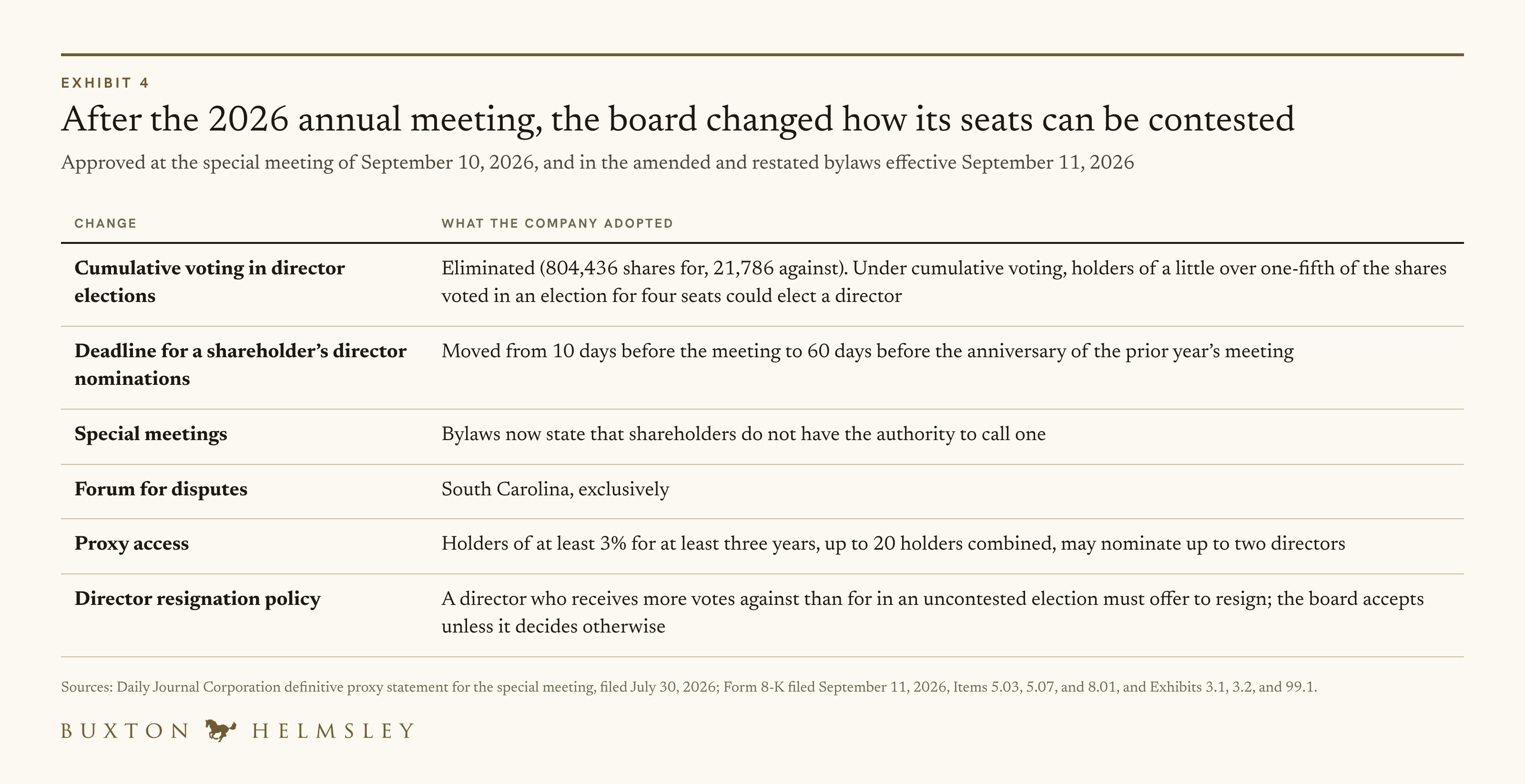
None of these changes corrected a filing.
What the board could have done in July 2025
When our first letter arrived on July 14, 2025, a board in Daily Journal’s position had a short list of things to do, several of which it has since done anyway, under protest and in public. Its directors could have filed the Forms 3 and 4 they owed, which Mr. Frank and Ms. Conlin did eleven weeks later and Mr. Rayani in January, and its CEO could have filed the zero-share Form 3 he owed from 2022 and the Forms 4 for his grants, which he still has not. An amendment correcting the cover date of the July 29 Form 8-K could have gone out the next morning.
On the accounting, the board could have put its analysis in a filing. It chose instead to tell shareholders, “Simply stated, Mr. Parker got it wrong” in August, and then published the research and development figure we had asked for in December.⁵ It could have disclosed its Chief Financial Officer’s pay when it said it would. And it could have taken up the offer in our December 13 letter to discuss a consensual resolution, which by then asked for no compensation of any kind.
It could also have put the review in hands other than its own. The July 29 Form 8-K said the board and its Audit Committee had decided to engage an independent accounting consultant, and the December 26 release said the company’s approach had been reviewed by a third-party expert.¹ ⁴ But the Audit Committee is the body that oversaw the accounting in question, and it was the Committee that engaged the review. As the Section 16 questions came out, the conflict widened: all three Audit Committee members had late filings of their own, and the fourth director, the CEO, had signed the filings at issue and had his own Form 3 in question.¹² By December, no director on the board could judge the matter without judging his or her own conduct. In our view, a board in that position adds a director with no part in the history, hands that director the review, and publishes its scope and conclusions. Daily Journal’s board kept the review with the directors whose oversight it concerned, and, as we wrote in February, we will not accept the results of any investigation overseen by or reported to them.¹⁶
Most of those were filings the company was already required to make. The directors who chose the press release over them are the directors who oversaw every filing described above.
What the auditor’s own standards require
Daily Journal’s auditor, Baker Tilly US, LLP, has served as the company’s auditor since 2016. On December 29, 2025, it reported that the fiscal 2025 financial statements present fairly, in all material respects, the company’s financial position in conformity with GAAP.⁵ Its report identifies one critical audit matter, on revenue recognition in software contracts. It does not mention software development costs or technological feasibility, although the same annual report changed the company’s definition of technological feasibility, and three days before the report the company had defended its accounting for those costs in a press release.⁴ ⁵
The PCAOB’s standards spell out what an auditor owes in that position. In deciding whether financial statements are free of material misstatement, the auditor “should evaluate the qualitative aspects of the company’s accounting practices, including potential bias in management’s judgments about the amounts and disclosures in the financial statements,” and it “must evaluate whether the financial statements are presented fairly, in all material respects, in conformity with the applicable financial reporting framework,” including whether they contain “the information essential for a fair presentation.”²⁶ It must report to the audit committee on the effect of significant accounting policies in “controversial areas,” on its conclusions about the quality of the company’s accounting practices, “including situations in which the auditor identified bias in management’s judgments,” and on “any disagreements with management.”²⁷ A matter of that kind becomes a critical audit matter, described in the auditor’s report for shareholders to read, when it relates to material accounts or disclosures and “involved especially challenging, subjective, or complex auditor judgment.”²⁸ And when an auditor learns of facts that existed at the date of its report and would have affected it, its standards require it to advise the company to disclose them and, if the company will not, to take steps to prevent further reliance on its report.²⁹
In our view, those standards point one way here. An auditor that accepts that the company has no development costs after technological feasibility should be able to say how it tested that conclusion against products that have been in service for years and that the company itself describes as being updated and upgraded. An auditor that signs off on an income statement giving postage its own line should be able to explain why a research and development category more than three times its size belongs in a footnote. A question this contested, on a judgment this subjective, is what the critical audit matter section of an auditor’s report is for. And if Baker Tilly now concludes that the fiscal 2025 statements are misstated, its own standards tell it what to do next. We have sent our analysis to Baker Tilly, and to the PCAOB,¹⁶ and we would welcome Baker Tilly’s answer on the record.
What remains open
On February 11, 2026, we wrote to Mr. Frank setting out what full compliance would require before the next annual meeting. Exhibit 5 shows where each item stands today.¹⁶ The items the company has addressed are those it could address without stating that a prior filing was incorrect.
Exhibit 5. Eight months on, where our February 11, 2026, requests stand
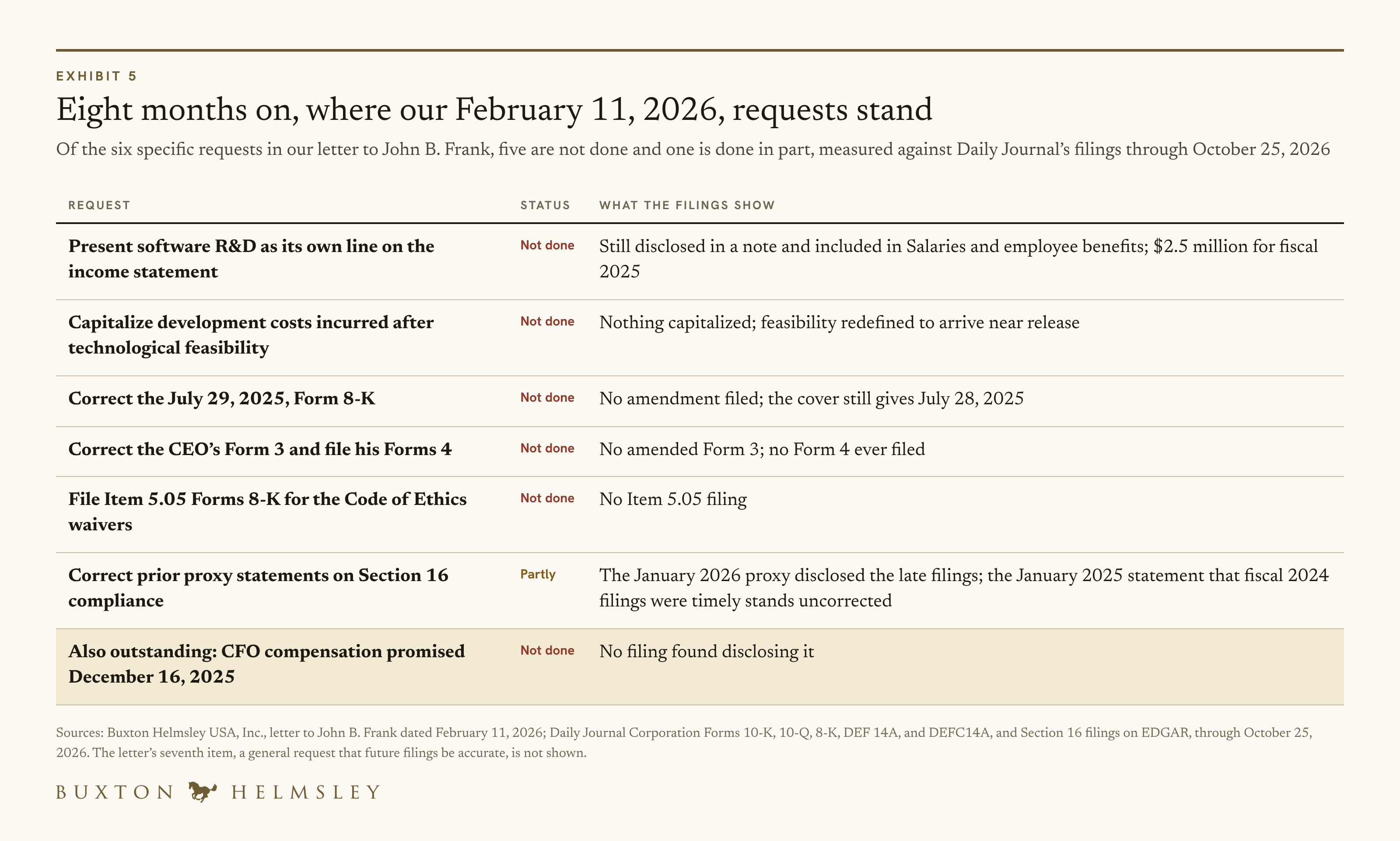
With cumulative voting gone, any shareholder who wants a seat on this board now has to outvote the board’s own nominees for it. That was the board’s choice to make, and shareholders approved it. Our part, from here, is the one we started with: we will keep checking each item in Exhibit 5 against what Daily Journal files, and publish what we find.
What a new hire does not fix
Daily Journal has answered questions about its reporting partly by adding people. Its annual report for fiscal 2025 disclosed a material weakness in internal control over financial reporting, “related primarily to segregation of duties,” that it had “not yet been able to fully remediate” as of September 30, 2025, and listed “increased finance personnel” among the steps it had taken.⁵ After our engagement began, it also hired a Director of SEC Reporting.
Shareholders are often invited to treat a hire like that as the remedy. It is an input, and the test of it is whether the filings change. On the items still open, they have not. The amendment correcting the cover date of the July 2025 Form 8-K, the CEO’s Forms 3 and 4, and the Form 8-K/A reporting the Chief Financial Officer’s pay are each short documents that a Director of SEC Reporting could prepare in an afternoon, and each problem is visible on the face of the company’s own filings.
What those filings need is a decision to make them, and that decision belongs to the Chief Executive Officer, the Chief Financial Officer, and the board, not to a staff position. When a company adds reporting staff and known deficiencies still go unfiled, the people responsible either do not understand what the rules require, do not think the rules matter, or understand them and have decided that correcting the record would mean conceding the point. In our view, none of those is a problem a new title can solve.
For an allocator or a shareholder, the lesson is to measure remediation by the filings rather than by the organization chart: take the list of deficiencies a company has acknowledged, or that have been put to it in writing, and check each one against EDGAR.
Daily Journal made a version of the same argument about its board. Its letter to shareholders of January 21, 2026, asked them to support directors “most all of whom were selected by Charlie,” its long-time former chairman, Charles T. Munger, “based upon his confidence in their judgment and integrity.”⁹ Who chose a director is a credential, like a new title; the filings described above are the record those directors made.
The same test applies to the person at the top. Section 16 reports are filed in an executive’s own name, and Daily Journal’s own press release set out what they require. Mr. Myhill-Jones signs the certifications that accompany the company’s annual and quarterly reports, and in more than four years as chief executive he has never filed a Form 4 for his own shares.¹² Two weeks after we set that out in a public letter, he was re-elected with more than 99% of the votes cast.¹⁰ ¹⁶ A shareholder who votes that way is accepting incomplete ownership reporting from the person who certifies the accuracy of everything else the company files.
All of our correspondence with Daily Journal since July 2025, and the company’s letters to us, are published at buxtonhelmsley.com/djco.
Related reading
Under the SEC’s Cross-Trading Proposal, a Fund’s Own Valuation Could Set the Price
Reading Travel + Leisure’s Loan Loss Ratio Against the SEC’s Complaint
Optimum’s Rate Reconciliation Treated a Franchise Impairment the Way It Treated Goodwill
Referenced Sources:
[1] Daily Journal Corporation, Current Report on Form 8-K, with exhibits (filed July 29, 2025) (primary; the cover page supports the stated date of report, July 28, 2025; the body supports the quoted opening sentence, the quoted remark about “age and experience,” the quoted description of the proposal as “$24 million worth of Company equity,” and the decision of the board and its Audit Committee to engage an independent accounting consultant; Exhibit 99.1 supports the date and contents of our letter of July 14, 2025, including its point on ASC 985-20; the exhibits also support the attachment of our letter of July 25, 2025, calling for the resignation of the Chief Executive Officer and the Chief Financial Officer).
[2] Daily Journal Corporation, Current Report on Form 8-K (filed August 14, 2025) (primary; supports the quoted statement “Simply stated, Mr. Parker got it wrong” and the quoted statement that the company had been accounting for its software development costs “in accordance with ASC 950-20”).
[3] Daily Journal Corporation, Current Report on Form 8-K (filed December 16, 2025) (primary; supports the appointment of Erik Nakamura as Chief Financial Officer, the statement that his compensation arrangements had not been finalized, and the quoted undertaking to disclose them “in a filing with the Securities and Exchange Commission”).
[4] Daily Journal Corporation, press release dated December 26, 2025, filed as Exhibit 99.1 to its Current Report on Form 8-K (filed December 29, 2025) (primary; the release supports the quoted subheading, the quoted announcement of referrals to federal and state authorities and to the SEC’s Division of Enforcement, the quoted statements that capitalization is not “mandatory,” that “the Company has no such costs,” and that the annual report would reflect “continued application of ASC 985-20,” the quoted statement on the Journal of Accountancy article, the quoted statement that each new upgrade or enhancement “must undergo its own feasibility assessment,” the quoted answer “This one is true” and the quoted description of the Form 3 and Form 4 requirements, the answer “Wrong” and the quoted statement on Ms. To’s retirement, the quoted description of a “consulting contract” paying “15 cents for every dollar of appreciation” and the quoted $24 million estimate, the description of our letters as “error-filled,” and the statement that the company’s approach had been reviewed by a third-party expert, and the release makes no reference to the withdrawal of the proposal; the filing index supports the attachment of our letters of December 13, 2025, as Exhibits 99.2 and 99.3).
[5] Daily Journal Corporation, Annual Report on Form 10-K for the fiscal year ended September 30, 2025 (filed December 29, 2025) (primary; Note 2 supports the quoted research and development figures of $2.5 million and $1.4 million and their inclusion in “Salaries and employee benefits,” the quoted definition of technological feasibility, the quoted statement that the period before release “is generally insignificant,” and the quoted statement that costs are capitalized after feasibility is established “until the product is released for sale”; the Critical Accounting Policies section supports the quoted sentence on development being “essentially completed concurrent with the establishment of technological feasibility”; the risk factors support the quoted phrase “to update and upgrade”; the income statement supports the eleven separately stated categories of operating expense and the amounts of $774,000 for postage and delivery, $639,000 for newsprint and printing, and $140,000 for stock-based compensation; Item 1 supports the quoted statements on AI features and further investment; Item 7 supports the quoted explanation of the rise in Journal Technologies’ operating expenses and the attribution of the rise in outside services to contractor services and hosting fees; Item 9A supports the quoted description of the material weakness and of “increased finance personnel”; the report of Baker Tilly US, LLP, dated December 29, 2025, supports its tenure as auditor since 2016, its opinion, and its single critical audit matter, on revenue recognition in software contracts; the exhibits support Ms. To’s separation agreement and its terms and the certifications signed by the Chief Executive Officer and the Chief Financial Officer).
[6] Daily Journal Corporation, Annual Report on Form 10-K for the fiscal year ended September 30, 2024 (primary; supports the absence of any figure for software research and development expense).
[7] Daily Journal Corporation, Quarterly Reports on Form 10-Q for the quarters ended December 31, 2025, March 31, 2026, and June 30, 2026 (primary; support the continued disclosure of research and development expense in the notes rather than on the face of the income statement, the figure of $0.9 million for the quarter ended December 31, 2025, its revision to approximately $0.2 million and the quoted statement on the revision, the figures of approximately $0.8 million and $1.8 million for the nine months ended June 30, 2026 and 2025, the absence of any disclosure of the Chief Financial Officer’s compensation, and the certifications signed by the Chief Executive Officer and the Chief Financial Officer).
[8] Daily Journal Corporation, Definitive Proxy Statement (filed January 8, 2025) (primary; supports the quoted statement that “during fiscal 2024 all filing requirements were timely satisfied,” the quoted description of Mr. Myhill-Jones’s shares as “granted to him in fiscal 2024,” the quoted reference to “his initial ownership of the 400 shares,” and his beneficial ownership of 400 shares).
[9] Daily Journal Corporation, Preliminary Proxy Statement (filed January 6, 2026), Definitive Proxy Statement (filed January 21, 2026), and letter to shareholders (filed January 21, 2026) (primary; the proxy statements support the company’s disclosure of its directors’ late Section 16 filings, Mr. Myhill-Jones’s beneficial ownership of 600 shares, and the absence of any disclosure of the Chief Financial Officer’s compensation; the letter to shareholders supports the quoted description of most of the directors as selected by Mr. Munger and the quoted headline that Buxton Helmsley “Previously Tried to Extract Consulting Payments”).
[10] Daily Journal Corporation, Current Reports on Form 8-K reporting the results of the annual meetings, filed February 21, 2025, and February 25, 2026 (primary; support the 40.3% of votes cast against Ms. Conlin and the 40.1% cast against Mr. Frank in 2025, and the re-election of the four directors in 2026 with more than 95% of the votes cast, Mr. Myhill-Jones with more than 99%).
[11] Daily Journal Corporation, Definitive Proxy Statement for the special meeting (filed July 30, 2026), and Current Report on Form 8-K (filed September 11, 2026) (primary; the proxy statement supports the proposal to eliminate cumulative voting, the quoted statement that cumulative voting “allows minority shareholders to elect a director contrary to the will of the majority,” and Mr. Myhill-Jones’s beneficial ownership of 800 shares; the Form 8-K and its exhibits support the approval of the proposal on September 10, 2026, and the bylaws adopted the next day, including the nomination deadline, the statement on special meetings, the exclusive forum, the proxy access bylaw, and the director resignation policy; the threshold of a little more than one-fifth of the shares voted is the arithmetic of cumulative voting for four seats).
[12] Section 16 filings on EDGAR: John B. Frank, Form 3 and Form 4 (filed October 3, 2025); Mary Conlin, Form 4 (filed October 3, 2025); Rasool Rayani, Form 3 and Form 4 (filed January 8, 2026); Erik Nakamura, Form 3 (filed January 12, 2026); Steven Myhill-Jones, Form 3 (filed December 16, 2024) (primary; support each filing date, the start dates the forms report, the grants reported and their dates, the quoted remark that each late filing “is not due to any error of the reporting person,” the date of Mr. Myhill-Jones’s Form 3, the 800 shares it reports, and its remark that 400 are unvested restricted stock units; the absence of any Form 4 by Mr. Myhill-Jones is as shown on EDGAR through October 25, 2026).
[13] Daily Journal Corporation, Current Report on Form 8-K (filed March 28, 2022) (primary; supports the election of Mr. Myhill-Jones as a director and interim Chief Executive Officer on March 22, 2022).
[14] Latticework Investing, “Charlie Munger: Full Transcript of Daily Journal’s 2023 Annual Meeting” (secondary; supports the quoted statement by Mr. Myhill-Jones at the February 2023 annual meeting).
[15] Deloitte, DART, ASC 950, Financial Services—Title Plant (secondary; reproduces the FASB Accounting Standards Codification and supports the title and subject matter of Topic 950).
[16] Buxton Helmsley USA, Inc., letters to the Daily Journal board of December 13, 2025 (filed by the company as exhibits to its Form 8-K of December 29, 2025), and letter to John B. Frank of February 11, 2026; all correspondence at buxtonhelmsley.com/djco (primary; the December 13 letter supports the quoted withdrawal of the compensation proposal; the February 11 letter supports the seven requests shown in Exhibit 5, the statement that we will not accept the results of any investigation overseen by or reported to the current board, the quoted provision of the company’s Code of Ethics, our submissions to the SEC’s Office of the Whistleblower and notices to the PCAOB, the quoted email of July 18, 2025, from Mr. Myhill-Jones, the quoted words of Mr. Rayani, and the account of Mr. Myhill-Jones’s Section 16 filings published two weeks before the 2026 annual meeting; the published correspondence supports our first sending of the Journal of Accountancy article in 2025).
[17] U.S. Securities and Exchange Commission, Form 8-K, General Instructions (primary; Item 5.02, Instruction 2, supports the requirement to file an amendment within four business days after compensation terms are determined; Item 5.05 and its Instruction 2 support the disclosure of waivers of a code of ethics and the definition of an implicit waiver).
[18] U.S. Securities and Exchange Commission, Release No. 34-98285 (September 5, 2023) (primary; supports Nasdaq Listing Rule 5610 and its requirement to disclose waivers of the code of conduct for directors).
[19] Daily Journal Corporation, Quarterly Reports on Form 10-Q for the quarters ended December 31, 2024, March 31, 2025, and June 30, 2025 (primary; support the absence of any figure for software research and development expense).
[20] Daily Journal Corporation, Current Report on Form 8-K (filed February 5, 2026) (primary; supports the composition of the Audit Committee and Ms. Conlin’s role as its chair).
[21] Buxton Helmsley USA, Inc., request for review to the State Bar of California, Complaint Review Unit, Case No. 25-O-32567 (April 3, 2026) (primary; not publicly available; supports the filing of the complaint on December 23, 2025, the closure of April 3, 2026, and its stated grounds, and the pending request for review).
[22] U.S. Government Publishing Office, eCFR, 17 CFR 210.5-03, Regulation S-X Rule 5-03, Statements of comprehensive income (primary; item 3 supports the quoted requirement to state separately “any material amounts”).
[23] Ryan P. Bouray and Glenn E. Richards, Crowe Horwath LLP, “Accounting for external-use software development costs in an agile environment”, Journal of Accountancy (March 12, 2018) (secondary; supports the authors and their firm, the publication in the AICPA’s journal, its description of a working model ready for customer testing as the familiar milestone for projects using the traditional, sequential approach, its description of agile development, and the quoted passages on technological feasibility, on enhancements that are not maintenance activities, on the costs that often should be capitalized, on the consequences of error, and on the difficulty of separating costs without coordination with accounting before a project begins).
[24] Daily Journal Corporation, Current Report on Form 8-K (filed October 29, 2025) (primary; supports the announcement on October 27, 2025, of Ms. To’s retirement effective January 15, 2026, her forty-two-year career with the company, the lump-sum payment of $175,000 described as a “retroactive pay adjustment,” the $40,000 bonus for fiscal 2025, the milestone bonuses of up to $75,000, and the general release of claims).
[25] Financial Accounting Standards Board, Statement of Financial Accounting Concepts No. 8, Conceptual Framework for Financial Reporting (September 2010; Chapter 3 as amended August 2018) (primary; Chapter 3, paragraph QC14, supports the quoted definition of neutrality; paragraphs BC3.27 and BC3.28 of the Basis for Conclusions support the quoted reason for leaving out prudence and conservatism and the quoted statement on understating assets or overstating liabilities; under ASC 105-10-05-3, Concepts Statements are not themselves authoritative GAAP).
[26] Public Company Accounting Oversight Board, AS 2810, Evaluating Audit Results (primary; paragraph .24 supports the quoted requirement to evaluate the qualitative aspects of accounting practices, including potential bias; paragraph .30 supports the quoted requirement to evaluate fair presentation; paragraph .31 supports the quoted phrase “the information essential for a fair presentation”).
[27] Public Company Accounting Oversight Board, AS 1301, Communications with Audit Committees (primary; paragraph .12 supports the required communication on significant accounting policies in “controversial areas”; paragraph .13 supports the required communication of the auditor’s conclusions on the qualitative aspects of accounting practices, including identified bias; paragraph .22 supports the required communication of “any disagreements with management”).
[28] Public Company Accounting Oversight Board, AS 3101, The Auditor’s Report on an Audit of Financial Statements When the Auditor Expresses an Unqualified Opinion (primary; paragraph .11 supports the definition of a critical audit matter and the quoted phrase “involved especially challenging, subjective, or complex auditor judgment”).
[29] Public Company Accounting Oversight Board, AS 2905, Subsequent Discovery of Facts Existing at the Date of the Auditor’s Report (primary; paragraphs .04 through .08 support the auditor’s obligations on learning of such facts, including advising the company to make disclosure and, if the company refuses, taking steps to prevent further reliance on its report).
[30] Financial Accounting Standards Board, Statement of Financial Accounting Standards No. 2, Accounting for Research and Development Costs (October 1974), now codified in ASC 730-10-25-2 (primary; paragraph 11 supports the elements of research and development costs, including the quoted language on contract services and indirect costs).
This publication is one of the Insights commentaries of Buxton Helmsley USA, Inc. (“Buxton Helmsley”). It reflects the opinions, analysis, and interpretations of Buxton Helmsley as of the date of publication, and it is based upon information that Buxton Helmsley believes to be accurate and that is derived from public sources or from other sources believed to be reliable. Buxton Helmsley does not represent or warrant that such information is accurate or complete, and it should not be relied upon as such. The views expressed are subject to change at any time, and Buxton Helmsley undertakes no obligation to update this publication or to correct any information contained within it.
Except for statements expressly attributed to an identified source or to a public filing, the statements in this publication constitute the opinions and good-faith analysis of Buxton Helmsley and are not statements of objective fact. Buxton Helmsley’s analysis may rest upon assumptions, estimates, and interpretations that could prove to be incorrect. Any reference to a potential violation, misstatement, impropriety, or deficiency reflects Buxton Helmsley’s analytical conclusions and opinions, and does not represent a finding by any court, regulator, or other authority. Readers should conduct their own investigation and analysis of any company, security, or matter discussed. Any company or person referenced that believes any statement in this publication to be inaccurate is invited to contact Buxton Helmsley at general@buxtonhelmsley.com, and Buxton Helmsley will give good-faith consideration to any correction supported by credible evidence.
This publication is provided for informational purposes only. It does not constitute, and should not be construed as, investment advice, a recommendation, or the provision of any individualized investment advisory service to any person, nor an offer or solicitation to buy, sell, or hold any security. Nothing in this publication takes into account the particular investment objectives, financial situation, or needs of any reader. No reader should construe this publication as creating any advisory, fiduciary, or other relationship between Buxton Helmsley and such reader. Readers should consult their own legal, tax, accounting, and financial advisers before making any investment decision.
As of the date of this publication, Buxton Helmsley holds a long position in the common stock of Daily Journal Corporation (NASDAQ: DJCO). Other than that position, Buxton Helmsley, its affiliates, the funds and accounts that it manages or advises, and its principals hold no position in the securities of the companies mentioned in this publication. Buxton Helmsley and the foregoing persons may, at any time and without further notice, purchase, sell, cover, or otherwise change any position in any security discussed in this publication, including in a manner inconsistent with the opinions expressed herein, for various reasons, including but not limited to new research discoveries. Buxton Helmsley may realize gains in the event that the price of any security discussed, including the common stock of Daily Journal Corporation, moves in a direction consistent with a position that it holds.
Buxton Helmsley has not received, and will not receive, any compensation from any third party, including any issuer discussed in this publication or any person holding an interest in any such issuer, in connection with the preparation or publication of this commentary, except as expressly disclosed in this publication. Buxton Helmsley was not engaged or compensated by any third party to publish this commentary, except as expressly disclosed in this publication.
This publication is not, and shall not be construed as, an offer to sell or a solicitation of an offer to buy any security or any interest in any fund or other investment vehicle managed or advised by Buxton Helmsley or any of its affiliates, nor is it an advertisement for any such fund, vehicle, or advisory service. Any such offer or solicitation will be made only by means of definitive offering documents, and only to eligible investors, in accordance with applicable law.
This publication is intended only for distribution to, and use by, persons in the United States. It is not directed to, intended for, or to be relied upon by, any person located in any jurisdiction outside the United States, and it does not constitute an offer, solicitation, or provision of any service in any such jurisdiction. Persons who access this publication from outside the United States do so on their own initiative and are responsible for compliance with the laws applicable to them.
This publication may contain forward-looking statements that reflect Buxton Helmsley’s current expectations and that are subject to risks and uncertainties that could cause actual results to differ materially from those expressed. Past performance is not indicative of, and does not guarantee, future results. No representation is made that any investment will achieve, or is likely to achieve, results comparable to those discussed.
To the fullest extent permitted by applicable law, neither Buxton Helmsley nor any of its affiliates, nor their respective principals, members, officers, employees, or agents, shall have any liability to any person for any direct, indirect, incidental, consequential, or other loss or damage arising from any use of, or reliance upon, this publication or any information contained within it.
If any provision of these disclosures is held to be invalid or unenforceable, the remaining provisions shall continue in full force and effect.
© 2026 Buxton Helmsley USA, Inc. All rights reserved. This publication may not be reproduced or redistributed, in whole or in part, without attribution to Buxton Helmsley.