The SEC Would Stop Asking Whether a Private Fund’s Auditor Is Subject to PCAOB Inspection
- Published
- October 8, 2026
- Reading time
- 22 min
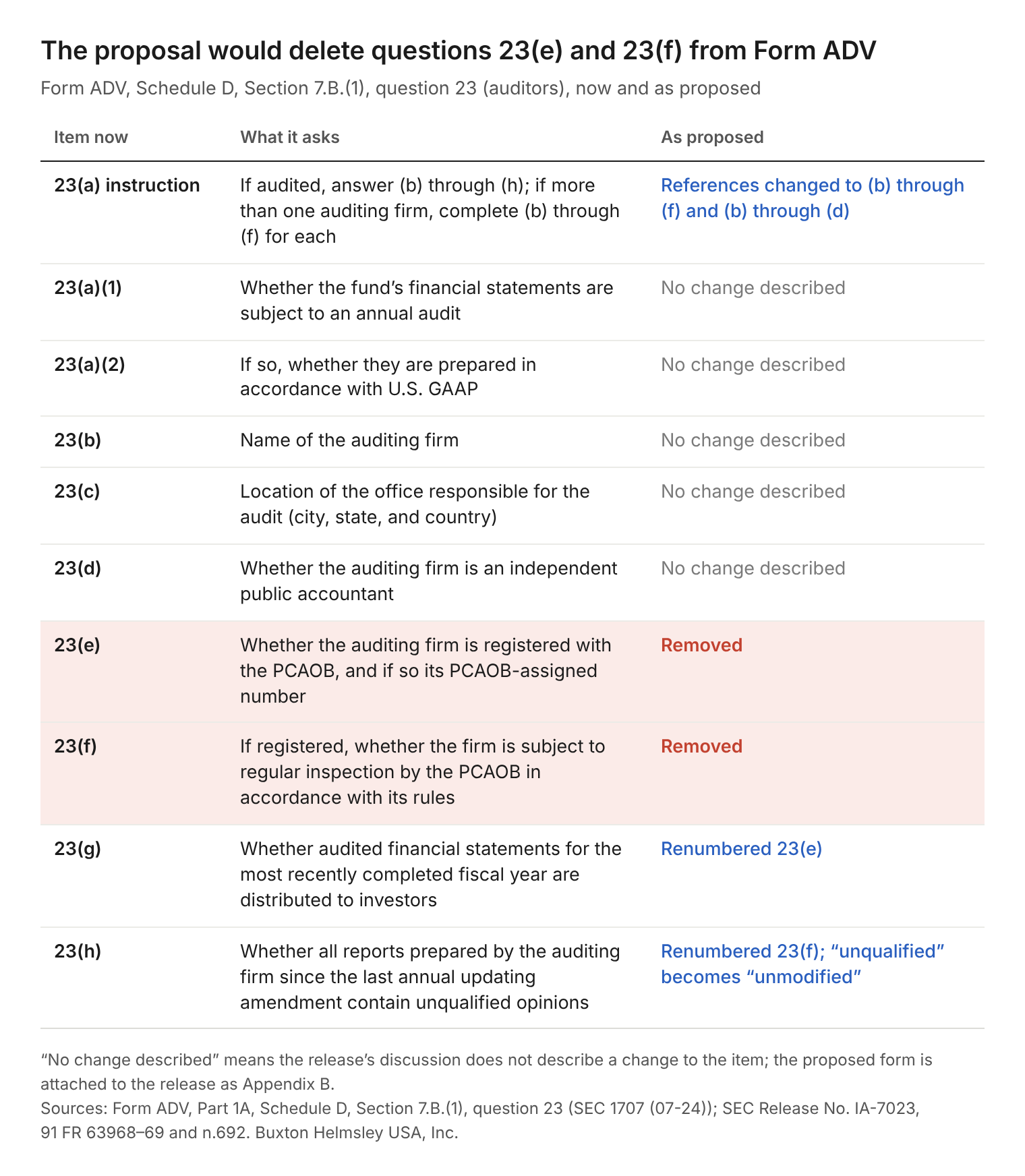
For each private fund an adviser reports on Form ADV, question 23 of Section 7.B.(1) of Schedule D asks whether the fund’s financial statements are audited and, if they are, poses a short set of questions about the auditor. It asks for the name of the auditing firm, the location of the office responsible for the audit, and whether the firm is an independent public accountant. Questions 23(e) and 23(f) follow. The first reads, “Is the auditing firm registered with the Public Company Accounting Oversight Board?” and provides a line for the number the Public Company Accounting Oversight Board (PCAOB) assigned to the firm. The second reads, “If ‘yes’ to (e) above, is the auditing firm subject to regular inspection by the Public Company Accounting Oversight Board in accordance with its rules?”¹
On October 1, 2026, the Securities and Exchange Commission proposed to delete both.² The proposal, which the Federal Register published on October 6, and on which comments are due by December 7, would rewrite the custody rules for investment advisers and for registered management investment companies and business development companies, much of it to accommodate crypto assets.² Among its other changes, it would remove the requirement that the accountant who audits a pooled investment vehicle, for an adviser relying on the custody rule’s audit provision, be registered with, and subject to regular inspection by, the PCAOB.² ³ Questions 23(e) and 23(f), along with two parallel items in Section 9.C. of Schedule D, would be removed with it. In the release’s words, the questions “would no longer be applicable under the proposed amendments to the Advisers Act custody rule.”²
The release explains the change to the requirement in a section of its own and again in its economic analysis. It explains the removal of the questions in one paragraph of its discussion of Form ADV, and its economic analysis mentions the removal in a footnote, as the first of several amendments it presents as conforming; the footnote closes by saying that “these proposed conforming amendments would not substantively modify any information required to be reported.”² In Buxton Helmsley’s reading, the reasons the release gives for dropping the requirement do not reach the questions. The release argues that the PCAOB does not inspect the engagements the custody rule requires, and that registration with the PCAOB, by itself, does not show whether a firm is subject to the PCAOB’s oversight. The Commission acknowledged the first point when it adopted the requirement in 2009.⁴ The second is the distinction question 23(f) draws. The release’s cost argument concerns the fees of engaging a PCAOB-registered firm, and its discussion of the questions identifies no cost of answering two questions about a firm the adviser already names in question 23(b). Its statement that the questions would no longer be applicable does not describe exempt reporting advisers (ERAs), which answer question 23 for their funds although, as the release itself notes elsewhere, the custody rule does not apply to them.² ³ And the release’s figure for the share of accountants retained solely for surprise examinations that are reported as registered and regularly inspected was computed from Form ADV items that include two the release would remove.²
The deletion would not make the information unavailable. The auditor’s name stays on the form, and the PCAOB publishes a searchable list of the firms registered with it, with each firm’s annual reports and inspection reports.² ⁵ Today the adviser answers the two questions in a filing it must update at least annually.² After the change, an investor who wants the answer from the public record would have to assemble it from the auditor’s name, one fund at a time.
The requirement as adopted
The custody rule applies to an investment adviser “registered or required to be registered” with the Commission.³ Under its audit provision, an adviser to a pooled investment vehicle is deemed to satisfy the rule’s surprise examination requirement, and is excepted from its client notice and account statement requirements, if, among other conditions, the vehicle is audited at least annually and the audited financial statements are distributed to its investors within 120 days of the fiscal year end.² ³ The audit has to be performed, in the rule’s words, “[b]y an independent public accountant that is registered with, and subject to regular inspection as of the commencement of the professional engagement period, and as of each calendar year-end, by, the Public Company Accounting Oversight Board in accordance with its rules.”³ As of December 2025, 5,509 registered advisers, or 33.5 percent of the total, reported that an independent public accountant audits the pooled vehicles they manage each year and that the audited statements go to the investors.²
The Commission added the PCAOB condition in amendments it adopted in December 2009.⁴ Commenters who opposed the condition for surprise examinations and internal control reports pointed out that the PCAOB’s authority to inspect was limited to audits of public issuers, and the Commission conceded the point in general terms. “We acknowledge that the PCAOB does not currently inspect auditor engagements required solely as a result of rule 206(4)-2,” the adopting release says.⁴ The Commission adopted the condition anyway, in the belief that excluding accountants not registered with and examined by the PCAOB “will provide greater confidence in the quality of the independent public accountant and complement the enhanced controls under the rule that apply when client assets are not maintained by an independent qualified custodian and in audits of certain pooled investment vehicles.”⁴ It added that “requiring that the accountant not only be registered with the PCAOB but subject to its inspection can provide indirect benefits regarding the quality of the accountant’s other engagements.”⁴
The indirect benefit the Commission described in 2009 depended on the second half of the condition. A footnote to the adopting release explained that the PCAOB regularly inspects a registered firm that issued an audit report for at least one issuer during any of the three prior calendar years, and that an adviser’s use of an accountant “registered with the PCAOB but not subject to regular inspection would not satisfy the rule’s requirements.”⁴ Under the PCAOB’s rules, a firm that issued audit reports for more than 100 issuers in the prior calendar year is subject to inspection every year, and a firm that issued audit reports for at least one and no more than 100 issuers in any of the three prior calendar years is subject to inspection at least once every three years.⁶ The October release counts as subject to regular inspection a firm that, in its three most recent annual reports to the PCAOB, issued or played a substantial role in an audit report for at least one issuer or at least one broker-dealer. The broker-dealer branch rests on the PCAOB’s interim inspection program for broker-dealer auditors and a 2019 staff letter.²
The condition therefore tested the firm’s practice outside the fund. The auditor of a fund whose adviser relied on the audit provision had to have issued a recent audit report for an issuer (the October release also counts a firm that played a substantial role in one) or, under the later staff position, for a broker-dealer, and that work had to be open to periodic inspection. The fund audit itself was not inspected, as the Commission said when it adopted the condition and says again now.² ⁴ As of May 2026, 1,430 accounting firms were registered with the PCAOB, and approximately 632 of them were subject to regular inspection.² On the release’s figures, roughly 800 registered firms (1,430 less approximately 632), a majority, were not subject to regular inspection; an adviser whose private fund one of them audited would answer “yes” to question 23(e) and “no” to question 23(f).
The public record since 2011
The questions sit in the part of Form ADV the Commission expanded in 2011, when it implemented the private fund provisions of the Dodd-Frank Act.⁷ Section 7.B.(1) of Schedule D asks for a separate report on each private fund an adviser manages, and the 2011 release made two choices about it that bear on the October proposal. The first concerned who answers: “Both registered and exempt reporting advisers are required to complete Item 7.B. and the related portions of Schedule D.”⁷ The second concerned who may read the answers. Part B of the section asks about five types of service providers that perform “important roles as ‘gatekeepers’” for private funds (auditors, prime brokers, custodians, administrators, and marketers), and “[t]his information will be publicly available, as is other information reported on Form ADV.”⁷
Commenters objected that the private fund information was competitively sensitive or proprietary, and that public disclosure was unnecessary because investors in these funds meet sophistication standards or may receive similar information from the adviser anyway. The Commission answered that “it is precisely the ability of these investors to compare Form ADV information to the information they have received in offering documents and due diligence that makes public disclosure valuable.” Public disclosure, it added, “could reduce the likelihood of advisers making false representations regarding fund service providers, such as administrators and auditors, who could uncover false representations by reviewing the information that advisers report to us and comparing it to their own client lists.”⁷ Elsewhere in the release, it described the result as “a publicly accessible foundation of basic information that could aid investors in conducting due diligence.”⁷
The October release does not cite the 2011 release, but it invokes the same idea. Of its Form ADV amendments, a group that includes the removal, it says, “Because Form ADV data is publicly available, these proposed amendments will also enhance the information available to investors,” and it expects new questions, among them questions identifying the accountants that audit pooled vehicles holding self-custodied crypto assets, to help investors see “which accounting firms advisers engage for purposes of independent checks on their self-custody practices.”² Its discussion of the questions it removes does not address what investors would lose. Its Paperwork Reduction Act analysis describes Part 1 of Form ADV as containing information “used primarily by Commission staff,” but adds that “[c]lients and prospective clients use the information required in Form ADV to determine whether to hire or retain an investment adviser,” and that “[r]esponses to the disclosure requirements are not kept confidential.”² In its discussion of Form ADV, the release also states that exempt reporting advisers “must complete Item 7 and any related items under Section 7.B.(1) of Schedule D,” and a footnote adds that the proposed changes to Section 7.B.(1) “would impact ERAs as well as registered investment advisers.”² Exhibit 1 sets out question 23 as it stands and as the release describes the change.
Exhibit 1. Form ADV, Schedule D, Section 7.B.(1), question 23, now and as proposed
The reasons given
The release states the original purpose of the condition: it was “intended to serve as a measure of quality of the audits and examinations required to be performed under the Advisers Act custody rule and the accountants performing these required audit and examination services.”² It then returns to the 2009 concession, that “the PCAOB does not inspect the engagements that are required solely because of the Advisers Act custody rule,” and draws a different conclusion from it. “In light of the Commission’s experience since the 2009 amendments,” the release says, “we now believe that any indirect benefits of the Advisers Act custody rule’s PCAOB registration requirements may not justify the incremental cost of engaging a PCAOB-registered firm.”² Two sentences follow that carry most of the argument:
A firm’s PCAOB registration status does not indicate whether the firm is subject to PCAOB oversight or inspection nor whether its professional services are within the PCAOB’s limited scope of oversight authority. Although there has been some positive correlation between PCAOB-registered firms subject to inspection and the quality of audit services, as the PCAOB has previously stated, PCAOB oversight status does not itself provide assurance of the quality of a firm’s professional services.²
For the second sentence’s reference to what the PCAOB has stated, the release cites a 2024 PCAOB proposal concerned with users “misperceiving that they are obtaining a level of assurance provided by a PCAOB-registered firm that is providing PCAOB-regulated services, when in fact . . . the service is not subject to PCAOB oversight.”² Because the PCAOB does not inspect the services the custody rule requires, the release concludes, “the PCAOB registration and inspection requirements are not an appropriate proxy for the quality of the audit and examination services required under the rule.”²
On cost, the release says the condition “generally increases the costs of audit and examination services,” because registered firms pay the PCAOB annual fees and because firms that market themselves as registered “have generally been found to have charged higher fees after becoming PCAOB-registered than they previously charged,” and that removing it would enlarge the pool of eligible accountants and increase competition.² The economic analysis puts a number on one part of the saving and qualifies the rest. Accountants registered with the PCAOB primarily to provide the services the custody rule requires could withdraw their registrations and save the annual fee: “[t]hese cost savings would be $500 per accountant,” the PCAOB’s annual fee for firms outside its two higher fee tiers.² ⁸ The analysis then says the requirements “may not be the primary barrier to entry into this market” and that the barrier may instead be “the setup of the necessary technology, operational capability, and regulatory knowledge.”² Firms performing these audits may also be registered anyway to support other lines of business, such as audits of public companies and broker-dealers, so that, in the release’s words, “reductions in the cost of audits or examinations due to the removal of the PCAOB requirements could be limited.”²
On investor protection, the analysis says that removing the inspection requirement “would likely not carry costs in the form of reduced investor protections, as the PCAOB does not inspect audit or examination engagements required solely by the Advisers Act custody rule.”² On the registration requirement, it says, “Whether the proposed removal of the PCAOB-registration requirement would impact audit quality is unclear,” and allows that, if accounting firms not registered with the PCAOB gain market share, “this could reduce audit quality.”² Each of the three academic studies the release cites on registration, inspection, and audit fees concerns audits of non-U.S. companies, and the release notes that the study it relies on for the audit quality point “was not conducted specifically in the context of activities required under the Advisers Act custody rule.”² The release also argues the other side of the quality question: that “removing the PCAOB requirement could lead to a greater number of high-quality firms in the market,” and that “there is no clear evidence suggesting that such an amendment would adversely affect investor protection related to these services.”²
The release describes the market in which all of this would play out. About 400 accounting firms are reported on Form ADV as independent public accountants for advisers, and the ten with the most reported engagements account for 80 percent of reported engagements.² Accountants retained solely for surprise examinations, which the rule does not require to be registered and inspected unless the adviser or a related person acts as a qualified custodian, are mostly reported as both: 84.7 percent of them were reported by advisers as registered with and regularly inspected by the PCAOB.² The release’s discussion of the change closes with five numbered requests for comment, among them whether the condition is “a meaningful measurement of quality” and whether the rule should instead require accountants to be enrolled in the peer review program of the American Institute of Certified Public Accountants (AICPA) with a rating of “pass” in their most recent review.²
The Form ADV questions receive one paragraph. After describing what Sections 9.C.(3) and 9.C.(4) and questions 23(e) and 23(f) ask, the release says, “These questions would no longer be applicable under the proposed amendments to the Advisers Act custody rule.” Because, in its view, the indirect benefits of the requirement may not justify its costs, the Commission “does not believe that PCAOB registration is a meaningful disclosure requirement in Schedule D of Form ADV.”² Advisers, it adds, “would continue to be required to report the name and location of the independent public accountant, indicate what services the accountant was engaged to perform, and report whether all internal control reports or audits contain unqualified opinions.”² The release numbers 342 requests for comment, and none of them asks whether questions 23(e) and 23(f) should stay on the form. The unnumbered request that introduces requests 227 through 231 concerns the requirement in the rule, and the release’s general request invites comment on “other matters that may have an effect on the proposed rules and forms.”²
What the reasons reach
Part of the release’s case against the requirement rests on a distinction between registration and inspection. Registration, it says, does not show whether a firm is subject to inspection, and the PCAOB proposal it cites was concerned with users who take registration to mean oversight that does not exist.² Form ADV already draws that distinction. Question 23(e) asks about registration, and question 23(f), which is reached only when the answer to 23(e) is “yes,” asks about inspection.¹ An investor who reads “yes” to the first and “no” to the second learns from the form itself that the auditor is registered but not subject to regular inspection. The release’s statement of why the disclosure is not meaningful, quoted above, speaks of registration alone, yet it removes the inspection question with it.²
The release’s sentence has a second half: registration also does not show whether a firm’s services are “within the PCAOB’s limited scope of oversight authority.”² That half turns on the engagement rather than the firm (an audit performed for the custody rule falls outside the PCAOB’s scope whoever performs it), so it does not distinguish one auditor from another, and question 23(f) answers the half that does. A “yes” to question 23(f) could be misread as saying the fund audit itself is inspected, which is the kind of misperception the PCAOB’s proposal described, but the form could address that with a line of instruction. In Buxton Helmsley’s reading, the release’s own argument supports keeping question 23(f).
The cost reasoning does not transfer either. The costs the release identifies (the PCAOB’s annual fee and the higher fees of firms that market their registration) come with engaging a registered firm.² An adviser that answers questions 23(e) and 23(f) incurs neither of them, and once the requirement is gone, an adviser could engage an unregistered firm and answer question 23(e) “no.” The release’s discussion of the questions does not identify a cost of answering them. It carries over the conclusion it reached about the requirement: because the requirement’s indirect benefits may not justify its costs, the disclosure is not meaningful.²
The applicability reasoning has a narrower reach than its wording. The custody rule applies to advisers “registered or required to be registered” with the Commission, which exempt reporting advisers are not.³ The release says as much elsewhere. In proposing a new question on crypto assets an adviser self-custodies for a private fund, it says that “[b]ecause ERAs are not subject to the Advisers Act custody rule,” the question would tell an exempt reporting adviser that it need not respond.² Exempt reporting advisers nonetheless answer question 23 for each private fund they report, as the 2011 release required and the October release confirms.² ⁷ For their funds, the answers to questions 23(e) and 23(f) have never reported compliance with the custody rule, so the statement that the questions “would no longer be applicable under the proposed amendments to the Advisers Act custody rule” does not describe what the answers are for those funds. The release acknowledges, in a footnote to the sentence proposing the removal, that changes to Section 7.B.(1) “would impact ERAs as well as registered investment advisers,” but it does not explain how questions that exempt reporting advisers answer for funds outside the custody rule would become inapplicable because of an amendment to that rule.²
The release’s own measurement depends on the items it would remove. The finding that 84.7 percent of accountants retained solely for surprise examinations are registered and regularly inspected is, according to the release, “[b]ased on advisers’ responses to section 9.C.(3), section 9.C.(4), and section 9.C.(5) of Schedule D of Form ADV.”² The proposal would remove current Sections 9.C.(3) and 9.C.(4) and renumber the items that follow.² The Commission could still reconstruct the figure by matching accountants’ names against the PCAOB’s list, but two of the three items it was computed from would no longer be reported, and the release’s measure of how often those accountants are registered and inspected rests largely on fields the release would delete.
None of this disputes the release’s premise. The PCAOB does not inspect the audits the custody rule requires, and it did not when the condition was adopted. Registration alone is a weak signal, and the form already treats it as one by asking a second question. Most reported engagements go to ten firms, and the release’s account of why audit firms register for other lines of business suggests that those firms would remain registered and inspected because of that other work.² In Buxton Helmsley’s view, the effect of the change would fall mainly outside that group, and the release names one place it may appear. To the extent that few registered and inspected firms can provide services related to crypto assets, it says, “crypto-specialized accounting firms that are not registered with the PCAOB may gain more market share relative to accounting firms providing services for traditional assets.”² For a fund audited outside the ten firms with the most engagements, questions 23(e) and 23(f) are the only items in the adviser’s own public filing that must answer, for that fund, whether its auditor is registered and subject to regular inspection: Form ADV lets a registered adviser omit from Section 9.C. of Schedule D auditor information it has already given for its private funds in Section 7.B.(1), and an exempt reporting adviser that is not registering with a state does not complete Item 9 at all.¹ ²
If the requirement were removed and question 23(f) kept, its answer would no longer record compliance with the custody rule for any fund. It would record the adviser’s choice of auditor, which is the kind of fact the 2011 release made public so that investors could compare it with what they had been told.⁷
Before December 7
An investor in a private fund, or one considering an allocation, can do four things while the proposal is open. The first is to read question 23 for the fund now, while questions 23(e) and 23(f) are still on the form, and to keep a copy of the answers with the date of the filing they came from. Form ADV is public, and the Section 7.B.(1) report for each private fund is part of it.² ⁷
The second is to check the answer independently, which, if the questions are removed, would be the only way to get it from a public source. The PCAOB’s list of registered firms can be searched by name, and a firm’s summary page there shows its registration, its annual and special reports, its inspection reports, and any disciplinary actions; the annual reports show the firm’s audit report activity over its three most recent reporting periods.⁵ The AICPA publishes a list of firms and their enrollment status in its peer review program, with links to accepted peer review documents for members of certain of its practice sections and quality centers and for firms that have asked for their documents to be made public.⁹ Neither source addresses the particular fund audit, which the PCAOB does not inspect, but together they show whether the firm that signs it has a practice someone else examines.
The third is to put the point in the fund’s documents. A side letter, or the fund’s offering documents, can carry a representation that the fund’s auditor is registered with, and subject to regular inspection by, the PCAOB, and an undertaking to notify investors before the fund changes auditors. That costs the manager little if the answer is “yes,” and in a side letter it replaces the public answer with a contractual one.
The fourth is to comment. Comments on File No. S7-2026-35 are due by December 7.² The release’s own questions concern the requirement, and a comment that addresses questions 23(e) and 23(f) separately would raise a question the release does not number.
The proposal would also change when investors in a new fund receive their first audited statements. For a pooled vehicle formed within the last 90 days of its fiscal year, the proposal would allow the adviser to distribute financial statements for that first short period, “which may be unaudited,” within 90 days of the year end, and to deliver audited financial statements covering the first fiscal year and the entire second fiscal year after the end of the second.² A fund formed in November with a December year end could therefore deliver its first audited statements after the close of its second December, covering more than a year of operations. The release asks whether those first-period statements should be reviewed by an independent public accountant.²
Buxton Helmsley will read the comment file for submissions that address questions 23(e) and 23(f), and the adopting release, if one is issued, for whether the two questions remain on the form.
Related reading
Referenced Sources:
[1] U.S. Securities and Exchange Commission, Form ADV (Paper Version), Uniform Application for Investment Adviser Registration and Report by Exempt Reporting Advisers, Part 1A, Schedule D, Section 7.B.(1), question 23, form SEC 1707 (07-24) (primary; supports the content of question 23, the quoted text of questions 23(e) and 23(f), and the instruction to Item 9.C. on auditor information already reported for private funds in Section 7.B.(1)).
[2] U.S. Securities and Exchange Commission, Adviser and Regulated Fund Custody Rules; Crypto Custody Rules, Release Nos. IA-7023, IC-36353, File No. S7-2026-35 (October 1, 2026), published at 91 FR 63870 (October 6, 2026) (SEC version) (primary; supports the summary, publication date, and comment deadline (91 FR 63870); the definition of regulated funds (91 FR 63872); the reporting obligations of exempt reporting advisers (n.90, 91 FR 63880); the discussion of the PCAOB requirement, its stated purpose, the quoted reasons, and the PCAOB proposal quoted in n.560 (Section II.G.3, 91 FR 63944–45); requests for comment 227 through 231 and the unnumbered request that introduces them (91 FR 63945); the audit provision amendments, including the treatment of newly formed pooled investment vehicles and request for comment 246 (Section II.G.4, 91 FR 63945–46, 63948); the stated purpose of the Form ADV amendments and the quoted statements on public availability and on identifying accounting firms (Section II.J.1, 91 FR 63963–64); the statement that ERAs are not subject to the custody rule (n.676, 91 FR 63965); the statement that ERAs must complete Item 7 and Section 7.B.(1) (91 FR 63968); the removal of Sections 9.C.(3) and 9.C.(4) and questions 23(e) and 23(f) from Schedule D, the quoted statements on those items, and the effect on exempt reporting advisers (Section II.J.1.(D), 91 FR 63968–69, nn.690 and 692); the general request for comment (91 FR 63973); the number of advisers reporting pooled vehicle audits, the counts of registered and regularly inspected firms, the 84.7 percent figure and its data source, the number of accounting firms reported on Form ADV, and the concentration of engagements (91 FR 63985–86, nn.861 and 862); the economic analysis of the PCAOB requirement, including the $500 figure, the qualifications on cost savings, the statements on investor protection and audit quality, and the expected effect on crypto-specialized firms (91 FR 64016–17, nn.1135 and 1137–1140); the list of conforming amendments to Form ADV and the footnote’s conclusion about them (n.1221, 91 FR 64027); the statements on efficiency, investor protection, and competition (91 FR 64038, 64040); and the description of Form ADV in the Paperwork Reduction Act analysis (91 FR 64063). Buxton Helmsley counted 342 numbered requests for comment in the release, none of which concerns questions 23(e) and 23(f)).
[3] 17 CFR 275.206(4)-2 (Advisers Act custody rule), paragraphs (a) and (b)(4), as currently published in the electronic Code of Federal Regulations (primary; supports the rule’s scope and the quoted text of paragraph (b)(4)(ii)).
[4] U.S. Securities and Exchange Commission, Custody of Funds or Securities of Clients by Investment Advisers, Release No. IA-2968, File No. S7-09-09 (December 30, 2009), published at 75 FR 1456 (January 11, 2010) (primary; supports the commenters’ objection, the quoted statements of the Commission, and nn.117 and 122 (Section II.C.3, 75 FR 1465), and the application of the condition to pooled vehicle audits (Section II.E, 75 FR 1466)).
[5] Public Company Accounting Oversight Board, Registered Firms (accessed October 7, 2026) (primary; supports the search by name and audit report activity, and the contents of a firm’s summary page).
[6] Public Company Accounting Oversight Board, Rule 4003, Frequency of Inspections (accessed October 7, 2026) (primary; supports the annual and triennial inspection thresholds).
[7] U.S. Securities and Exchange Commission, Rules Implementing Amendments to the Investment Advisers Act of 1940, Release No. IA-3221, File No. S7-36-10 (June 22, 2011), published at 76 FR 42950 (July 19, 2011) (primary; supports the quoted statements on which advisers complete Item 7.B. and the related portions of Schedule D, the public availability of private fund gatekeeper information, and the reasons given for it (76 FR 42965, 42968, 42969, and 42983)).
[8] Public Company Accounting Oversight Board, Annual Fee (accessed October 7, 2026) (primary; supports the fee schedule).
[9] AICPA & CIMA, “For the public” (accessed October 7, 2026) (primary; supports the description of the AICPA Peer Review Public File).
This publication is one of the Insights commentaries of Buxton Helmsley USA, Inc. (“Buxton Helmsley”). It reflects the opinions, analysis, and interpretations of Buxton Helmsley as of the date of publication, and it is based upon information that Buxton Helmsley believes to be accurate and that is derived from public sources or from other sources believed to be reliable. Buxton Helmsley does not represent or warrant that such information is accurate or complete, and it should not be relied upon as such. The views expressed are subject to change at any time, and Buxton Helmsley undertakes no obligation to update this publication or to correct any information contained within it.
Except for statements expressly attributed to an identified source or to a public filing, the statements in this publication constitute the opinions and good-faith analysis of Buxton Helmsley and are not statements of objective fact. Buxton Helmsley’s analysis may rest upon assumptions, estimates, and interpretations that could prove to be incorrect. Any reference to a potential violation, misstatement, impropriety, or deficiency reflects Buxton Helmsley’s analytical conclusions and opinions, and does not represent a finding by any court, regulator, or other authority. Readers should conduct their own investigation and analysis of any company, security, or matter discussed. Any company or person referenced that believes any statement in this publication to be inaccurate is invited to contact Buxton Helmsley at general@buxtonhelmsley.com, and Buxton Helmsley will give good-faith consideration to any correction supported by credible evidence.
This publication is provided for informational purposes only. It does not constitute, and should not be construed as, investment advice, a recommendation, or the provision of any individualized investment advisory service to any person, nor an offer or solicitation to buy, sell, or hold any security. Nothing in this publication takes into account the particular investment objectives, financial situation, or needs of any reader. No reader should construe this publication as creating any advisory, fiduciary, or other relationship between Buxton Helmsley and such reader. Readers should consult their own legal, tax, accounting, and financial advisers before making any investment decision.
As of the date of this publication, Buxton Helmsley, the funds and accounts that it manages or advises, and its principals hold no position in the securities of the companies mentioned in the article. Buxton Helmsley and the foregoing persons may, at any time and without further notice, purchase, sell, cover, or otherwise change any position in any security discussed in this publication, including in a manner inconsistent with the opinions expressed herein, for various reasons, including but not limited to new research discoveries. Buxton Helmsley may realize gains in the event that the price of any security discussed moves in a direction consistent with a position that it holds.
Buxton Helmsley has not received, and will not receive, any compensation from any third party—including any issuer discussed in this publication or any person holding an interest in any such issuer—in connection with the preparation or publication of this commentary, except as expressly disclosed in this publication. Buxton Helmsley was not engaged or compensated by any third party to publish this commentary, except as expressly disclosed in this publication.
This publication is not, and shall not be construed as, an offer to sell or a solicitation of an offer to buy any security or any interest in any fund or other investment vehicle managed or advised by Buxton Helmsley or any of its affiliates, nor is it an advertisement for any such fund, vehicle, or advisory service. Any such offer or solicitation will be made only by means of definitive offering documents, and only to eligible investors, in accordance with applicable law.
This publication is intended only for distribution to, and use by, persons in the United States. It is not directed to, intended for, or to be relied upon by, any person located in any jurisdiction outside the United States, and it does not constitute an offer, solicitation, or provision of any service in any such jurisdiction. Persons who access this publication from outside the United States do so on their own initiative and are responsible for compliance with the laws applicable to them.
This publication may contain forward-looking statements that reflect Buxton Helmsley’s current expectations and that are subject to risks and uncertainties that could cause actual results to differ materially from those expressed. Past performance is not indicative of, and does not guarantee, future results. No representation is made that any investment will achieve, or is likely to achieve, results comparable to those discussed.
To the fullest extent permitted by applicable law, neither Buxton Helmsley nor any of its affiliates, nor their respective principals, members, officers, employees, or agents, shall have any liability to any person for any direct, indirect, incidental, consequential, or other loss or damage arising from any use of, or reliance upon, this publication or any information contained within it.
If any provision of these disclosures is held to be invalid or unenforceable, the remaining provisions shall continue in full force and effect.
© 2026 Buxton Helmsley USA, Inc. All rights reserved. This publication may not be reproduced or redistributed, in whole or in part, without attribution to Buxton Helmsley.